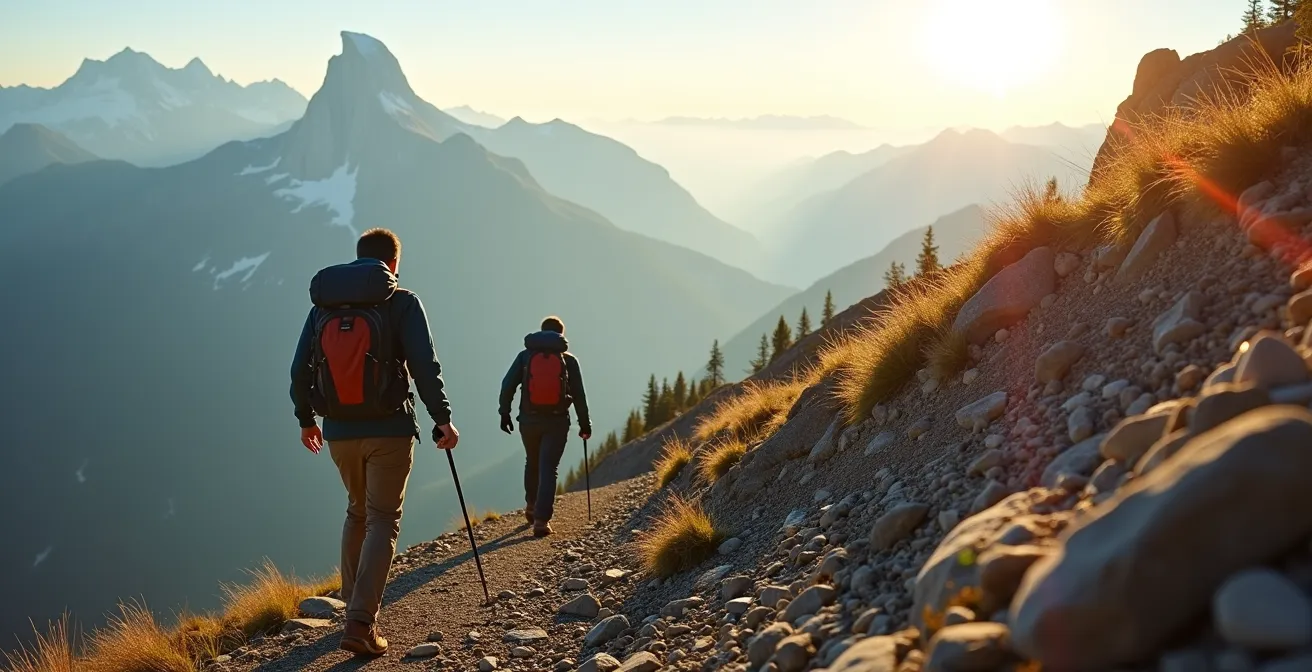
For fit hikers from sea level, preventing altitude sickness in the Rockies isn’t about general endurance; it’s about mastering the specific physiological stresses of moderate altitude.
- Your body’s primary challenges are hypoxic stress (less oxygen), accelerated respiratory water loss, and increased biomechanical load on steep terrain.
- Effective prevention requires targeted training that mimics vertical gain, a hydration strategy that compensates for “thin” dry air, and pacing techniques that conserve energy at a cellular level.
Recommendation: Shift your preparation focus from cardiovascular fitness alone to a holistic protocol addressing acclimatization, hydration, and energy economy before you even leave home.
You’ve trained for months. You run, you cycle, you’re a regular at your gym in Toronto or Vancouver. You feel strong, fit, and ready to conquer the iconic trails of the Canadian Rockies. Yet, within hours of arriving in Banff or Lake Louise, you’re hit with a debilitating headache, nausea, and profound fatigue. This isn’t a failure of your fitness; it’s a predictable physiological response to a threat your sea-level body doesn’t recognize: moderate altitude. The air at 2,500 metres (around 8,200 feet) contains significantly less effective oxygen, a challenge no amount of flat-ground running can prepare you for.
The common advice—”drink water,” “acclimatize,” “go slow”—is not wrong, but it’s dangerously incomplete. It tells you *what* to do, but not *why* it’s critical or *how* to do it effectively. Without understanding the underlying physiological mechanisms, this advice remains generic and often underestimated. The key to a safe and successful trip is not just following a checklist, but internalizing the science behind why your body struggles and how you can proactively support its adaptation process. This is not about being a super-athlete; it’s about being a smart one.
This guide moves beyond the platitudes. We will deconstruct the specific physiological stresses you will face and provide an expert-led, science-backed protocol to counteract them. We will explore why training for vertical gain is fundamentally different from other cardio, how hydration needs change dramatically in the alpine, and why the definition of a “moderate” trail is dangerously misleading for an unacclimatized visitor. By understanding the “why,” you can transform vague suggestions into a precise and effective prevention strategy.
text
This article provides a complete physiological framework for your preparation. It is structured to guide you from pre-trip training to on-trail best practices and smart acclimatization planning, ensuring you arrive prepared for the unique demands of the Rockies.
Summary: A Physiological Guide to Preventing Altitude Sickness in the Canadian Rockies
- Stairmaster vs Hill Sprints: Which Training Better Prepares Legs for the Rockies?
- Why You Need to Drink 50% More Water at Lake Louise Than in Toronto?
- Stiff vs Flexible Soles: Which Boot Prevents Ankle Rolls on Scree Slopes?
- Why a “Moderate” Trail in the Rockies is “Hard” Elsewhere?
- The “Rest Step” Technique: How to Climb All Day Without Burning Out?
- Why Your Gas Mileage Drops by 30% When Driving the Icefields Parkway?
- Wet and Cold: Why Hypothermia is a Risk Even at 10°C in the Woods?
- How to Secure Banff Campsites When Reservations Fill Up in 10 Minutes?
Stairmaster vs Hill Sprints: Which Training Better Prepares Legs for the Rockies?
Training for the relentless vertical of the Canadian Rockies requires simulating the specific biomechanical load of climbing, something that general running or even hill sprints cannot fully replicate. The goal is to develop muscular endurance under continuous, steep-angle stress. While hill sprints are excellent for power, they don’t prepare your leg muscles for the sustained, grinding ascents that define trails around Banff and Jasper. The most effective training tool is one that forces constant upward motion against gravity, closely mimicking a mountain climb.
For this reason, the Stairmaster or a steeply inclined treadmill is superior. Unlike running, these machines eliminate the eccentric loading (downhill impact) and focus entirely on concentric (uphill) muscle contraction. Mountaineering experts confirm that a Stairmaster, with its effective 75-100% gradient, is far more specific training than a treadmill limited to a 15% incline. The objective is to build the capacity for sustained vertical gain. A concrete benchmark comes from a case study of a hiker at sea level training for the high-altitude Colorado Trail. They were able to achieve 2,000 feet of elevation gain in 60 minutes on a treadmill at maximum incline while wearing a 30lb pack, demonstrating the type of specific endurance needed.
Your training should focus on time and vertical feet climbed, not just distance or speed. Aim to spend 60-90 minute sessions on a Stairmaster or incline treadmill, progressively adding weight to a backpack to simulate your on-trail load. This type of training specifically strengthens the glutes, quads, and calves for continuous climbing, directly preparing your body’s “engine” for the unique demands of alpine terrain and reducing the overall physiological strain when you arrive at altitude.
Why You Need to Drink 50% More Water at Lake Louise Than in Toronto?
The advice to “drink more water” at altitude is common, but it drastically undersells the physiological reality. At elevations like Lake Louise (1,600m), your body loses water at a significantly accelerated rate due to two primary factors: lower humidity and increased respiration. The air is not just “thinner”; it’s much drier, pulling moisture from your skin and lungs with every breath. More importantly, your body compensates for lower oxygen pressure by breathing faster and deeper—a state called hyperpnea. This increased respiratory rate is where the most significant, and often unnoticed, water loss occurs.
According to the Wilderness Medical Society, this isn’t a minor increase. Your body loses water through respiration at high altitude twice as fast as it does at sea level. This is respiratory water loss, and it happens even when you are resting. When you add in the physical exertion of hiking, which further increases your breathing rate and causes sweating, your total fluid loss can be immense. Dehydration thickens your blood, making your heart work harder to circulate oxygen, which compounds the effects of hypoxic stress and can directly trigger the headaches and fatigue associated with Acute Mountain Sickness (AMS).
This is why a simple “eight glasses a day” approach is insufficient. Your hydration strategy must be aggressive and proactive. Start increasing your water intake a week before your trip to ensure you arrive fully hydrated. On the trail, you should be drinking consistently throughout the day, aiming for 4-6 litres of water, depending on the exertion and temperature. A reliable sign of adequate hydration is clear, copious urine. Don’t wait until you feel thirsty; by then, you are already dehydrated. Carry a high-capacity reservoir or bottle and a reliable water filter to take advantage of the abundant glacial streams in the Rockies.
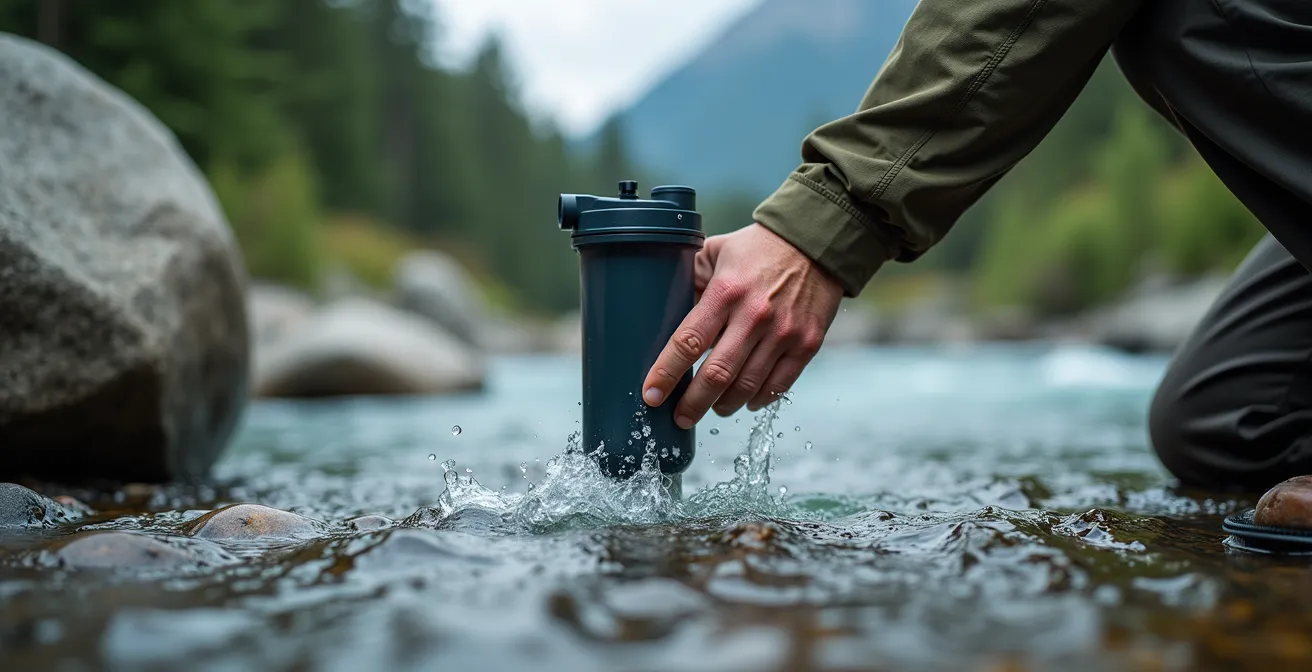
As seen in the image, being able to replenish your water supply on the go is critical. Filtering water from a mountain stream is not just a convenience; it’s an essential part of a high-altitude hydration protocol. This constant replenishment is the single most effective non-pharmacological tool you have to prevent the onset of AMS. Treat hydration as a non-negotiable part of your hiking process, as vital as your boots or backpack.
Stiff vs Flexible Soles: Which Boot Prevents Ankle Rolls on Scree Slopes?
Choosing the right hiking boot for the Canadian Rockies is a matter of matching footwear technology to the specific terrain, and the primary variable is sole stiffness. A flexible, sneaker-like boot that is comfortable on a well-groomed trail in a provincial park near home can become a liability on the rugged, unstable surfaces found at higher elevations in Banff or Jasper. The key is understanding that as the trail becomes steeper and more uneven—particularly on scree slopes or talus fields—the boot’s sole must become a stable platform to protect your foot and ankle.
On loose rock, a flexible sole allows your foot to twist and bend with every shifting stone, forcing your ankle’s small stabilizing muscles to work constantly. This leads to rapid fatigue and dramatically increases the risk of a debilitating ankle roll. A stiff-soled boot, by contrast, creates a rigid lever. It does not conform to the unstable ground; instead, it provides a solid, predictable base for your entire foot, transferring the load to the larger muscle groups in your legs and reducing strain on your ankles. This rigidity is your primary defense against twists and sprains on challenging terrain.
The appropriate level of stiffness is directly related to the trail’s difficulty and elevation. While a flexible boot is fine for a low-elevation walk like Johnston Canyon, a semi-rigid sole is better for the rocky paths to Lake Agnes, and a truly stiff, mountaineering-style boot (often rated B1) is essential for the stability needed on steep scree like that found on Parker Ridge. As a Canadian Rockies hiking expert on a popular forum noted when discussing trail elevations, the terrain at Lake Agnes (7,000 feet) and Parker Ridge (7,800 feet) is significantly more demanding than lower trails, necessitating more supportive footwear.
The following table breaks down boot recommendations based on the type of terrain you can expect in the Rockies.
| Terrain Type | Boot Flexibility | Example Trails | Elevation Range |
|---|---|---|---|
| Well-maintained paths | Flexible soles | Johnston Canyon | 4,900ft start |
| Moderate rocky trails | Semi-rigid soles | Lake Agnes | 7,000ft |
| Steep scree slopes | Stiff soles (B1-rated) | Parker Ridge | 7,500-7,800ft |
Why a “Moderate” Trail in the Rockies is “Hard” Elsewhere?
A trail’s difficulty rating is dangerously relative for a visitor from sea level. A “moderate” 10 km hike in the Rockies is physiologically incomparable to a “moderate” 10 km hike in Ontario’s Gatineau Park. The difference is hypoxic stress. At higher elevations, the partial pressure of oxygen is lower, meaning with every breath, you are taking in fewer oxygen molecules. Your body is quite literally being starved of its primary fuel. At the highest point of Trail Ridge Road, a popular high-altitude area, there is approximately 35% less oxygen than at sea level. This forces your heart and lungs to work significantly harder just to deliver the same amount of oxygen to your muscles as they would receive at rest back home.
This oxygen deficit magnifies the physical effort of hiking. Muscles fatigue faster, cognitive function can slow, and what would be a manageable incline at sea level feels monumentally difficult. This is why a fit person can feel completely drained on a seemingly simple trail. Your cardiovascular system, no matter how well-trained for sea-level conditions, is operating in an overdraft state. Underestimating this invisible stressor is the most common mistake visitors make. It’s not just about the steepness or length of the trail; it’s about the compromised environment in which you are performing.
The consequences of pushing too hard in this state can be severe. In a tragic case from July 2024, a 51-year-old visitor from sea level was found unresponsive at the Mount Ida Trailhead, at an elevation of 10,759 feet. The coroner determined the death was caused by an acute cardiac event resulting from High-Altitude Pulmonary Edema (HAPE), a severe form of altitude sickness where the lungs fill with fluid. This stark example from a report on altitude sickness in the Rockies underscores that this is a medical issue, not a fitness one. The “moderate” rating on a trail map does not account for your personal acclimatization level. You must adjust your expectations and assume every trail will be significantly harder than its rating suggests.
The “Rest Step” Technique: How to Climb All Day Without Burning Out?
Pacing at altitude is not about moving slowly; it is about maximizing energy efficiency at a cellular level. The “Rest Step” is a fundamental mountaineering technique designed to do exactly that. It’s a rhythmic, deliberate walking method that allows you to climb for hours without hitting a wall of muscular fatigue. The core principle is to use your skeletal structure, rather than your muscles, to support your body weight for a brief moment with each step. This provides a micro-rest that, when repeated thousands of times, dramatically conserves energy.
As the experts at Backpackers Gone Wild advise in their Canadian Rockies guide, “Pace yourself in your ascent. Charging up a mountain does not allow your body time to acclimate to the environment. A slow and steady ascent will not only let you get used to the thinner air but give you more overall enjoyment.” The Rest Step is the practical application of this “slow and steady” philosophy. Instead of powering up with bent knees, which keeps your leg muscles under constant tension, you transfer your weight onto a straight, locked-out leg. For that one second, your bones are holding your weight, and your muscles get to relax and receive a quick flush of oxygenated blood. It feels unnaturally slow at first, but it is the key to all-day endurance.
Mastering this technique allows you to maintain a consistent pace, such as the 1,000 vertical feet per hour benchmark used by mountaineers on major ascents. It turns an exhausting climb into a sustainable, meditative rhythm. It’s a conscious decision to trade short-term speed for long-term endurance, a critical trade-off in an oxygen-deprived environment. This is how you avoid burning out your muscles and putting your body under unnecessary physiological stress.
Your Action Plan: Mastering the Rest Step
- Step up and fully straighten your back leg, consciously locking the knee.
- Transfer 100% of your body weight onto the bone structure of that straight leg.
- Consciously relax the muscles of the weighted leg for a one-second pause. You should feel the tension release.
- Swing your other leg forward to its next placement without putting weight on it yet.
- Repeat the process, creating a steady, rhythmic “step-lock-pause, step-lock-pause” cadence. Adjust your tempo based on the steepness of the terrain.
Why Your Gas Mileage Drops by 30% When Driving the Icefields Parkway?
When you drive the spectacular Icefields Parkway, which reaches elevations over 2,000 metres (6,700 feet), you might notice your car feels a bit sluggish and your fuel economy suffers. This is because an internal combustion engine, like the human body, requires oxygen to function efficiently. The lower oxygen density at altitude means less efficient fuel combustion, resulting in reduced power and higher consumption. This automotive analogy is a perfect parallel for what happens to your own body in the same environment.
Your body is also an engine, and its fuel is oxygen. When you step out of your car at the Peyto Lake overlook or the Icefields Centre, your “engine” is suddenly forced to operate with that same 30% reduction in efficiency. This is why a simple act like walking up the steps to the Visitor Centre can leave you feeling surprisingly winded. While most people are generally fine below 2,500 metres (about 8,200 feet), these higher-elevation stops along the Parkway are often the first place visitors from sea level feel the distinct effects of altitude. It’s a sudden, tangible reminder that the environment has changed.
It’s important to put these elevations in perspective. While they are high enough to cause physiological stress, the Canadian Rockies are not an exceptionally high mountain system compared to others like the Colorado Rockies. The highest pass you are likely to drive is around 6,700 feet. However, for a body that is accustomed to sea level, this change is significant. The key is to respect this change. When you get out of the car at these high-elevation viewpoints, move deliberately. Walk slowly, avoid rushing, and pay attention to how your body feels. Use these moments as mini-acclimatization opportunities, allowing your body a few minutes to adjust to the lower oxygen pressure before exerting yourself.
Wet and Cold: Why Hypothermia is a Risk Even at 10°C in the Woods?
Hypothermia is often associated with freezing winter conditions, but in the mountains, it’s a year-round threat, even on a seemingly mild 10°C summer day. The danger isn’t the temperature alone; it’s the combination of getting wet, being exposed to wind, and, crucially, being in a state of exhaustion. In the Canadian Rockies, this exhaustion is frequently initiated or worsened by the physiological stress of altitude. Altitude sickness and hypothermia are a dangerous pairing, as one significantly increases the risk of the other.
When you are suffering from even mild altitude sickness, your body is already compromised. Symptoms like headache, lack of appetite, and poor sleep deplete your energy reserves and impair your judgment. As noted in a personal account from a former Banff Gondola employee who experienced severe symptoms after moving from 190m to over 2,000m for work, the effects can be intense. When you are in this weakened state, your body’s ability to regulate its core temperature is diminished. Getting caught in a classic Rockies afternoon rain shower at 10°C might be a minor inconvenience if you’re well-rested and energized. But if you’re already exhausted from hypoxic stress, that same chill can rapidly overwhelm your body’s ability to produce heat, leading to the onset of hypothermia.
The impaired judgment from altitude sickness is a critical risk factor. You might not feel the need to stop and put on your rain gear quickly enough, or you might push on when you should be seeking shelter. This is why your mountain safety system must account for this combined threat. Always carry a full set of waterproof outer layers (jacket and pants), as well as insulating mid-layers (like fleece or down), regardless of the morning forecast. If you feel the combined effects of being cold, wet, and exhausted, you must stop immediately, find shelter from the wind, change into dry layers if possible, and consume high-energy food and warm liquids. Ignoring these early warnings because you feel “a little off” from the altitude is a potentially fatal mistake.
Key Takeaways
- Preventing altitude sickness is a physiological task, not a test of general fitness. Success depends on targeted preparation.
- Aggressive hydration (4-6 litres/day) is the most effective non-pharmacological tool to combat the effects of accelerated respiratory water loss at altitude.
- Mastering energy efficiency techniques like the Rest Step and using terrain-appropriate gear (stiff-soled boots) are critical for managing the increased biomechanical load in a hypoxic environment.
How to Secure Banff Campsites When Reservations Fill Up in 10 Minutes?
In the Canadian Rockies, “securing” your trip goes far beyond navigating the notoriously competitive Parks Canada reservation system. The most important reservation you can make is for your own health and well-being. The best strategy for a successful trip involves planning your itinerary around the physiological need for acclimatization. This means thinking of your first few nights not in terms of proximity to the most famous landmarks, but in terms of elevation. A slower, stair-step approach to altitude is the most effective way to prevent AMS.
According to health guidelines for visiting the Rockies, if you are ascending to altitudes higher than 2,400m (8,000ft), you should spend at least one night at a medium altitude to adjust. This is particularly crucial if you are flying into Calgary (1,045m) and driving directly into the mountains. Instead of aiming for a campsite in Lake Louise (1,600m) on your first night, consider booking your initial stay in a lower-elevation hub like Canmore (1,309m) or in Kananaskis Country. This allows your body to begin the critical process of acclimatization—producing more red blood cells—while you sleep, which is when the process is most efficient. After a night or two, you can then move up to higher campgrounds in Banff or beyond.
This approach transforms the booking challenge into a strategic advantage. While everyone else is fighting for the few spots at the most popular high-elevation campgrounds, you can secure a spot more easily at a lower elevation, which is actually better for your body. Remember that altitude sickness is not a rare occurrence. Research indicates that AMS can affect as many as 20% of all visitors who travel from sea level to above 8,000 feet, regardless of their physical condition. By prioritizing a gradual ascent in your lodging plan, you are actively choosing prevention and setting yourself up for a trip where you can truly enjoy the spectacular scenery you came to see, rather than fighting a preventable illness.
Now that you understand the physiological principles, the next step is to integrate this knowledge into a concrete travel itinerary. Plan your first two days with minimal physical exertion and prioritize a gradual increase in elevation to ensure a safe and enjoyable adventure in the Canadian Rockies.
Frequently Asked Questions About Altitude Sickness in the Canadian Rockies
At what elevation do most people start feeling altitude effects?
Generally, most people are fine as long as they stay below 2,500 m (about 8,200 feet). However, sensitive individuals, especially those arriving from sea level, can feel mild effects at lower elevations, starting around 2,000 m.
Where do visitors typically feel altitude in the Canadian Rockies?
Common spots where visitors first notice symptoms are high-elevation stops along the Icefields Parkway, such as the Peyto Lake overlook or the Icefields Centre. The sudden exertion of walking up stairs or a short path after getting out of a car at over 2,000 m can be a trigger.
How do Canadian Rockies elevations compare to US mountains?
The Canadian Rockies are not a particularly high mountain system compared to some ranges in the United States, like the Colorado Rockies. Altitudes are lower overall, and the highest mountain pass you are likely to drive across is Highwood Pass at about 2,206 m (7,239 feet), which is significantly lower than many passes in Colorado.