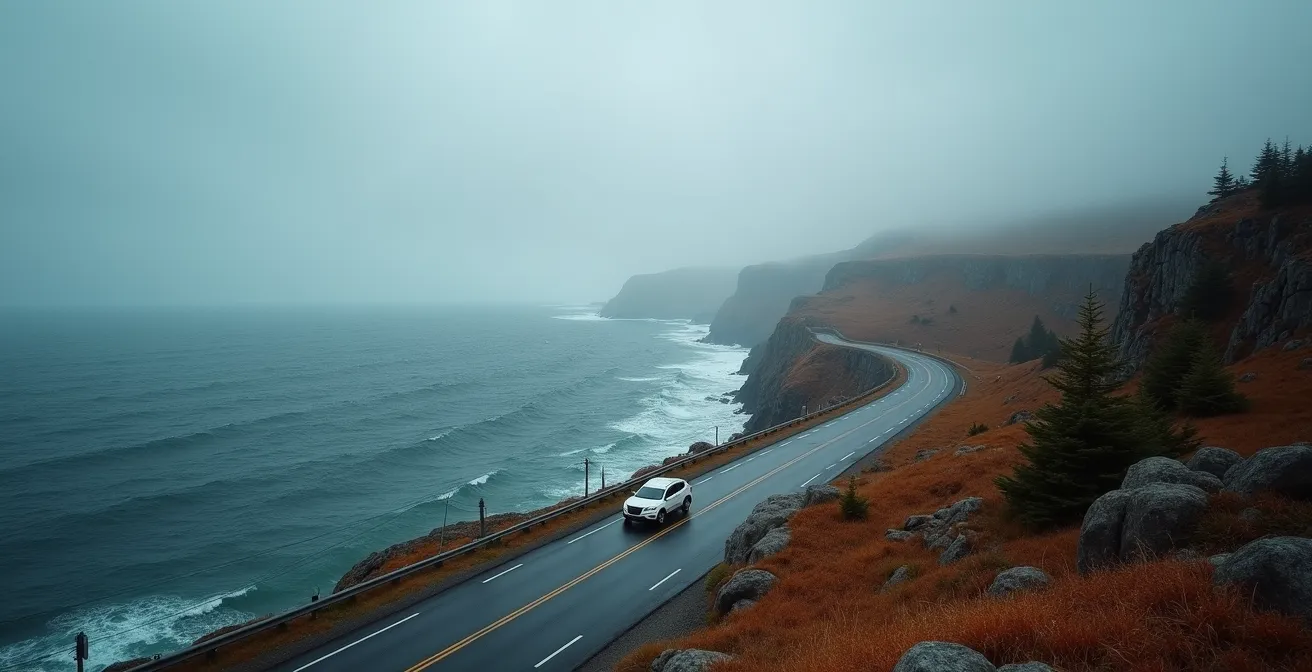
Contrary to common belief, an October road trip in Newfoundland isn’t a lesser version of a summer holiday—it’s a more authentic and rewarding adventure for the prepared traveler.
- Success hinges on proactive planning for “service gaps” (fuel, food) and volatile weather, not on finding attractions that are still open.
- The real Newfoundland reveals itself in the off-season through community interactions and dramatic, storm-swept landscapes that summer tourists never see.
Recommendation: Embrace a mindset of “resilient travel.” Focus on being prepared for the journey’s challenges, from carrying extra fuel to packing both a wind shell and quality rain gear.
So, you’re thinkin’ about a trip to the Rock in October. The travel blogs probably have you spooked, talking about closed shops, unpredictable gales, and the kind of damp cold that seeps right into your bones. They’re not entirely wrong. An autumn trip here isn’t for the faint of heart, and it’s certainly not the postcard vacation of sunny puffin tours and crowded ice cream parlours in Twillingate. Most guides will tell you what’s shut down, what you’ll miss, and why maybe you should wait until June.
But what if they’re looking at it all wrong? What if the key to an unforgettable Newfoundland adventure isn’t avoiding the challenges of October, but leaning into them? This isn’t a guide about what’s closed. It’s a guide about what opens up when you’re one of the few travellers on the road: authentic experiences, raw natural beauty, and a profound connection to the resilient spirit of this place. It’s about being prepared, not scared.
This guide is your insider’s manual for that journey. We’ll cover the practical, non-negotiable preparations for navigating the island’s remote stretches. We will explore how to find the real, beating heart of Newfoundland culture when the tourist shows are over. We’ll also break down exactly what you need to stay warm and dry when the Atlantic decides to throw everything it has at you. Forget the summer crowds; this is how you experience the real Newfoundland.
This article will guide you through the essential strategies for a successful and memorable autumn road trip. From logistical necessities like fuel and road-worthiness to the cultural and natural rewards that await, you’ll find everything you need to plan your adventure.
Summary: Your Guide to an Unforgettable Autumn Trip on the Rock
- Why You Must Fill Your Tank in Gander Before Heading to Fogo Island?
- The Road Condition Mistake That Requires a 4×4 on the East Coast Trail?
- How to Find an Authentic Screech-In Ceremony vs a Tourist Bar Version?
- Rain Gear vs Wind Shell: Which is More Critical for Newfoundland in Fall?
- How to Ask for Directions When You Can’t Understand the Local Dialect?
- Why Taking the Ferry to Newfoundland Might Cost You More Than Flying?
- When is the Last Reliable Gas Station Before the Northern Loop Section?
- How Early in June Do Icebergs Start Disappearing from “Iceberg Alley”?
Why You Must Fill Your Tank in Gander Before Heading to Fogo Island?
While the title points to a specific northern route, the lesson is universal for any remote Newfoundland travel, especially on the South Coast: underestimate your fuel needs at your peril. In October, the island operates on a different rhythm. Seasonal gas stations may have reduced hours or closed entirely after Thanksgiving, creating vast stretches of road with no services. This is what we call the “service gap,” and it’s the first rule of resilient travel here. Thinking “I’ve got half a tank, I’ll be fine” is a rookie mistake that can leave you stranded with no cell service.
The solution is to adopt the local mindset: never pass a major hub without topping up. Whether you’re in Corner Brook, Clarenville, or Marystown, if you see a gas station, you fill the tank. It doesn’t matter if it’s only a quarter empty. While the North Atlantic network has about 110 locations across the province, they are clustered in towns. On routes like the 200km stretch of Route 480 to Burgeo, they are non-existent. Planning your fuel stops is as critical as planning your accommodations.
To turn this anxiety into a simple routine, a pre-journey checklist is essential. It’s a habit that transforms a potential crisis into a minor inconvenience.
Your Pre-Journey Fuel Planning Checklist
- Identify your ‘point of no return’ for your chosen route, such as the TCH junction before Route 480 to Burgeo.
- Call ahead to verify station hours, as many rural locations reduce their hours significantly after the Thanksgiving weekend.
- Fill up at major hubs like Corner Brook or Clarenville, even if your tank is still half-full.
- Carry cash as a backup; remote stations can sometimes have issues with their card readers.
- For truly remote stretches like Route 480, seriously consider carrying an approved jerry can for emergency fuel.
The Road Condition Mistake That Requires a 4×4 on the East Coast Trail?
Let’s clear something up: the East Coast Trail is a world-class hiking path, not a road. But the question highlights a critical concern for an October driver: the state of the roads *leading* to those beautiful, remote trailheads and outports. In autumn, the biggest threat isn’t always snow, but frost heaves and potholes. The cycle of daytime thaws and nighttime freezes can tear pavement and gravel roads apart, creating ruts and craters that can swallow a small car’s tire whole. A standard rental sedan with low clearance might be fine on the Trans-Canada Highway, but it’s a liability on secondary routes.
You don’t necessarily need a giant 4×4, but a vehicle with decent ground clearance—like a small SUV or a truck—is highly recommended. It’s the difference between navigating a damaged section with confidence and hearing a sickening scrape from your undercarriage, miles from the nearest mechanic. This is especially true on long gravel arteries like Route 480, where help is a long, long way off. The mistake isn’t just bringing the wrong car; it’s assuming all “roads” on the map are created equal.
This image gives you a sense of what a seemingly minor bit of road damage can look like up close. That gap is everything.

As you can see, that extra few inches of clearance is the buffer between a smooth passage and a damaged oil pan. Choosing your rental vehicle isn’t about luxury; it’s about risk management. It’s a key part of your weather-proofing strategy for the vehicle itself, ensuring your trip isn’t cut short by a preventable mechanical issue.
How to Find an Authentic Screech-In Ceremony vs a Tourist Bar Version?
In October, the search for an “authentic” screech-in ceremony is often a fool’s errand. The boisterous, tourist-focused events on George Street in St. John’s may be running, but they are a performance. The real, unscripted culture of Newfoundland doesn’t live there, especially in the off-season. The magic happens when you stop looking for the ceremony and start looking for the community. The truth, as local expert Lora points out, is found away from the main drag. As she says in her Newfoundland Road Trip Guide:
The magic of Newfoundland lies in the peninsulas… the best places to go in Newfoundland are by the ocean off the highway.
This is never truer than in the fall. Instead of a bar, head to a community hall, a local Royal Canadian Legion branch, or a church. This is where you’ll find fall suppers, fundraisers, and local gatherings. This is where authentic immersion happens. You won’t be a spectator; you might be asked to help sell tickets, or you’ll share a table with a fisherman who can tell you more about the province in ten minutes than any tour guide could in an hour. These are the places where the stories are real, the accents are thick, and the hospitality is genuine.
Case Study: Cultural Connection on the Southwest Coast
Travelers in October often find the most genuine connections in unexpected places. The Southwest Coast and the Port au Port Peninsula, known as the French Ancestors Route, are a perfect example. Instead of looking for staged events, visitors who stop at community centres for fall suppers or local fundraisers discover an organic cultural immersion. They find themselves in the middle of a living culture—a confluence of Mi’kmaq, Acadian, and English heritage—far more enriching than any performance designed for tourists.
Rain Gear vs Wind Shell: Which is More Critical for Newfoundland in Fall?
Asking whether you need rain gear or a wind shell in Newfoundland is like asking if a fish needs water. The answer is yes, and you need both. The real question is understanding which to prioritize and why. Many visitors make the mistake of bringing a heavy, insulated winter coat, which is often too much. The key to comfort is layering, and your outer layer is your primary defense. A cheap rain poncho won’t cut it; you need quality gear to handle the two distinct threats of an Atlantic autumn: the persistent, soaking drizzle and the soul-stealing wind.
A wind shell is non-negotiable, especially on the west coast. The Wreckhouse area, a notorious stretch of the Trans-Canada Highway, is famous for winds so strong they can literally blow trucks off the road. But even on a “calm” day, the wind will cut through fleece and wool, chilling you to the bone. Your wind shell is your personal force field. On the other hand, proper rain gear is your defense against hypothermia. The danger isn’t always a dramatic downpour; it’s the hours-long drizzle that slowly soaks through inferior gear, a phenomenon known as ‘wetting out’. Once you’re wet, the wind does the rest. As the provincial government’s monitoring often shows, significant rain events are a standard feature of a Newfoundland October.
The right choice of gear depends entirely on your location and the specific risk you’re facing at that moment. This is the essence of weather-proofing yourself for the trip.
This table breaks down where and why each piece of gear becomes critical. It’s a simple guide to making the right choice when you step out of your car at a coastal viewpoint.
| Gear Type | Critical Locations | Priority Level | Specific Risks Addressed |
|---|---|---|---|
| Wind Shell | Wreckhouse area (TCH), Port aux Basques | Essential | Transport Canada wind warnings, vehicle overturn risk |
| Rain Gear (Quality) | All coastal stops, ferry terminals | Essential | Persistent drizzle, hypothermia from ‘wetting out’ |
| Emergency Car Kit | Route 480, all remote stretches | Critical | Stranding risk, no cell service zones |
How to Ask for Directions When You Can’t Understand the Local Dialect?
First off, relax. Getting tangled up in the Newfoundland dialect is a rite of passage. It’s a rich, poetic, and sometimes gloriously indecipherable version of English. The worst thing you can do is pretend you understand when you don’t. A bit of humour and humility will get you much further. Admitting, “I’m sorry, I’m having a bit of trouble with the accent,” is often met with a smile and a slower, clearer repeat of the directions.
The real pro-move, however, is to change how you ask for directions in the first place. Don’t rely on your phone’s GPS, which will likely fail you the moment you leave a major town. The foundation of your navigation strategy should be a physical map or downloaded offline maps (on an app like Maps.me). This gives you a powerful tool for the “show, don’t tell” technique. Instead of asking a complex question, simply point to your destination on the map and ask, “Is this the right way to Burgeo?” or “How do I get here?”
Furthermore, learn to think in landmarks, not street names. In most outports, streets don’t have names, or nobody uses them. Directions are given relative to major community features. Asking for “the old school,” “the government wharf,” or “the Co-op” will get you much more useful information. It’s a subtle shift that makes a world of difference. Here are a few key strategies:
- Always carry a physical map or download offline maps before leaving cell coverage.
- Learn three key geographical terms: ‘bight’ (a small bay), ‘tickle’ (a narrow strait), and ‘bottom of the bay’ (the innermost part of a bay).
- Use the ‘show don’t tell’ technique by pointing to locations on your map while asking.
- Embrace confusion with humour; it often leads to clearer directions.
- Ask for landmarks like ‘the government wharf’ rather than street names.
Why Taking the Ferry to Newfoundland Might Cost You More Than Flying?
For many, taking the Marine Atlantic ferry from Nova Scotia is a romantic, essential part of the Newfoundland road trip experience. And it can be. But in October, that romance can quickly turn into a logistical and financial nightmare. While the base cost of the ferry plus your vehicle might seem comparable to a flight and a rental car, the hidden variable is the weather. A fall storm in the Cabot Strait doesn’t just make for a rough crossing; it can cancel ferries for days at a time.
This is where the costs multiply. If your ferry is cancelled, you’re stuck in North Sydney, paying for extra accommodation and food. If you’re on the island and your return ferry is cancelled, you could miss flights home, face extra rental car charges, and burn through your budget on unplanned hotel stays. This isn’t a rare occurrence; it’s a predictable risk of October travel. Flying into St. John’s, Gander, or Deer Lake and renting a vehicle on the island insulates you from this primary point of failure. It might feel less “epic,” but it’s a far more resilient travel strategy for a trip with a tight schedule or budget.
The challenges are even more pronounced for the smaller coastal ferries that connect remote communities on the south coast. As one travel story about the Burgeo-Ramea-Grey River ferry highlights, October service is reduced and highly weather-dependent. A two-day trip can easily become a five-day trip, a crucial factor for anyone planning to explore these isolated but beautiful outports. The ferry isn’t just a boat; it’s a lifeline ruled by the Atlantic.
When is the Last Reliable Gas Station Before the Northern Loop Section?
This question, though it mentions the Northern Peninsula, is at the heart of any South Coast itinerary. Knowing your “last chance for gas” is not a suggestion; it’s a survival skill. As we’ve established, the “service gap” is real, and running out of fuel is a trip-ending mistake. Before you turn off the Trans-Canada Highway onto any of the major peninsulas or long secondary roads, you must have a full tank of gas and a clear understanding of what lies ahead.
On the South Coast, there are several critical junctions where this rule applies. Turning onto the Burin Peninsula (Route 210), Marystown is your last major service hub. If you’re heading down the Bay d’Espoir Highway (Route 360), you need to fill up in Bishop’s Falls. But the most infamous example is Route 480 to Burgeo, a beautiful but desolate 150-kilometre drive. Once you make that turn off the TCH, there is absolutely nothing until you reach the town. No gas, no food, no cell service.
Thinking about this visually is the best way to burn it into your travel plan. The following table acts as your definitive guide to these critical fuel points on the South Coast.
Here is a breakdown of the last reliable stops for the major southern routes. Treat these points as non-negotiable stops on your itinerary.
| Route/Peninsula | Last Reliable Station | Distance to Peninsula Tip | October Considerations |
|---|---|---|---|
| Burin Peninsula (Route 210) | Marystown | ~60 km to Fortune | Multiple pumps, 24/7 availability |
| Route 480 to Burgeo | TCH junction stations | ~150 km | No services after turning off TCH |
| Bay d’Espoir Highway | Bishop’s Falls | ~100 km | Fill up before Route 360 |
Key Takeaways
- October travel in Newfoundland is about embracing challenges like unpredictable weather and limited services, not avoiding them.
- Success depends on proactive “weather-proofing” (vehicle choice, proper gear) and managing “service gaps” (fuel, offline maps).
- The greatest rewards are found off the beaten path in authentic community interactions and dramatic autumn landscapes, far from closed tourist traps.
How Early in June Do Icebergs Start Disappearing from “Iceberg Alley”?
You’re asking about June icebergs for an October trip, and that tells me you’ve been looking at the wrong guidebooks. Let’s set the record straight: the icebergs are long gone by October. But this is the best news you could get. It forces you to stop chasing the summer tourist checklist and start seeing what’s right in front of you. October on the South Coast offers natural spectacles that are, in their own way, just as dramatic and far more exclusive.
This is the season for storm watching. Head to an exposed headland like Cape St. Mary’s Ecological Reserve or Boutte du Cap on the Port au Port Peninsula. Instead of a placid blue ocean, you’ll witness the raw power of the Atlantic as massive waves crash against the cliffs. It’s a humbling, awe-inspiring experience. It’s also the time for wildlife. The moose are in their rutting season, making them more active and visible, especially at dawn and dusk on interior routes like the Baie d’Espoir highway (drive slowly!). The longer, darker nights also bring a real possibility of seeing the Northern Lights, especially from a dark-sky location on the coast after a cold front has cleared the air.
You’re trading the fleeting beauty of icebergs for the raw, elemental power of the island in transition. It’s a shift from passive viewing to an active, immersive experience. Instead of a list of things to see, here is a list of things to *look for*:
- Storm Watching: Cape St. Mary’s Ecological Reserve offers safe platforms for watching October’s dramatic coastal storms.
- First Snow: Keep an eye on forecasts for the high, barren sections of the TCH and Route 480’s interior plateau for the first dustings of snow.
- Moose Rut Activity: Drive with extreme caution at dawn and dusk on all routes; moose are highly active during the October mating season.
- Fall Bird Migration: Coastal viewpoints along the Burin Peninsula provide excellent opportunities to watch seabirds as they migrate south.
- Aurora Potential: The longer nights and clear, cold fronts of October create chances for northern lights viewing from dark South Coast locations.
Now that you’re armed with this knowledge, you understand that a trip to Newfoundland in October isn’t a compromise; it’s a choice. It’s a choice to seek out the authentic, to be prepared for the elements, and to find beauty in the raw power of the North Atlantic. The next step is to start sketching out your own resilient itinerary, building in the flexibility and preparation that will turn challenges into adventures.
Frequently Asked Questions about Navigating Newfoundland
What does ‘go on down the bay’ mean?
This means you should travel toward the innermost part of the bay, which is usually away from the open ocean and deeper into the community.
What’s a ‘government wharf’ and why is it used in directions?
A government wharf is a federally-maintained public dock that you’ll find in almost every outport. Because it’s a central, universal feature, it’s often the main landmark used for giving directions in small communities.
What does ‘where she’s to’ mean?
This is a classic Newfoundland phrase simply meaning ‘where it is.’ If you ask for the location of the post office, someone might reply, “I’ll show you where she’s to.”