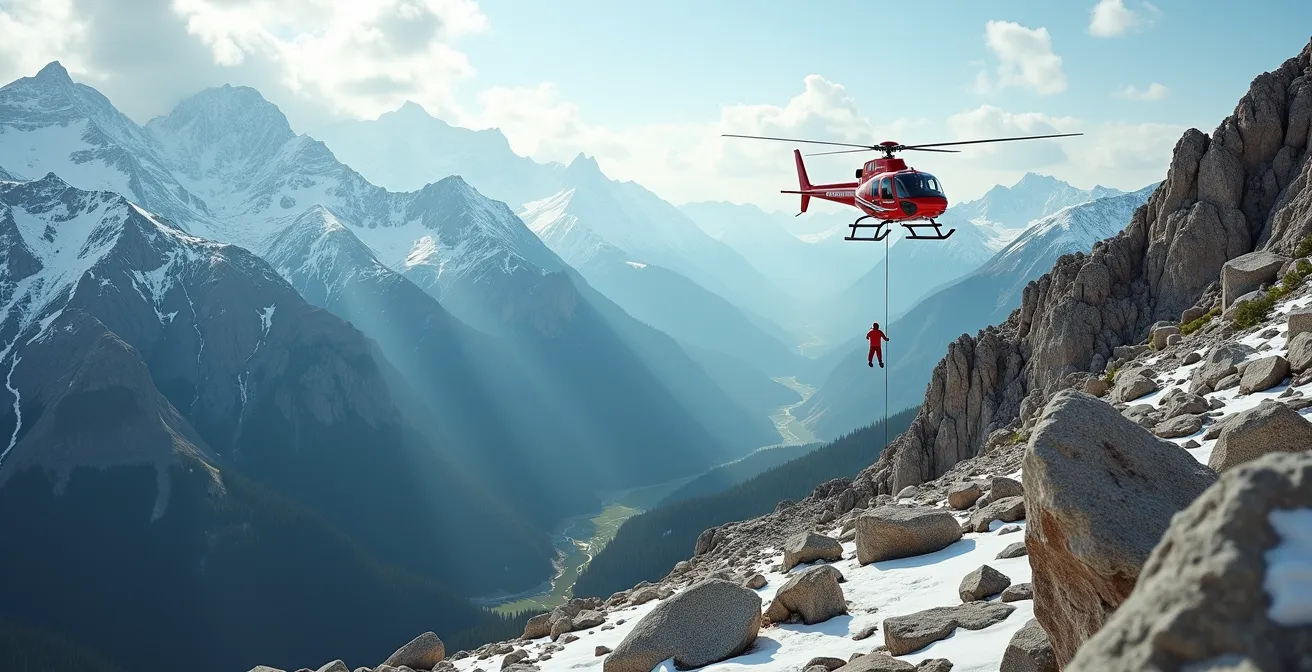
Your assumption that standard travel insurance protects you from financial ruin after a wilderness accident in Canada is a dangerous myth.
- Most policies contain “High-Risk Activity” exclusion clauses that void coverage for activities like backcountry skiing unless you purchase expensive add-ons.
- Canada’s “free” healthcare does not extend to ambulance or helicopter services for tourists, exposing you to the full, uncapped cost of your evacuation.
- Liability waivers signed with tour operators are legally binding in Canada and can prevent you from suing for damages, even if the operator is negligent.
Recommendation: Before your trip, you must secure a specialized insurance policy with explicit coverage for adventure sports, search and rescue, and air ambulance evacuation to mitigate catastrophic financial liability.
As an adventure sports enthusiast, you plan for every contingency. You have the right gear, check the avalanche forecast, and carry a satellite messenger. You also have travel insurance, likely from your premium credit card, and you feel secure. You believe that if the worst happens—a fall in a remote canyon, an injury deep in the backcountry—a helicopter will arrive, and your policy will handle the bill. From an underwriter’s perspective, this belief is the single greatest financial risk you are taking. It’s not the fall that will ruin you; it’s the bill that comes after.
The common advice to “read the fine print” is a platitude that vastly underestimates the problem. The issue isn’t a single line of text but a chain reaction of contractual voids, jurisdictional cost-shifting, and legally binding waivers you’ve accepted without understanding the consequences. In the Canadian wilderness, your standard insurance policy can become worthless at the precise moment you need it most, transforming a medical emergency into a personal financial catastrophe that can easily exceed $20,000.
This article will not rehash generic advice. Instead, it will dissect the financial and legal framework that governs wilderness rescue in Canada. We will analyze the specific clauses that void your policy, explain why public healthcare won’t save you, demystify the power of liability waivers, and outline the steps necessary to ensure your financial survival. We will move beyond the illusion of being ‘covered’ and into the reality of managing extreme financial liability.
This guide breaks down the critical financial and legal risks you face during adventure travel in Canada. The following sections dissect the policy clauses, healthcare system gaps, and legal waivers that can leave you exposed to devastating costs.
Summary: Understanding Your True Financial Exposure in the Canadian Wilderness
- The “High Risk Activity” Clause That Voids Your Policy for Backcountry Skiing
- Why “Free Healthcare” in Canada Doesn’t Apply to Tourists?
- What Rights Do You Give Up When You Sign a Tour Operator’s Waiver?
- Why Insurance Companies May Deny Claims If You Didn’t Call for Help Immediately?
- The Ambulance Bill Surprise: Why a 10km Ride Costs $500?
- Why Standard Travel Insurance Won’t Cover Your Churchill Cancellation?
- The Release of Liability Waiver That Makes You Waive Your Right to Sue?
- How to Prevent Altitude Sickness When Hiking in the Canadian Rockies?
The “High Risk Activity” Clause That Voids Your Policy for Backcountry Skiing
The most common point of failure for standard travel insurance policies is the “high-risk activity” exclusion. From an underwriter’s standpoint, activities like backcountry skiing, mountaineering, or ice climbing are not part of a standard risk profile. Your credit card’s complimentary insurance is designed for a tourist visiting museums in Vancouver, not for someone dropping into a remote couloir in the Rockies. The policy language is deliberately precise: it often excludes activities in areas that are not marked, not patrolled, and not cleared for avalanche dangers. This definition perfectly describes the backcountry, effectively creating a contractual void the moment you step off-piste.
The financial consequences are immediate and severe. Without coverage, you are personally liable for the full cost of any rescue. For instance, non-BC residents face helicopter evacuation costs of approximately $2,800 per hour, according to the Alpine Club of Canada. A multi-hour search and extraction can quickly escalate into a five-figure bill. Insurers mitigate this risk by offering specific add-ons, such as “Adventure Sports Optional Coverage.” As a case in point, TuGo Insurance requires customers to purchase a “Sports & Activities Coverage” add-on to be covered for recreational backcountry skiing. This isn’t an upsell; it’s a fundamental re-classification of your risk profile, and without it, your base policy is effectively useless for your intended activity.
Action Plan: Auditing Your Policy for High-Risk Exclusions
- Keyword Search: Scrutinize your policy document for terms like ‘backcountry,’ ‘off-piste,’ ‘mountaineering,’ and ‘extreme sports’ to locate the specific exclusion clause.
- Activity Verification: Confirm if specific activities like heli-skiing or cat-skiing are covered. Often, they are only permissible if conducted with a licensed commercial operator.
- Coverage Add-ons: Identify if the insurer offers an ‘Adventure Sports Optional Coverage’ or similar rider. This is the most critical step to ensure you are actually insured.
- Check Limitations: Look for specific limits that could still void a claim, such as elevation ceilings (e.g., no coverage above 3,000 meters) or requirements for guide certification (e.g., must be with an ACMG-certified guide).
- Get Written Confirmation: Contact the insurer with a list of your intended activities and request written confirmation (via email) that your policy, including any add-ons, will cover them.
Why “Free Healthcare” in Canada Doesn’t Apply to Tourists?
A persistent and dangerous myth among visitors is that Canada’s universal healthcare system will cover them in an emergency. While the Canada Health Act ensures that services provided *inside* a hospital by a physician are covered for residents, it creates a critical financial trap for tourists regarding pre-hospital care. Emergency Medical Services (EMS), including ground and air ambulances, are not mandated as an insured service under this federal act. The funding and fee structure are left to the individual provinces and territories, which universally charge non-residents significant fees for these services.
This jurisdictional distinction is the root cause of “surprise” medical bills. You may be stabilized at a local clinic, but the cost of getting there falls entirely on you. The system is designed to provide care first and deal with billing later, giving a false sense of security. As health-care consultant Mary Jane Hampton explained to the CBC, the act’s scope is narrowly defined and does not include the very services required in a wilderness rescue.
Ambulances are not part of the Canada Health Act… the only things that were covered in that legislation that would be insured were things that happened inside a hospital and services that are performed by a doctor.
– Mary Jane Hampton, Health-care consultant
For an adventure traveler, this means the most expensive parts of a rescue—the helicopter flight, the paramedics’ time, and the ground ambulance transfer—are uninsured by the state. Without a private insurance policy that explicitly covers these evacuation and transport costs, you are personally responsible for 100% of the invoice. This gap between the public perception of “free healthcare” and the financial reality of provincial EMS billing is a primary source of catastrophic debt for injured tourists.
What Rights Do You Give Up When You Sign a Tour Operator’s Waiver?
Before any guided adventure in Canada, from zip-lining to heli-skiing, you will be handed a multi-page document: the release of liability waiver. Many adventurers treat this as a mere formality, a piece of paper to be initialed and signed quickly. This is a grave financial miscalculation. In the Canadian legal system, a well-drafted waiver is not a simple disclaimer; it is a legally binding contract in which you voluntarily relinquish your right to sue the operator, even if your injury is caused by their negligence. The courts have consistently and firmly upheld these documents as a complete defense for operators.
This paragraph introduces a concept complex. To understand its gravity, it is useful to visualize the moment of commitment. The illustration below captures this critical transaction.

As this image suggests, the focus is on the document. The landmark case of Loychuk v. Cougar Mountain Adventures Ltd. serves as a stark precedent. Two participants were injured in a zip-line collision due to a guide’s error—a clear case of operator negligence. Despite this, the Supreme Court of Canada upheld the waiver they had signed, dismissing their lawsuit. The court affirmed that as long as the operator provides sufficient time to read the document and takes reasonable steps to bring its terms to the participant’s attention, the waiver is enforceable. By signing, you are contractually agreeing to assume all risks, including those created by the company you are paying for their expertise and safety.
Why Insurance Companies May Deny Claims If You Didn’t Call for Help Immediately?
In the aftermath of an accident, your first instinct might be to self-rescue or wait to see if an injury improves. From a claims perspective, this delay can be a fatal flaw. Most travel insurance policies contain a clause requiring you to contact their 24/7 emergency assistance provider immediately or as soon as reasonably possible after an incident occurs. This is not a suggestion; it is a contractual obligation. The rationale is to allow the insurer to manage the case from the outset, control costs, and verify the legitimacy of the claim.
Failing to make this call can give the insurer grounds for denial. They may argue that the delay exacerbated the injury or led to more expensive treatment options that could have been avoided. Furthermore, initiating a rescue on your own can be a costly mistake. If you directly contact a private helicopter company or a nearby guiding operation without first getting approval from your insurer’s assistance line, you may become personally responsible for the entire bill. The insurer can claim you went “out of network” and deny reimbursement for services they did not pre-authorize. This is why policies stress the importance of using their designated providers.
Your satellite device is your lifeline, but it’s also a tool that must be used correctly for your policy to respond. Initiating an SOS through your device and then immediately contacting your insurer’s emergency line is the correct procedure. This creates a documented timeline and ensures the rescue is coordinated under the financial protection of your policy. Deviating from this protocol, no matter how well-intentioned, introduces a significant risk of claim denial and leaves you holding the bag for costs that can run into the tens of thousands of dollars.
The Ambulance Bill Surprise: Why a 10km Ride Costs $500?
The “surprise” ambulance bill is often the first tangible proof for an injured tourist that Canada’s healthcare system isn’t what they imagined. The costs are not standardized nationally and vary significantly by province, but they are consistently high for non-residents. An invoice for hundreds or even thousands of dollars for a short transfer can be shocking, but it is a direct result of the policy explained earlier: emergency transport is not an insured service under the Canada Health Act. Provinces bill for these services to recover costs, and non-residents, lacking provincial health coverage, are charged the full, unsubsidized rate.
A look at the fee structure in a province like British Columbia provides a clear example of this two-tiered system. The data shows a stark difference in financial liability between a resident and a visitor for the exact same service, as demonstrated by the fee changes over the years. The following table, based on historical data from the BC government, illustrates this disparity.
| User Type | Fee Structure (Example) | Modern Rate (Approximate) |
|---|---|---|
| BC Residents (MSP) | $54 + $0.50/km (pre-2007) | $80 flat fee |
| Non-BC Residents (Ground) | $396 (pre-2007) | Variable, often $500+ |
| Non-BC Residents (Helicopter) | $2,400/hour (pre-2007) | $2,800/hour+ |
This table clearly shows that while a resident’s fee is a nominal, flat rate, a non-resident is exposed to the much higher, actual cost of the service. A ground ambulance fee of over $500 is standard in many provinces for visitors. When it comes to air ambulances, the costs become astronomical. As Alberta Health Services bluntly states, “The Canada Health Act does not require EMS to be funded as an insured service.” This policy decision is the direct source of your financial liability.
Why Standard Travel Insurance Won’t Cover Your Churchill Cancellation?
Your financial risk isn’t limited to accidents. In remote Canadian destinations like Churchill, Manitoba, the primary threat is often trip cancellation or interruption due to factors beyond your control. Extreme weather, transportation failures, and wildlife availability are inherent risks in the north. However, standard trip cancellation insurance may not protect you here due to two powerful exclusion clauses: the “foreseeable event” and “common carrier” exclusions.
Insurers can argue that a blizzard in Churchill in November is a “foreseeable event,” not a random, unexpected occurrence. Because extreme weather is a known characteristic of the region, they may deny a claim for a trip cancelled due to a storm. Similarly, travel to Churchill often relies on small regional airlines or a single rail line. The “common carrier” exclusion may void your coverage if your trip is cancelled due to the financial default or equipment failure of these specific, non-major transport providers. These policies are written to cover the failure of a major airline like Air Canada, not the unique and sometimes fragile transport infrastructure of the Canadian North.
The isolation that makes these destinations so appealing is the very thing that creates the insurance risk. A standard policy is ill-equipped to handle the specific challenges of northern travel.
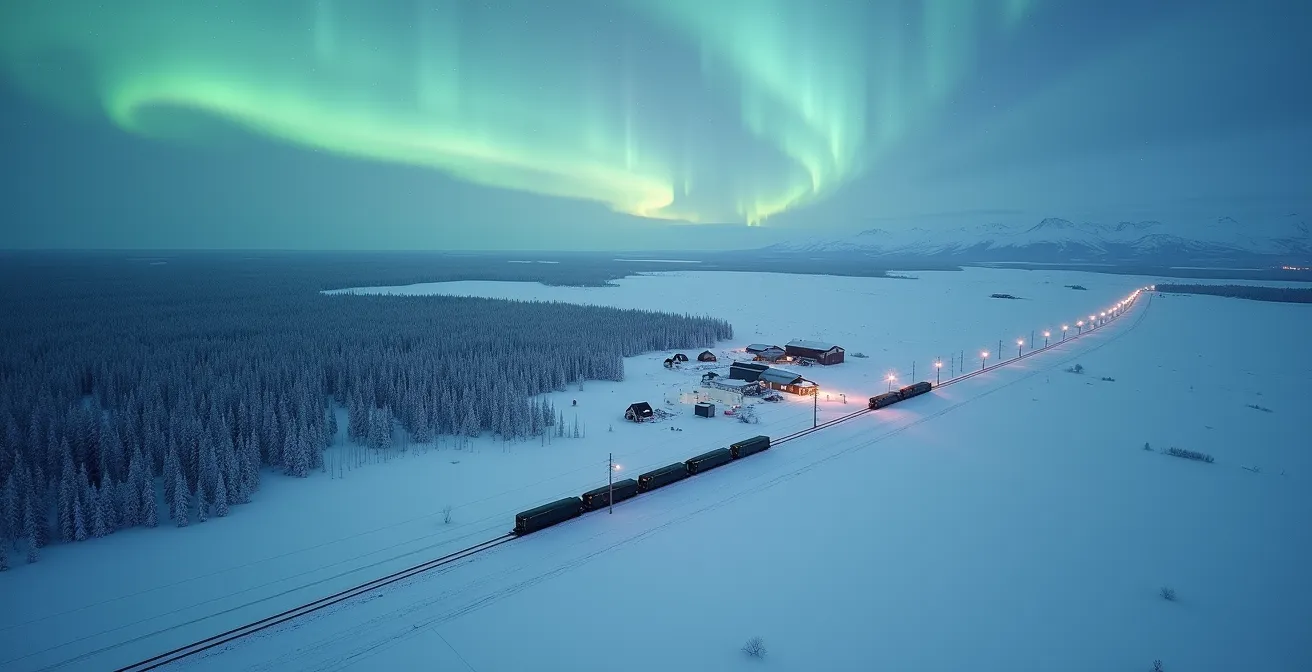
To be adequately protected, travelers must look beyond standard packages. The only reliable option is often a premium “Cancel for Any Reason” (CFAR) policy. This coverage allows you to cancel for reasons not listed in a standard policy, but it is significantly more expensive and typically only reimburses a percentage (e.g., 75%) of your non-refundable costs. It is a financial tool for mitigating, not eliminating, the high cost of a cancelled trip to a place where unpredictability is the only predictable element.
The Release of Liability Waiver That Makes You Waive Your Right to Sue?
Even if you understand that a waiver is a contract, you may not grasp the full extent of the rights you are signing away. The core of the issue lies in the legal term “negligence.” Most people assume a waiver protects an operator from inherent risks of an activity (e.g., a rock falling while climbing), but not from the operator’s own mistakes (e.g., providing faulty equipment or bad instructions). In Canada, this assumption is false. A properly worded waiver explicitly releases the operator from liability for their *own negligence*.
The frightening reality is that most people who sign these documents have no idea what they’ve agreed to. A landmark legal case, Ochoa v. Canadian Mountain Holidays Inc., which followed a 1991 heli-skiing avalanche that killed nine people, exposed this profound misunderstanding. The presiding judge made a stunning observation about the signed waivers:
In the largest-ever adventure lawsuit in Canada…the court noted that only one of eight educated signers actually understood what ‘negligence’ meant in their waiver, and even the company’s founder didn’t know what negligence the waiver specifically covered.
– Madam Justice Koenigsberg, Ochoa v. Canadian Mountain Holidays Inc., 1996
This reveals a critical gap: if even highly educated participants and company founders don’t understand the waiver’s content, the average adventurer stands little chance. Yet, the courts will enforce it if specific conditions are met. The waiver must be clearly drafted, signed before the activity, and the operator must take steps to bring its contents to the signer’s attention with enough time to read it. By meeting these procedural steps, the operator secures a powerful legal shield, and you, the participant, are left with almost no legal recourse, regardless of the cause of the accident.
Key Takeaways
- Standard and credit card travel insurance policies are fundamentally inadequate for adventure sports in Canada due to high-risk activity exclusions.
- Public healthcare in Canada does not cover ambulance or helicopter evacuation for tourists, exposing you to the full, uncapped cost.
- Liability waivers are legally binding contracts in Canada that absolve operators of responsibility even in cases of their own negligence, leaving you with no legal recourse.
How to Prevent Altitude Sickness When Hiking in the Canadian Rockies?
While the focus of this article is on financial liability, the most effective risk management strategy is always incident prevention. In the Canadian Rockies, one of the most common and preventable medical issues that can trigger a costly emergency response is altitude sickness, or Acute Mountain Sickness (AMS). While the elevations are not extreme compared to the Himalayas, they are high enough to affect unacclimatized individuals, especially those arriving from sea level. Locations like the Lake Louise Ski Resort summit (2,637m) and Sunshine Village (2,730m) are well within the altitude zone for AMS.
Preventing altitude sickness is not just a health precaution; it is a crucial financial decision. The symptoms of severe AMS—debilitating headache, nausea, confusion, and ataxia—can mimic those of a serious injury and often result in a call for an emergency evacuation. A rescue triggered by preventable AMS carries the same price tag as one for a traumatic injury. Therefore, a proper acclimatization plan is your first and most cost-effective insurance policy.
The strategy is simple: ascend gradually. Your body needs time to adapt to the lower oxygen levels. The following table outlines key elevations in the Rockies to help you plan a gradual ascent, and a proper strategy involves “climbing high and sleeping low.”
| Location | Elevation | Altitude Risk Level |
|---|---|---|
| Calgary | 1,048m (3,438 ft) | Low |
| Banff Townsite | 1,463m (4,800 ft) | Low-Moderate |
| Lake Louise Village | 1,750m (5,741 ft) | Moderate |
| Bow Summit (Icefields Parkway) | 2,088m (6,850 ft) | Moderate |
| Lake Louise Ski Resort Summit | 2,637m (8,652 ft) | High |
| Sunshine Village Summit | 2,730m (8,957 ft) | High |
Ultimately, a successful adventure in the Canadian wilderness hinges on mitigating financial risk with the same seriousness as you mitigate physical risk. The next logical step is to have your current insurance policies professionally audited against the specific risks of your planned activities and to secure a specialized policy that explicitly covers helicopter evacuation and adventure sports. Do not assume you are covered; verify it.
Frequently Asked Questions about Travel Insurance in Northern Canada
What’s the difference between trip cancellation and trip interruption coverage?
Trip cancellation covers your non-refundable costs if you have to cancel your trip *before you depart*. Trip interruption is critically important for remote destinations like Churchill, as it covers your costs if your trip is disrupted by an unforeseen event *after it has already started*, such as a sudden weather event grounding flights home.
Are weather-related cancellations in Northern Canada covered?
Not always. Standard policies may exclude “foreseeable events.” Because extreme weather is a known and common occurrence in places like Churchill, an insurer may argue that a blizzard is not an unexpected event and deny the claim. For this reason, a “Cancel for Any Reason” (CFAR) policy is often a more reliable, albeit more expensive, option for these destinations.
What is a “Common Carrier” exclusion?
This is a key exclusion for northern travel. It means your policy may not cover cancellations or delays caused by the failure of your transportation provider. These clauses are often written to cover major national airlines, but can exclude the smaller, regional airlines or rail services that are common lifelines in the Canadian North, leaving you uncovered if they experience mechanical failure or financial default.