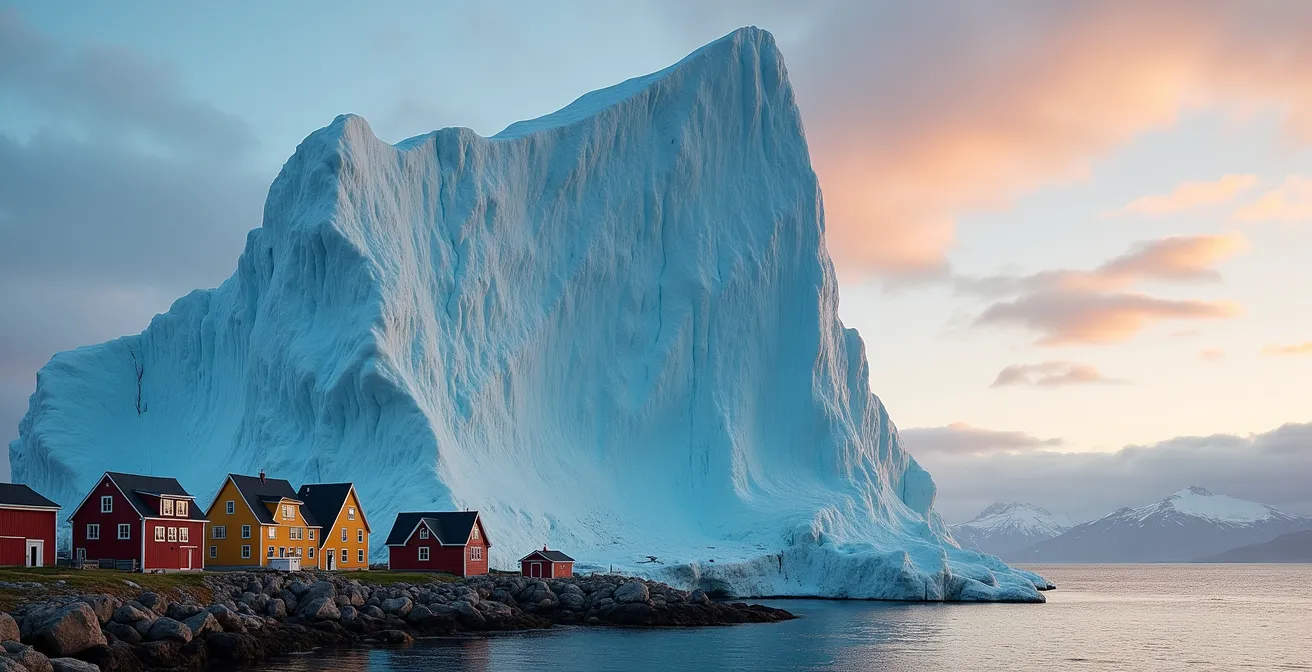
The iceberg season’s end is dictated more by tour logistics than the ice itself; many operators shut down soon after Canada Day (July 1st), regardless of remaining icebergs.
- The “peak season” of late May to early June refers to the highest quantity of bergs, but not necessarily the largest or most accessible ones.
- An iceberg’s appearance, particularly a deep blue colour, indicates it’s in a late, unstable stage of its decay cycle, often preceding a dramatic flip.
Recommendation: For the best chance at seeing large icebergs, aim for the first three weeks of June and verify tour operator schedules in advance, as logistical feasibility drops sharply afterwards.
For any tourist planning a trip to Newfoundland, the question of timing is paramount, especially when the goal is to witness the majestic parade of icebergs down “Iceberg Alley.” The common advice points to a “peak season” in late May and early June, creating a frantic rush to book flights and tours. This often leads to a crucial miscalculation: travellers assume the season simply fades out, with smaller icebergs trickling by into July. This perception misses the complex reality of the iceberg lifecycle and the on-the-ground logistics of Canadian marine tourism.
The disappearance of icebergs isn’t a gentle decline; it’s a story of rapid decay, dramatic transformation, and logistical cut-offs. Understanding these dynamics is the true key to success. It’s not just about being there during the peak, but about positioning yourself to intercept these ten-thousand-year-old giants at their most spectacular, just before they vanish. While seeing them from shore is occasionally possible, getting up close via a tour provides an entirely different perspective on their scale and beauty.
This guide moves beyond the generic “peak season” advice. We will explore the lifecycle of an iceberg as it travels south, explaining the scientific and practical factors that dictate your viewing window. We’ll delve into safety, photography, and the critical, often-overlooked business realities that determine when the season truly ends for a tourist. It’s about shifting from a passive hope of seeing an iceberg to a strategic plan for witnessing them in their full glory.
To help you navigate this unique adventure, we will cover the key considerations, from choosing the right type of tour to understanding the tell-tale signs of an iceberg’s behaviour and the hard deadlines of the local tourism industry. This framework will allow you to plan your trip with the precision of an iceberg tracker.
Summary: Navigating Newfoundland’s Iceberg Season with Precision
- Boat vs Helicopter Tour: Which Gets You Closer to the Icebergs Safely?
- Why Does an Iceberg Turn Blue Before It Flips Over?
- How to Get a Refund if the Icebergs Drift South of St. John’s?
- The Exposure Setting That Makes Glacial Ice Look Bright White Instead of Grey
- When is the Best Time of Day to Avoid Rough Seas in Iceberg Alley?
- Tundra Buggy vs Walking Tour: Which is Safer for Close Encounters?
- Camera vs Eye: Why Do the Lights Look Greener on Your Screen?
- Is Driving the Newfoundland South Coast Feasible in October?
Boat vs Helicopter Tour: Which Gets You Closer to the Icebergs Safely?
Choosing between a boat and a helicopter tour isn’t just a matter of budget; it’s a strategic decision about perspective versus proximity. A helicopter offers a breathtaking aerial view, revealing the full scale of an iceberg and its underwater shadow in the clear North Atlantic. However, for a truly intimate and sensory experience—feeling the cold air, hearing the crackle of melting ice, and appreciating the sheer verticality of the berg—a boat tour is unparalleled. This is the most common way to experience the 700 to 800 icebergs that arrive annually off the coast.
Safety, however, is the paramount concern when getting “close.” Reputable boat operators in Canada adhere to strict guidelines. The primary risk is not collision but a sudden calving (a large piece breaking off) or a complete flip of the iceberg, which can displace a massive amount of water and create large waves. A helicopter is inherently safer from these direct marine risks, but it cannot provide the same close-up encounter.
For a boat tour, “safely” getting closer means trusting a certified captain who understands iceberg dynamics. They know how to read an iceberg’s stability and will maintain a prudent distance based on its size and condition. The responsibility is on you, the tourist, to choose a qualified and transparent operator. Before booking, you should feel empowered to ask critical safety questions to ensure the operator meets rigorous standards.
Your Pre-Tour Safety Checklist: Questions for Newfoundland Operators
- Verify captain certification under Canadian Marine Personnel Regulations for near-coastal voyages.
- Ask about specific safety protocols for iceberg calving events and emergency procedures.
- Confirm the vessel complies with Transport Canada’s Marine Safety Management System requirements.
- Request information about their minimum safe approach distances based on iceberg size and type.
- Inquire about their weather cancellation policies and what alternative tour options are available.
Why Does an Iceberg Turn Blue Before It Flips Over?
The dazzling, sapphire blue of some icebergs is one of nature’s most stunning displays, but it’s also a critical visual cue about the iceberg’s age, structure, and instability. Most icebergs appear white because their surface snow and ice are riddled with tiny air bubbles that scatter light across the entire spectrum. The white appearance is simply the reflection of all colours of light. However, the transformation to blue signals a dramatic change in the ice’s density and integrity.
As an iceberg ages and melts, the immense pressure of its own weight, or the pressure from the original glacier, squeezes out these air bubbles. This creates highly compressed, dense glacial ice. When light penetrates this bubble-free ice, it acts like a filter. It absorbs the longer, red and yellow wavelengths of light, allowing the shorter, blue wavelengths to pass through and be seen by our eyes. This phenomenon is why the oldest, most compacted ice appears intensely blue. As Juliana M. Marson notes in National Geographic, the origin of this ice is profound:
The icebergs calved from these glaciers are often formed from ice that is potentially tens of thousands of years old.
– Juliana M. Marson, National Geographic
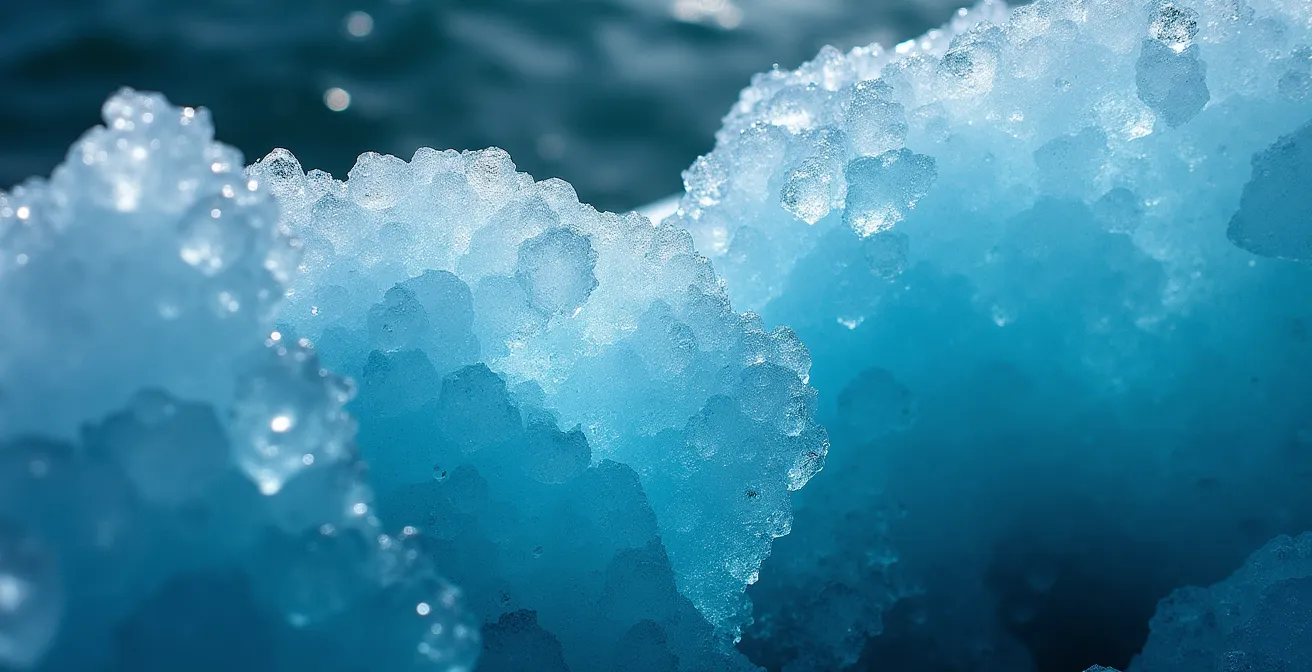
This blue colour is often a prelude to a flip. As the iceberg melts from the bottom up in the slightly warmer ocean water, its centre of gravity shifts. The dense, blue ice, which may have been deep underwater, can become part of the visible structure. When the iceberg becomes too top-heavy or bottom-light, it will spectacularly roll over to find a new, more stable position. Therefore, while a blue iceberg is a breathtaking photographic opportunity, it’s also a sign of an iceberg in its late-stage decay—beautiful, but unstable and best observed from a very safe distance.
How to Get a Refund if the Icebergs Drift South of St. John’s?
One of the biggest anxieties for tourists is booking a non-refundable trip only to find that the icebergs are not cooperating. The first thing to understand is a crucial distinction tour operators make: cancellations due to weather versus cancellations due to a “no-show” by Mother Nature. If a tour is cancelled by the operator for safety reasons, such as high winds or heavy fog, a full refund or the option to reschedule is standard practice across Newfoundland.
However, the scenario where tours are running but no icebergs are within a reasonable distance is different. Iceberg sightings are a natural phenomenon and are almost never guaranteed. If your tour goes ahead but you don’t see any bergs, you are generally not entitled to a refund. The tour is for the boat journey and the experience on the water; the icebergs are the hoped-for bonus. This is a standard policy in nature-based tourism worldwide.
To protect your investment, the best tool is travel insurance. A standard policy will typically cover you if the operator cancels the tour (e.g., due to weather). But to be covered for the “no iceberg” scenario, you would need a premium “Cancel For Any Reason” (CFAR) add-on. This allows you to cancel your trip for reasons not covered by standard policies, though you typically only recover a percentage of your pre-paid costs. It is vital to check the specific terms of any policy.
The following table summarizes the typical policies you’ll encounter with major tour operators in the region, based on an analysis of information from tourism bodies like Newfoundland and Labrador Tourism.
| Cancellation Reason | Typical Refund Policy | Insurance Coverage |
|---|---|---|
| Weather cancellation | Full refund | Standard travel insurance covers |
| No iceberg sighting | No refund (natural phenomena) | Requires ‘Cancel For Any Reason’ upgrade |
| Operator cancellation | Full refund or rescheduling | Standard coverage applies |
The Exposure Setting That Makes Glacial Ice Look Bright White Instead of Grey
A common frustration for photographers in Iceberg Alley is returning with photos of magnificent icebergs that look dull and grey, a far cry from the brilliant white they remember. This happens because your camera’s light meter is designed to see the world as “middle grey.” When faced with a massive, bright white iceberg against a similarly bright sky and water, the meter gets fooled. It darkens the exposure to turn the brilliant scene into a muddy grey, a classic case of automatic systems failing in extreme lighting.
The key to overriding this is a feature called exposure compensation. By telling your camera to intentionally overexpose the shot, you are correcting its misinterpretation. Dialing in an exposure compensation of +0.7 to +1.3 is often the sweet spot. This brightens the entire scene, rendering the iceberg as the brilliant white you see with your eyes, and preventing the often-grey North Atlantic sky from looking too dark and gloomy.
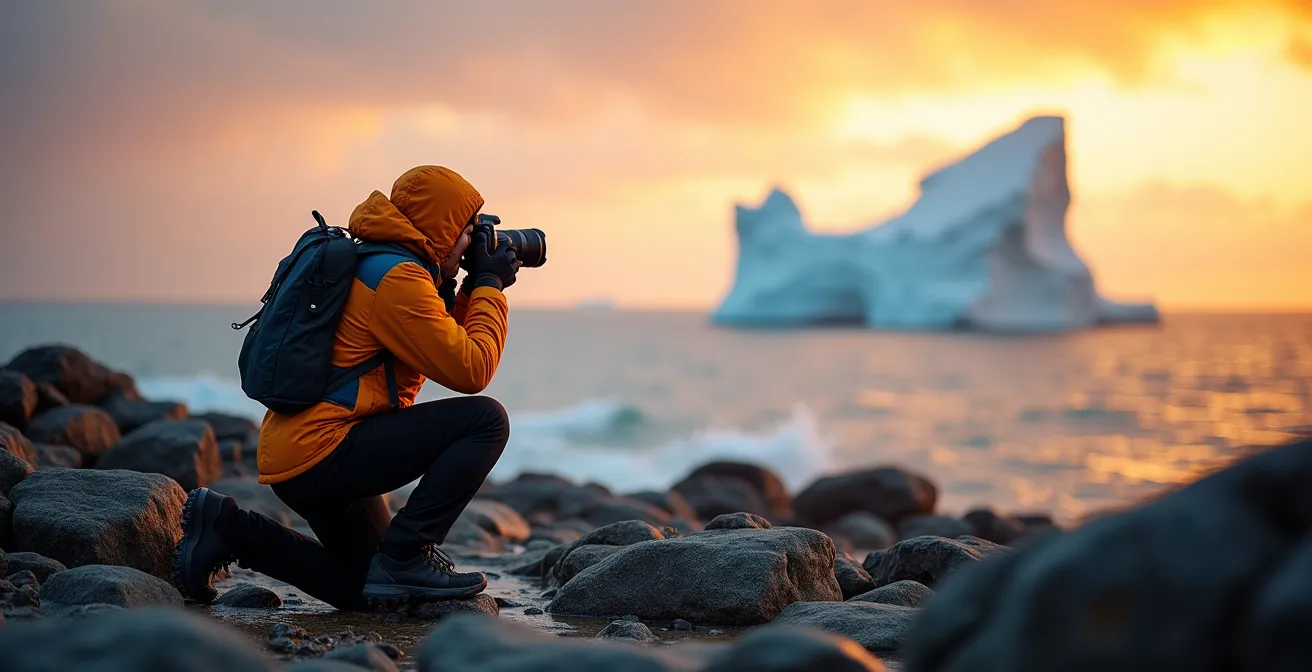
Beyond this single most important setting, several other techniques can elevate your iceberg photography from simple snapshots to professional-quality images. These adjustments help manage the unique challenges of the marine environment, from harsh glare to unpredictable sea spray.
- Use a circular polarizing filter: This is non-negotiable. It cuts the intense glare from the water’s surface, which allows the deep, rich blues of the submerged parts of the iceberg to show through dramatically.
- Shoot in RAW format: This gives you maximum flexibility in post-processing to recover highlights, adjust white balance, and bring out the subtle textures in the ice that a JPEG would discard.
- Use a lens hood: It does more than block stray light. In the harsh marine conditions of Newfoundland, it acts as a crucial first line of defense, protecting your lens from salty sea spray.
- Try slow-motion video: If your camera has this feature, use it to capture the drama of small calving events or the powerful action of waves crashing against the ice.
When is the Best Time of Day to Avoid Rough Seas in Iceberg Alley?
While the timing of the season is crucial for iceberg sightings, the timing of your daily tour is key to a comfortable and enjoyable experience. The waters of the North Atlantic are notoriously unpredictable, but a general pattern often holds true: the seas are calmest in the early morning. Winds tend to be lighter at dawn and pick up throughout the day, creating more chop and swell in the afternoon. For this reason, booking the first tour of the day is often your best strategy to avoid rough seas.
This aligns perfectly with the seasonal timing. The conventional wisdom, as promoted by tourism authorities, is that the late May to early June period is the peak season for the sheer number of icebergs. However, this advice needs a critical layer of context. The journey for these icebergs begins months earlier, and their arrival is not always smooth.
As Newfoundland and Labrador Tourism clarifies, the early season has its own challenges and opportunities. This expert observation highlights a key dynamic of the iceberg lifecycle:
April and May are the months when bergs are most plentiful, but they may be locked up in sea ice.
– Newfoundland and Labrador Tourism, Official Tourism Website
This means that while the bergs are present, they may be inaccessible to tour boats until the surrounding sea ice breaks up. Early June often represents the sweet spot when the sea ice has cleared, but the main flotilla of large icebergs has not yet melted significantly or drifted too far south. Therefore, an early morning tour in the first or second week of June often provides the optimal combination of calm seas and a high probability of accessible, large icebergs.
Tundra Buggy vs Walking Tour: Which is Safer for Close Encounters?
While the title mentions Tundra Buggies—vehicles synonymous with polar bear viewing in Churchill, Manitoba—the underlying question of safety during close encounters is directly transferable to iceberg tours. In the context of Iceberg Alley, the “Tundra Buggy” is analogous to a large, stable, multi-deck tour vessel, whereas a “walking tour” can be compared to a small, nimble Zodiac or even a sea kayak. The safety implications of this choice are significant and governed by Canadian marine regulations.
A larger vessel offers inherent stability and a higher viewing platform, providing a greater margin of safety from waves created by a calving or flipping iceberg. These vessels, often over 5 gross tonnage, are subject to stringent Transport Canada regulations. An analysis of these rules shows that they mandate extensive safety equipment, rigorous crew certification, and comprehensive emergency management systems. This creates a highly controlled and predictable environment for passengers, much like the protected environment of a Tundra Buggy in polar bear territory.
Conversely, a smaller Zodiac or kayak offers an undeniably thrilling, water-level perspective. The experience is more intimate and adventurous. However, the risk profile is different. While still regulated, these smaller craft have greater maneuverability but less protection from sudden wave action. The expertise of the guide is absolutely critical. According to recent updates in the Canada Gazette regarding marine safety, operators of all vessel sizes must have safety protocols, but the requirements for larger vessels are more comprehensive. Choosing a smaller craft means placing more trust in the guide’s ability to read the ice and the water in real-time. Neither is inherently “unsafe” if operated professionally, but the large vessel minimizes risk through engineering and regulation, while the small vessel manages risk through agility and guide expertise.
Camera vs Eye: Why Do the Lights Look Greener on Your Screen?
This question is typically asked about the Aurora Borealis, but the core principle—why what your camera captures differs from what your eye sees—is perfectly applicable to iceberg viewing. Tourists are often perplexed when their photos show brilliant, deep blues in the ice that seemed more subtle in person. The reason is a combination of technology and technique, not a deception.
Your camera’s sensor and a photographer’s filter can perceive and emphasize light in ways the human eye cannot. As one photography expert with field experience in Newfoundland notes, what we see in promotional materials is often an enhanced reality. The goal is to capture the essence of the scene, not a flat, literal depiction.
A tour operator’s photos are often taken with polarizing filters on the sunniest days, showing vibrant blues.
– Photography expert observation, Field experience in Newfoundland
A polarizing filter is the key. It works much like polarized sunglasses, cutting through the reflective glare on the water’s surface. This glare washes out colour. By eliminating it, the filter allows the camera to capture the rich, deep blue light being refracted from the submerged part of the iceberg—a colour that is truly there, but often masked to the naked eye.
This highlights the importance of not just photographing the icebergs, but truly observing them. Your eyes, aided by a good pair of polarized sunglasses, can reveal details that a camera might miss. Watching for signs of instability or listening for the unique sounds of melting ice adds a layer to the experience that a screen cannot replicate. For a safe and enriching viewing, it’s best to balance time behind the lens with direct observation.
- Use polarized sunglasses to reduce glare and spot underwater ice portions, mimicking the effect of a camera filter.
- Observe visual cues of instability, such as fresh cracks, excessive melting, or streams of water running down the iceberg’s face.
- Spend time just observing the iceberg’s behaviour and its interaction with the waves, rather than only photographing it.
- Listen for “bergy seltzer,” the distinct fizzing or popping sound of ancient, compressed air escaping as the ice melts.
- Note any recent changes in the iceberg’s waterline, which can indicate melting below the surface and signal potential instability.
Key Takeaways
- The ideal viewing window is often the first three weeks of June, when sea ice has cleared but the largest bergs have not fully decayed.
- Safety is paramount; always choose operators compliant with Transport Canada regulations and understand that a blue iceberg signals potential instability.
- The practical end of iceberg season is logistical, with many tour operators ceasing operations after Canada Day (July 1st), regardless of ice presence.
Is Driving the Newfoundland South Coast Feasible in October?
While a scenic drive along Newfoundland’s rugged South Coast is a fantastic idea for a fall trip in October, it is entirely disconnected from the reality of the iceberg season. By October, the icebergs of spring and early summer are a distant memory, long since melted in the warmer Atlantic waters. This question, however, leads to a more vital point for the aspiring iceberg chaser: understanding the hard, logistical end of the season.
Many tourists mistakenly believe the season winds down gradually through July and August. The reality is that the operational season for many tour providers has a firm end date. The official start of the tourism season is often marked by events like The Iceberg Festival, which begins on the first Friday of June for 10 days. This period represents the industry at its peak capacity.
However, the shutdown is swift. As a crucial case study on tour operations reveals, the business of iceberg chasing is highly seasonal and concentrated. Especially in the smaller outports and communities along the coast, the infrastructure that supports tourism is often dismantled shortly after the peak. According to extensive field observation, many Newfoundland iceberg tour operators, particularly those outside the main hub of St. John’s, typically shut down after Canada Day (July 1st). The decline in tourist numbers and the increasing unpredictability of the weather make it economically unfeasible to continue running tours, even if a few stray icebergs drift by later in the summer.
Just as driving the South Coast becomes logistically challenging in October due to weather, finding an iceberg tour becomes logistically unfeasible after early July. Your planning must account for this hard deadline. Waiting until the last minute in June or hoping for a July sighting is a significant gamble, not because there won’t be a single piece of ice left in the ocean, but because there may be no one left to take you to it.
Therefore, to truly maximize your chances, the next logical step is to move from general planning to concrete action. Begin researching specific tour operators in your target region—be it Twillingate, Bonavista, or St. John’s—and contact them directly about their operational schedules for June.