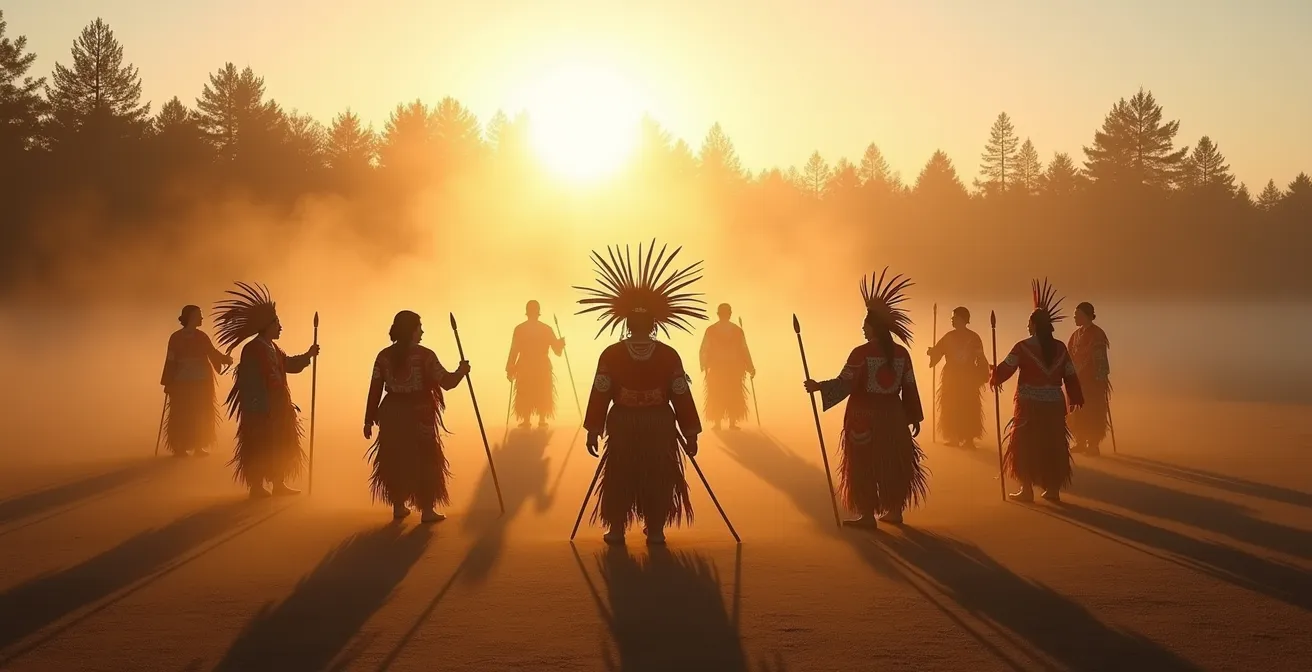
Attending a powwow is not about memorizing a list of rules to avoid causing offence. It’s about shifting your mindset from a passive tourist to a respectful witness. This guide moves beyond simple do’s and don’ts to explain the deep spiritual and cultural significance behind the protocols, empowering you to participate with genuine understanding and respect, particularly within the Canadian context.
The energy is electric. The sound of the drum resonates deep in your chest, a heartbeat for the entire gathering. Dancers in breathtaking, intricate outfits move with a grace and power that feels timeless. You want to experience this moment, to connect with a profound part of Indigenous culture in Canada. But a voice of anxiety whispers in your ear: “What if I do something wrong? What if I offend someone? Am I even welcome here?” This fear is common for many non-Indigenous people wanting to attend their first powwow.
Most online guides offer a simple list of rules: don’t touch this, stand here, don’t take photos there. While correct, this approach frames the experience as a minefield of potential mistakes. It encourages you to be a timid observer, constantly worried about breaking an unwritten rule. But what if the true path to respectful attendance wasn’t about fearfully following rules, but about joyfully understanding the living spirit behind them?
This guide is your invitation to shift that perspective. We will explore the ‘why’ behind the ‘what’—the spiritual significance, the historical context, and the community values that shape powwow protocol. By understanding the heart of these traditions, you move from being an outsider afraid of missteps to becoming a welcome and respectful witness, capable of honouring the culture you’ve been invited to share. This journey will equip you not with a checklist of anxieties, but with a foundation of genuine respect.
This article will walk you through the most crucial aspects of powwow etiquette, from the sacredness of a dancer’s regalia to the proper way to observe key ceremonies. You’ll learn to navigate different types of events and even how to connect across language barriers, ensuring your experience is meaningful for both you and your hosts.
Summary: How to Connect with Locals in Rural Quebec If You Don’t Speak French?
- Why You Must Never Touch a Dancer’s Regalia Without Explicit Permission?
- How to Show Respect During the Grand Entry at a Traditional Powwow?
- Public vs Private: Which Ceremonies Are Open to Tourists in British Columbia?
- The Photography Mistake That Can Get You Ejected from a Sacred Site
- Why Listening to an Elder is More Valuable Than Reading a Guidebook?
- What is a “Cèilidh” and How Does It Differ From a Concert?
- Festival or Local Fair: Which Event Is More Welcoming to Outsiders?
- How to Connect with Locals in Rural Quebec If You Don’t Speak French?
Why You Must Never Touch a Dancer’s Regalia Without Explicit Permission?
Of all the protocols at a powwow, this is the most absolute. To a non-Indigenous guest, the stunning beadwork, feathers, and fabrics that make up a dancer’s outfit might look like a “costume.” This is a fundamental misunderstanding. What you are seeing is sacred regalia, and each piece is a deeply personal and spiritual extension of the person wearing it. It is not an outfit for a performance; it is how a dancer dresses their spirit for a ceremony.
Many elements of regalia are earned, gifted, or created over hundreds of hours and hold immense spiritual significance. They can represent family history, personal journeys, or a connection to the Creator. For instance, across countless Indigenous nations, the eagle is revered as the most sacred of all birds, seen as a direct messenger to the Creator. An Eagle Feather is one of the highest honours a person can receive, earned through great community service or personal achievement. Touching it without permission is not just a breach of etiquette; it is a profound act of disrespect to the dancer, their community, and their spirituality.
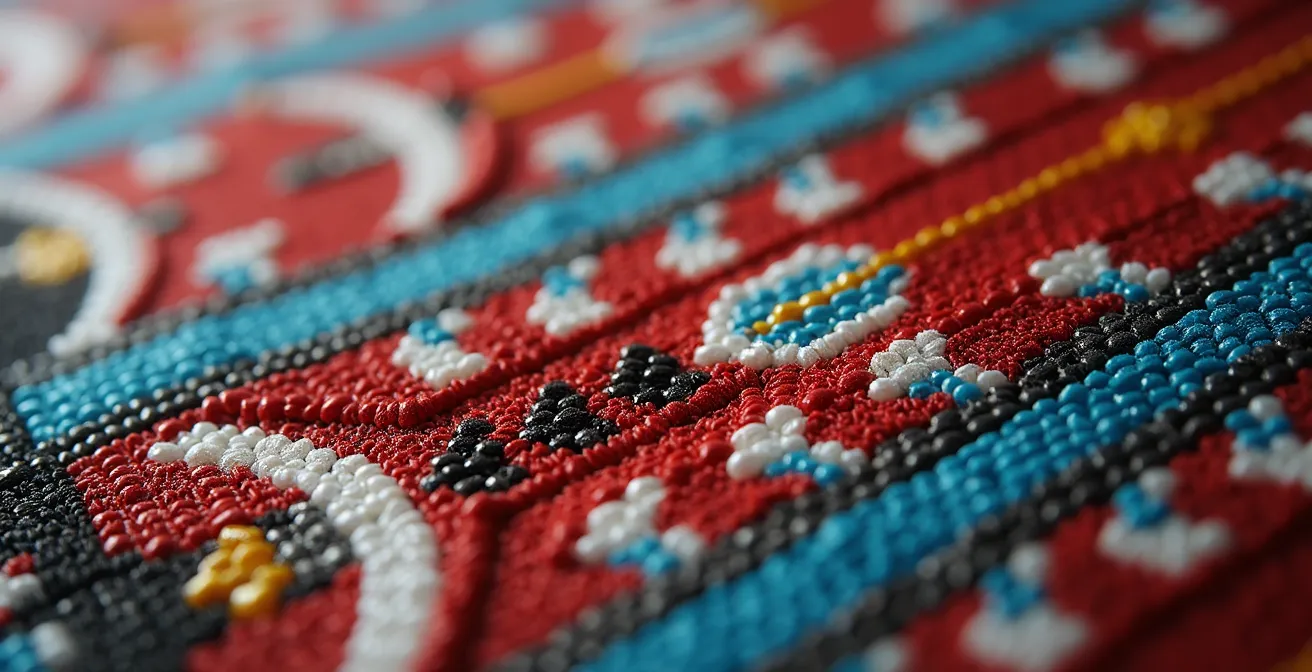
This reverence is so profound that it’s even reflected in law, which recognizes the spiritual importance of these items and controls their handling. The intricate beadwork, the flow of the ribbons, the placement of each feather—it all tells a story and holds power. To touch it uninvited is to interrupt that story and disrespect that power. Think of it not as an object to be admired up close, but as a part of the person themselves that you should give space and reverence.
Action Plan: Essential Protocol When Near Regalia
- Acknowledge the Sacredness: Never touch a dancer’s regalia, the Powwow drums, or Eagle Feathers. Understand these are sacred items, not clothing.
- Understand the Honour: Recognize that dancers earn their Eagle Feathers through ceremony as a symbol of high regard for their community work.
- Ask for Permission to Photograph: Before taking photos of any dancer, always ask for their explicit permission. You must get a parent’s permission before photographing children.
- Protocol for Fallen Items: If you see an Eagle Feather or a piece of regalia fall to the ground, do not touch it. Immediately and quietly get the attention of the Arena Director or another staff member.
- Internalize the Meaning: Remember that a dancer’s regalia is how they dress their spirit. It consists of handcrafted garments, adornments, and sacred items with deep spiritual significance.
How to Show Respect During the Grand Entry at a Traditional Powwow?
The Grand Entry is the official start of the powwow and one of its most important ceremonies. It’s a vibrant procession that brings all the dancers into the arena, or arbor, for the first time. Your role as a respectful witness is most active here. The Master of Ceremonies (MC) will announce the Grand Entry, and this is your cue to rise. Unless you are physically unable, standing is a universal sign of respect during this entire procession.
You will be asked to remove your hat or cap. The procession is led by Indigenous veterans carrying Eagle Staffs and the flags of the host First Nation, as well as the Canadian flag. The Eagle Staff is not just a flag; it is a sacred item that represents the Nation and its people. Giving it the same respect you would a national flag is a minimum expectation. As they enter the arbor, you are witnessing an honouring of heritage, sovereignty, and the enduring spirit of the people.
Following the flag and staff bearers are other dignitaries, Elders, powwow royalty, and then, in a kaleidoscope of colour and motion, the dancers. They are organized by dance style. During this time, there is no talking on your phone or casual chatter. Your attention should be focused on the procession. Listen to the MC, as they will often explain who is entering the arbor and the significance of the songs being played.
At the beginning of the powwow during the grand entry, the Eagle staff, tribal flags, and the Canadian flag are often carried by military veterans out of respect for their service. Soldiers are given the same consideration as warriors of the past… During the powwow there may also be special songs in honor of military veterans.
– Sault Ste Marie Convention & Visitors Bureau, 8 Things to Know Before Attending a Powwow Guide
Some dances that follow the Grand Entry, known as Intertribal dances, are open to everyone, and the MC will invite all guests to join. This is a wonderful opportunity to participate. However, other dances are for specific styles or age groups. The best guide is to listen to the MC and watch what others are doing. When in doubt, observing respectfully is always the right choice.
Public vs Private: Which Ceremonies Are Open to Tourists in British Columbia?
A common source of anxiety for non-Indigenous guests is knowing which events they are welcome to attend. The simple answer is that if a powwow is publicly advertised—on websites, on posters, in tourism guides—you are welcome. Powwows are, by nature, gatherings meant to share culture. However, it’s crucial to understand that not all Indigenous ceremonies are public events.
This distinction is rooted in painful Canadian history. For 75 years, Canada’s Indian Act prohibited powwows and other cultural expressions from 1876 until 1951. These vital celebrations were kept alive in secret, forced into the private sphere by colonial law. When the prohibition was lifted, the renewed freedom led to a resurgence of public celebrations. Attending a public powwow is therefore accepting an invitation to witness the resilience and strength of a culture that refused to be extinguished.
In British Columbia, as across Canada, there is a clear difference between public celebrations and private, community-specific ceremonies. Winter Spirit Dances of the Coast Salish, for example, or healing ceremonies, are typically private and by invitation only. These are not for public consumption. A public powwow, on the other hand, is an open door. Your attendance as a respectful witness is a form of reconciliation in action.
This table, based on information from Indigenous Tourism BC, provides a helpful guide for navigating events in the province:
| Type of Event | Public Access | Examples in BC | How to Identify |
|---|---|---|---|
| Competition Powwows | Open to public | Kamloopa Powwow, Squamish Nation Youth Pow Wow | Advertised on tourism websites, public posters |
| Traditional/Social Powwows | Usually open | Community celebrations | May have limited advertising, check with host Nation |
| Winter Spirit Dances | Private/Closed | Coast Salish ceremonies | Not advertised publicly, invitation only |
| Healing Ceremonies | Private/Closed | Various Nations | Internal community events only |
The Photography Mistake That Can Get You Ejected from a Sacred Site
In our digital age, the instinct to capture every beautiful moment on camera is strong. At a powwow, you must actively resist this impulse. The critical mistake is assuming you have the right to take a photo of anyone, or any moment, at any time. Photography is a privilege, not a right, at these events. Unannounced or inappropriate photography can be seen as deeply intrusive and may lead to you being asked to leave.
The guiding principle is simple: always ask for permission first. If you want to take a picture of a dancer in their regalia, approach them when they are not dancing or preparing to dance, and politely ask. More often than not, they will be happy to oblige. However, never take a photo of a child without the explicit permission of their parent. During certain ceremonies, the MC will explicitly state that no photography is allowed. This often includes prayers, honour songs, and memorial dances. During these moments, your camera must be put away completely. Being a respectful witness means being present in the moment, not documenting it for your social media feed.
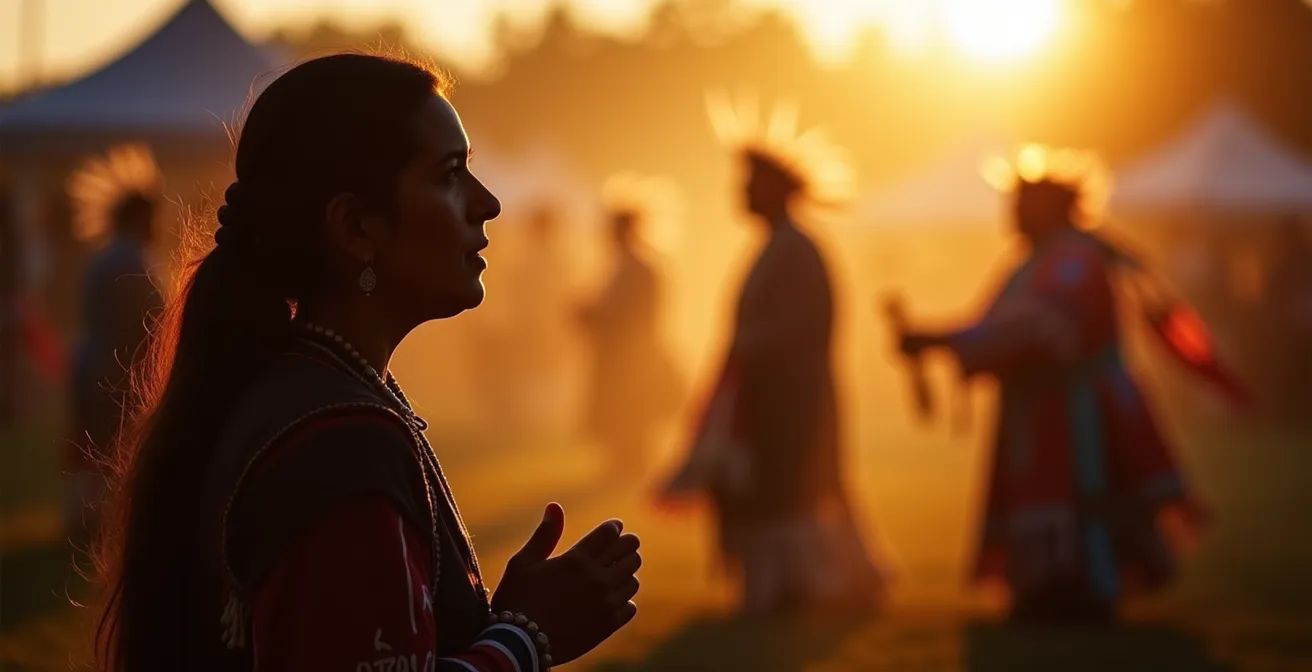
This protocol extends beyond powwows to many sacred Indigenous sites across Canada. At places like Áísínai’pi (Writing-on-Stone) in Alberta or Petroglyphs Provincial Park in Ontario, photography of sacred rock art is restricted. This is not just to prevent physical damage, but also to prevent spiritual harm. For some, a photograph is seen as capturing a piece of the spirit of the person or place being photographed. Selling photos of participants or the event for your own profit is considered highly inappropriate. Your role is to witness, not to document for personal gain.
Why Listening to an Elder is More Valuable Than Reading a Guidebook?
You can read a hundred articles like this one and still only scratch the surface of understanding Indigenous culture. Guidebooks and protocols are helpful starting points, but they are static. They are a snapshot. True understanding comes from the living, breathing source of the culture: its people, and especially its Elders.
Elders are the keepers of traditional knowledge, history, and wisdom. Their teachings are not delivered in a lecture format; they are shared through stories, observations, and conversations in what is known as the oral tradition. Listening to an Elder share a story is receiving a gift of knowledge passed down through countless generations. It is a dynamic exchange, where the teaching is often tailored to the listeners and the moment. A guidebook can tell you a rule; an Elder can tell you the story that gives that rule its heart.
Finding these opportunities requires a respectful approach. You don’t simply walk up to an Elder and demand knowledge. Instead, you can visit places that facilitate these interactions. Across Canada, many Indigenous cultural centres and heritage sites offer structured opportunities. At Wanuskewin Heritage Park in Saskatchewan, for example, visitors can join scheduled Elder talks. The Huron-Wendat traditional site near Quebec City offers similar guided experiences. National Indigenous Peoples Day (June 21st) celebrations are another excellent opportunity to find public events featuring Elder storytelling.
When you are in the presence of an Elder who is speaking, you listen with your full attention. You don’t interrupt, and you wait until they have finished before asking questions. This act of deep, patient listening is a form of respect in itself. It acknowledges the immense value of the knowledge being shared and honours the person who has carried it their whole life. This experience provides a depth of context and connection that no written text can ever replicate.
What is a “Cèilidh” and How Does It Differ From a Concert?
To truly grasp the unique nature of a powwow, it can be helpful to compare it to other cultural celebrations you might encounter in Canada. A Cèilidh (pronounced “kay-lee”), a traditional Gaelic social gathering common in Atlantic Canada, offers a perfect point of contrast. Like a powwow, a Cèilidh involves music, dance, and community. However, their fundamental purposes and contexts are vastly different.
A Cèilidh is primarily a social party. Its main purpose is entertainment, community bonding, and the celebration of Scottish or Irish heritage through music and dancing, in which everyone is generally encouraged to participate. A concert is a performance for an audience. A powwow, however, is much more. As Métis writer Zane states in a guide for Destination Indigenous, a powwow is a vibrant cultural gathering that serves as a celebration of Indigenous heritage, spirituality, and unity. While it is a social event, it is also deeply ceremonial.
The presence of sacred items like Eagle Staffs, the specific protocols, the prayers and honour songs—these elements infuse the powwow with a spiritual dimension that is not a feature of a Cèilidh or a standard concert. The history of cultural survival, overcoming the prohibitions of the Indian Act, also gives the modern powwow a profound sense of reclamation and resilience. Understanding this difference is key for a non-Indigenous guest. You are not just attending a party or a show; you are being welcomed into a space that holds social, celebratory, and sacred significance all at once.
This table highlights the key differences:
| Aspect | Cèilidh (Atlantic Canada) | Powwow |
|---|---|---|
| Primary Purpose | Social gathering, music, dance | Social AND spiritual/ceremonial |
| Participation | Open dancing encouraged for all | Specific dances for guests (intertribals only) |
| Cultural Context | Heritage celebration | Cultural reclamation and resilience |
| Historical Background | Continuous tradition | Survived prohibition (1876-1951) |
| Sacred Elements | Minimal | Eagle staffs, prayers, ceremonies |
Festival or Local Fair: Which Event Is More Welcoming to Outsiders?
For a first-time guest, the sheer variety of powwows can be daunting. They range from small, intimate community gatherings to massive, multi-day competitions. While all publicly advertised powwows are welcoming, some are more accessible for newcomers. The best entry point for a non-Indigenous guest is often a large, “competition” powwow.
These events, which can feel like a festival, are structured around dance and drum competitions with significant prize money. Because they are designed to accommodate large public crowds, they offer a more structured environment for a first-timer. You’ll find ample seating, food and craft vendors, and, most importantly, very clear announcements from the MC who is accustomed to guiding a diverse audience. Major events like the Manito Ahbee Festival in Winnipeg or the Six Nations Champion of Champions powwow in Ontario are excellent examples. Their websites and social media often provide specific information for visitors, making them a “cultural gateway” for those new to the experience.
In contrast, a “traditional” powwow is often more like a large family or community reunion. The focus is less on competition and more on social dancing, honouring community members, and renewing connections. While guests are still welcome, the event may feel less structured, and the MC may assume a higher level of background knowledge from the attendees. Starting with a competition powwow allows you to build your understanding and confidence in a more guided setting.
Regardless of the type, remember that as a spectator, you are free to come and go as you please. You can browse the vendor stalls, enjoy traditional foods like bannock or Indian tacos, and watch the dancing. The key is to attend with an open heart and a curious mind. The goal is not to “do” the powwow perfectly, but to experience its beauty and power with respect.
Key Takeaways
- Shift your mindset from a tourist afraid of rules to a respectful witness honouring a living culture.
- Sacred items like regalia and Eagle Feathers are spiritual extensions of a person or Nation and must never be touched without permission.
- Publicly advertised powwows are open invitations to celebrate Indigenous culture and resilience; respect the privacy of closed ceremonies.
–
How to Connect with Locals in Rural Quebec If You Don’t Speak French?
Attending a powwow in a region with a different primary language, such as in rural Quebec, might seem to add another layer of complexity for an English-speaking visitor. In places like Kahnawà:ke or the traditional territory of the Huron-Wendat Nation, you may hear a mix of French, English, and Indigenous languages like Kanien’kéha (Mohawk) or Wendat. However, this is a perfect opportunity to realize that respect is a universal language, communicated powerfully through actions.
Your body language speaks volumes. Maintaining a calm, attentive presence, offering a genuine smile, and giving heartfelt applause after a dance performance are all non-verbal ways of showing your appreciation that transcend any language barrier. Your presence alone, as a quiet and respectful witness, communicates your support.
One of the most effective ways to connect and show support is through economic reciprocity. The artisans and food vendors at a powwow are often local families and entrepreneurs. Purchasing a piece of beadwork, a carving, or a meal of traditional food is a direct and tangible way to support the community. This simple transaction is a powerful act of connection. You are not just a consumer; you are contributing to the livelihood of the people who are sharing their culture with you.
Don’t be afraid to try. A simple “Bonjour” can go a long way, and many people, especially those in roles like Head Staff or Committee members, will speak multiple languages and are happy to help a visitor with questions. The most important thing is your intention. If you approach every interaction with humility, respect, and a genuine desire to learn, you will find that a shared language is not necessary to make a meaningful connection. Your respectful actions will speak for themselves, ensuring you are a welcome guest.
Your journey from a nervous guest to a respectful witness is an act of reconciliation in itself. By investing the time to understand the ‘why’ behind the protocols, you honour the depth and resilience of Indigenous cultures in Canada. The next step is to find a public powwow near you, attend with an open heart, and put this understanding into practice.