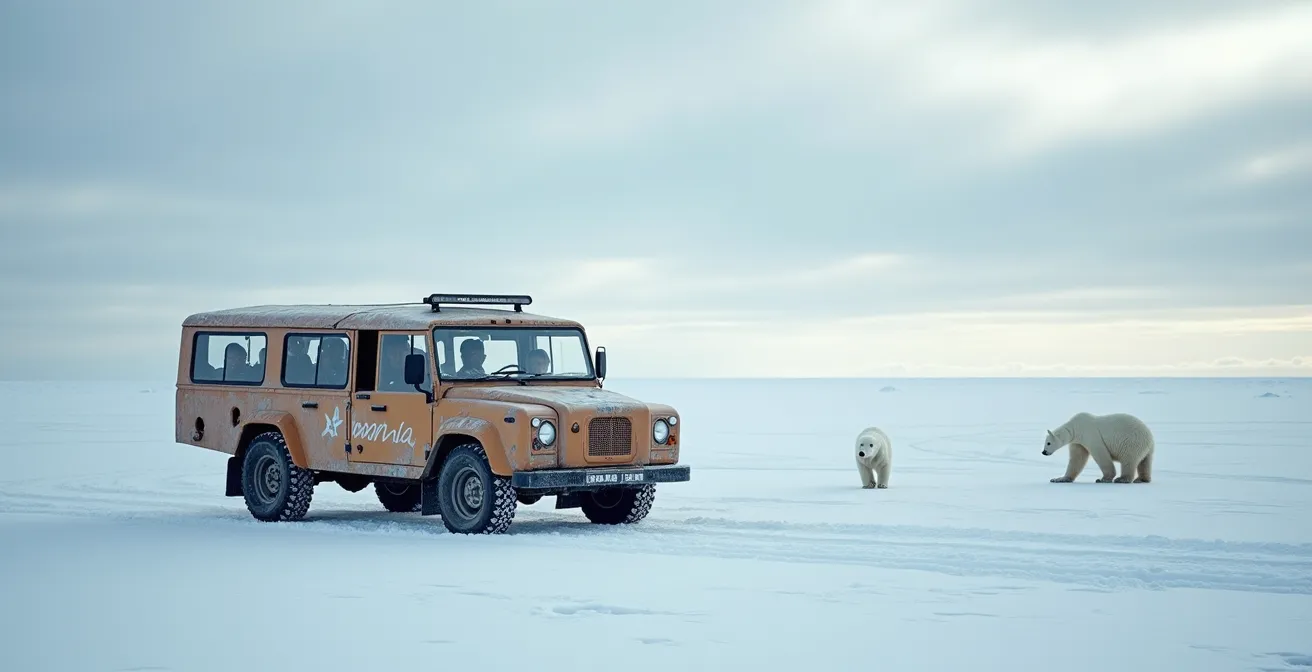
A $5,000 CAD budget for a Churchill polar bear trip is feasible, but only if you abandon the quest for ‘cheap’ and adopt a strategy of smart cost allocation.
- Premium spending on a Tundra Buggy tour is an “experience guarantee,” not a luxury.
- Apparent savings on transport (train) or gear (boots) are often “false economies” that risk your entire investment.
Recommendation: Focus your budget on a high-quality, full-day Tundra Buggy tour in peak season and specialized insurance, then build the rest of your trip around that core investment.
So, you’ve dreamt of seeing polar bears in Churchill, typed it into Google, and your jaw hit the floor. The numbers are daunting, and the immediate question that forms is, “Can this even be done for a reasonable amount?” You’ve likely seen figures that make a $5,000 budget seem like a fantasy. As a specialist in arctic travel, I can tell you that it’s possible, but it requires a fundamental shift in mindset.
Most guides will give you the standard advice: book far in advance, pack warm clothes, and compare tour operators. While true, this advice misses the central challenge of a Churchill expedition. This is not a destination where you find “deals.” Budgeting for Churchill isn’t about cutting costs everywhere; it’s about strategic cost allocation. It’s about understanding where spending a premium is a non-negotiable investment in your experience, and where seemingly smart savings are actually false economies that can jeopardize your entire trip.
The real question isn’t just “Is $5,000 enough?” but rather “How do I intelligently spend $5,000 to guarantee a successful and safe polar bear experience?” This guide is designed to answer that. We will move beyond the sticker shock and break down the real costs, the hidden risks, and the critical decisions you need to make regarding transport, tour types, timing, gear, and insurance to make your dream trip a reality without wasting a single dollar.
To help you navigate these crucial decisions, this article breaks down the key budget components. You’ll find a detailed analysis of each major expense, allowing you to build a realistic financial plan for your Churchill adventure.
Summary: A Practical Guide to Budgeting Your Churchill Polar Bear Expedition
- Train vs Plane: Is the Savings on the Winnipeg-Churchill Train Worth the 48-Hour Journey?
- Tundra Buggy vs Walking Tour: Which is Safer for Close Encounters?
- October or November: When Are Your Chances of Seeing Bears Highest?
- The Footwear Error That Ruins a Tundra Buggy Expedition
- Why Standard Travel Insurance Won’t Cover Your Churchill Cancellation?
- Why February Offers Better Aurora Visibility Than November in Yellowknife?
- How to Photograph Moose Without Provoking a Charge During Rutting Season?
- How to Pack for the Arctic Tundra: The Gear You Cannot Rent?
Train vs Plane: Is the Savings on the Winnipeg-Churchill Train Worth the 48-Hour Journey?
On paper, the choice seems simple. A roundtrip VIA Rail ticket from Winnipeg can be half the price of a flight on Calm Air. For a budget-conscious traveler, saving hundreds of dollars on transport feels like a huge win. However, this is the first and most classic example of a potential false economy in Churchill planning. The 48-hour journey each way isn’t just a time commitment; it’s a financial variable with hidden costs.
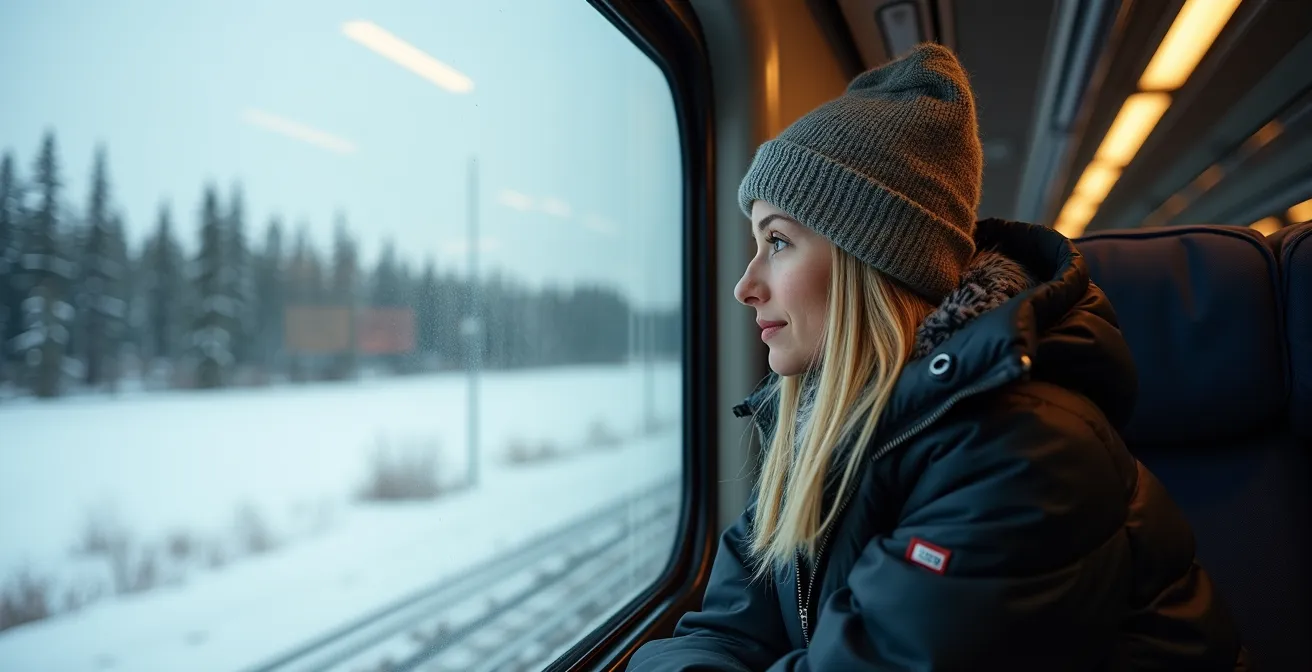
You must factor in the price of meals for two full days on the train. More critically, the northern rail line is notorious for delays, sometimes exceeding 24 hours. If you have non-refundable tours or hotels booked, a single delay can cost you more than the flight would have. For a Canadian professional, the two extra days of travel also represent a significant opportunity cost in lost vacation time. The sleeper car option, which includes meals, can offset some costs but brings the price closer to that of a flight. Ultimately, while the train offers a romantic, scenic journey, the flight provides certainty. For a short, high-stakes trip where every day counts, allocating more of your budget to flying is often the most financially sound decision.
Tundra Buggy vs Walking Tour: Which is Safer for Close Encounters?
Once in Churchill, your single biggest expense will be the tours. You’ll see options ranging from more affordable walking tours to premium, full-day Tundra Buggy expeditions. The price difference is stark, but this is where strategic spending becomes paramount. Your goal is to see polar bears, and the method of viewing directly impacts the probability of success and safety. A walking tour, while intimate, is a ground-level activity that relies heavily on luck and keeps you at a significant distance for safety. The chances of a close, prolonged encounter are relatively low.
The Tundra Buggy, a massive all-terrain vehicle, is designed to safely navigate the tundra and allow for incredibly close encounters. The elevated platform keeps you high above the bears, a safe position from which to observe and photograph them. This is not a luxury; it is an experience guarantee. Paying a premium for at least one full day on a Tundra Buggy is the single best way to ensure your trip’s primary objective is met. According to some analyses, the probability of a close encounter on a buggy is dramatically higher than on foot.
Case Study: The Hybrid Strategy
A smart approach, proven effective by many travelers, is the hybrid model. A couple from Vermont, for example, maximized their sightings and managed costs by booking one premium Tundra Buggy day and supplementing it with more affordable van tours on other days. An analysis of their trip confirms that taking both a van tour AND a tundra buggy tour provided the best overall value. The buggy guaranteed the iconic, close-up bear photos, while the van tours offered different perspectives and covered more ground around the town area.
This strategy allocates the budget where it matters most—the guaranteed close encounter—while using more economical options to round out the experience.
October or November: When Are Your Chances of Seeing Bears Highest?
Timing your Churchill trip is a delicate balance of maximizing bear sightings while managing costs and weather risks. The undisputed peak of polar bear congregation occurs when hundreds of bears gather along the coast of Hudson Bay, waiting for the sea ice to form so they can begin their seal hunt. This prime viewing window is a major factor in your trip’s success.
According to tourism guides and migration pattern data, the highest concentration of bears is found during a very specific period. An analysis of these patterns reveals that late October to early November marks peak activity with hundreds of bears visible on the tundra. This is, without question, the time when your chances of seeing multiple bears are highest. Tour and accommodation prices reflect this, making it the most expensive time to visit.
So, which month is better?
- October: Offers the advantage of more daylight hours for photography, vibrant autumn colors on the tundra, and generally more stable weather. The bear population is building towards its peak.
- Early to Mid-November: This is the absolute peak for bear numbers. However, the weather is more volatile, with a higher risk of blizzards that can cancel tours. Daylight hours are shorter, and the landscape is a stark white.
For a trip on a $5,000 budget, the risk-reward calculation is critical. Booking in late October provides a near-peak experience with a lower risk of costly, weather-related disruptions. If you choose November, it’s wise to budget for an extra buffer day in case of cancellations.
The Footwear Error That Ruins a Tundra Buggy Expedition
Here is the most painful false economy you can make: skimping on footwear. You’ve spent thousands to get to Churchill and secure a spot on a Tundra Buggy. You’re out on the tundra, and a majestic polar bear approaches the vehicle. Everyone rushes to the outdoor viewing platform for an unobstructed, eye-level view. Everyone except you. You’re stuck inside, shivering, because the cold has become unbearable, and your feet feel like blocks of ice. You are reduced to watching the experience of a lifetime through a frosty window.
A visitor reported that inadequate boots meant missing the outdoor viewing platform opportunities during their $630 CAD Tundra Buggy tour, essentially reducing their premium experience to watching bears through windows. The static cold inside the vehicle was manageable, but the outdoor platform was impossible without proper -40°C rated boots.
This happens all the time. The critical mistake is buying boots rated for active use (like hiking or skiing) when you will be sitting or standing still for hours on a metal platform in Arctic winds. You need boots rated for static cold. Investing $300-$500 CAD in proper Arctic-rated boots from a Canadian brand like Baffin or Sorel isn’t a luxury; it’s insurance for the thousands you’ve already spent.
Your Arctic Footwear Audit Checklist
- Assess Rating: Do your boots have a static cold rating of at least -40°C, not just an “active use” rating?
- Check the Fit: Have you sized up 1-2 sizes from your normal shoe size to accommodate a thick sock system and ensure good blood circulation?
- Build the System: Do you have a proper sock layering system, including a thin moisture-wicking liner sock and a thick, high-quality wool or synthetic insulating sock?
- Test for Stillness: Have you tested the full boot-and-sock system by sitting still in the coldest conditions you can find for at least an hour to check for cold spots?
- Plan for Rentals: If purchasing is not feasible, have you researched and pre-booked boot rentals in Churchill to ensure your size is available?
Why Standard Travel Insurance Won’t Cover Your Churchill Cancellation?
After allocating funds for flights, tours, and gear, the final line item that many travelers question is insurance. “I already have travel insurance through my credit card or an annual plan. Why do I need more?” This assumption can be a catastrophic financial error. A trip to Churchill is not a standard vacation; it’s an expedition to a remote, subarctic region, and most basic insurance policies are simply not designed for its unique risks.

Standard policies often contain exclusion clauses for trip cancellations or interruptions caused by “adverse weather events in known high-risk locations.” A November blizzard in Churchill is a known risk, not an unforeseen event. Furthermore, “adventure activities” are frequently excluded, and some underwriters may classify a Tundra Buggy tour as such. Mechanical failure of specialized vehicles or train delays on the remote northern line are other common risks that are rarely covered. You must purchase a specialized expedition or remote travel insurance policy. This will add an estimated $150-$250 CAD to your budget but provides critical coverage. Key elements to verify before purchasing include:
- Remote Evacuation: Coverage for emergency medical evacuation from Churchill, where the nearest major hospital is over 1,000 km away in Winnipeg.
- Weather & Transport Delays: Specific confirmation that cancellations due to blizzards, flight issues with Calm Air, or VIA Rail delays are covered.
- Activity Coverage: Written confirmation that “polar bear viewing tours” are not excluded.
Why February Offers Better Aurora Visibility Than November in Yellowknife?
While Yellowknife is globally renowned as a top destination for the Aurora Borealis, many travelers are surprised to learn that Churchill is also a fantastic location for viewing the northern lights. The question of timing—whether February’s cold, clear skies are better than November’s stormy disposition in a place like Yellowknife—raises an interesting point for the budget-conscious Churchill traveler: considering an off-peak trip.
“Churchill is also known as a beluga whale watching hotspot and one of the best places to see the northern lights.”
– Travel Manitoba Tourism Board, Polar Bear Viewing Guide
While the main polar bear season is in autumn, a trip in late winter offers a completely different, and often more affordable, Arctic experience. A visit in February or March presents a unique opportunity to witness something truly special: polar bear cubs emerging from their dens. This alternative trip combines two incredible phenomena: the aurora and new life. The longer, darker nights of late winter, coupled with typically clearer and more stable weather than in November, create excellent conditions for aurora viewing. At the same time, this is when mothers and their “cubs of the year” (COYs) take their first steps into the world, a spectacle arguably as moving as the autumn gathering.
For a wildlife enthusiast on a tight budget, this late-winter option can be a brilliant strategic choice. Tour and accommodation costs are dramatically lower than during the November peak, allowing a $5,000 budget to stretch much further. You trade the sheer quantity of the autumn bear migration for the unique quality of seeing cubs and the increased likelihood of witnessing spectacular northern lights displays.
How to Photograph Moose Without Provoking a Charge During Rutting Season?
While your primary target in Churchill is the polar bear, the safety principles of wildlife photography are universal. The respect and distance required to safely photograph a bull moose during its rutting season are directly transferable to observing a 600 kg polar bear. The cardinal rules are always the same: never surprise the animal, understand its behaviour, maintain a safe distance, and use the right equipment to close that distance optically, not physically. For Churchill, this means leveraging the safety of your tour vehicle and making smart equipment choices.
Photography on the tundra presents a unique financial and logistical puzzle. Do you rent or buy a telephoto lens? A 400mm+ lens is essential for frame-filling shots, but purchasing one represents a significant investment. Renting in Winnipeg is an option, but availability can be limited. The decision is a core part of your budget allocation.
The following table breaks down the equipment decision, a crucial consideration for any photographer planning a trip to Churchill.
| Option | Cost | Pros | Cons |
|---|---|---|---|
| Rent 400mm+ lens | $200-400 CAD/week | No travel risk, latest equipment | Availability in Winnipeg limited |
| Buy telephoto lens | $2000-8000 CAD | Long-term investment, familiar gear | High upfront cost, travel insurance needed |
| Photo-specific tour | Premium +30% over standard | Optimal positioning, patient group | Higher tour cost |
Beyond equipment, proper etiquette on the Tundra Buggy is crucial for everyone’s success. Your actions directly impact the wildlife and the experience of others. Always remember to maintain silence when bears are near, never use a flash, and be mindful of sharing window space. The best shot is a respectful one.
Key takeaways
- Prioritize spending on a Tundra Buggy tour and specialized insurance; these are experience guarantees, not luxuries.
- Beware of false economies: cheap boots or saving time with the train can cost you the entire experience.
- Optimal timing is a trade-off between peak bear density in November and more stable weather and light in October.
How to Pack for the Arctic Tundra: The Gear You Cannot Rent?
While you can rent major items like parkas and boots in Churchill, a successful and comfortable trip depends on the personal items you bring from home—the gear that simply cannot be rented or bought locally. Forgetting one of these can range from a minor inconvenience to a trip-ruining disaster. Your packing strategy should focus on redundancy and managing the cold’s effect on you and your equipment.
A photographer shared that their camera battery lasted only 20 minutes in -30°C conditions versus 3 hours at room temperature. They recommend bringing at least 4 spare batteries for a full day Tundra Buggy tour and keeping spares warm inside jacket pockets. Power banks should be rated for sub-zero operation as standard models fail in Arctic conditions.
The extreme cold drains batteries at an alarming rate. This applies to your camera, your phone, and any essential power banks. Another critical consideration is medication. With the high potential for weather delays, you should always pack at least double the quantity of any prescription medication in your carry-on luggage. The same goes for prescription eyeglasses; fogging and freezing are constant issues, so bringing a backup pair and anti-fog wipes is essential. It’s about anticipating points of failure. What are the absolute essentials you must pack yourself?
- Extra Batteries and Power Banks: Cold can reduce battery life by over 75%. Bring multiple spares and keep them warm in an internal pocket close to your body.
- Prescription Medications: Pack at least twice the amount you’ll need for your planned trip duration to account for potential multi-day delays.
- Prescription Glasses/Sunglasses: Bring a backup pair. A broken or lost pair of glasses can render you unable to fully experience the trip.
- First-Aid Supplies: While guides have kits, your personal kit with blister treatment (for breaking in new boots), pain relievers, and any personal necessities is vital.
- Mental Preparation: Wildlife viewing involves waiting. Bring books, podcasts, or music for the slow moments to manage expectations and enjoy the entire process.
Ultimately, a successful $5,000 trip to Churchill is an exercise in strategic thinking. By investing in the core components that guarantee your experience—the right tour, the right timing, and the right gear—you transform a daunting expense into a manageable and unforgettable Arctic expedition.
Frequently Asked Questions on a Churchill Polar Bear Trip
Why do polar bears gather in Churchill during October-November?
Bears congregate along Hudson Bay’s shoreline waiting for the annual freeze-up to begin their seal-hunting season. The approaching freeze-up prompts this gathering behavior.
Is weather risk higher in November than October?
Yes, November brings increased blizzard risk and potential tour cancellations. Budget an extra buffer day and approximately $300 CAD for additional lodging/food if choosing November.
What advantages does October offer beyond bear viewing?
October provides vibrant autumn tundra colors, more daylight hours for photography, potential migratory bird sightings, and generally more stable weather conditions than November.