
The $200 price on a guided tour isn’t a guarantee of quality; it’s a claim of value that demands scrutiny.
- Genuine value lies in verifiable elements like elite guide certifications (ACMG), exclusive access that bypasses public queues (like the Lake Louise shuttle), and strict adherence to ethical wildlife laws.
- Hidden costs and risks are buried in cancellation policies and booking channel commissions, which can inflate the price without adding to your experience.
Recommendation: Don’t just book a tour—audit it. Use the frameworks in this guide to dissect the price and confirm you are paying for tangible expertise and access, not just convenience.
You’re standing in a bustling visitor center in Banff or a windswept harbour in St. John’s, faced with a decision. A glossy brochure advertises a half-day guided tour for a steep $200. A nagging question surfaces: is this a tourist trap or the key to an unforgettable experience? For the budget-conscious traveler, this moment is a critical crossroads between a priceless memory and a costly mistake. The common advice is to check reviews or accept that tours “save you time,” but this superficial guidance fails to address the core issue. It treats the price tag as a single, opaque number.
But what if the key wasn’t simply to decide if it’s “worth it,” but to perform a forensic audit on that $200 figure? The true value of a premium tour isn’t in the convenience you can see, but in the hidden assets you must verify. These include a guide’s life-saving certifications, the operator’s legal right to access restricted areas, the ethics embedded in their wildlife viewing practices, and the risk you offload through their insurance and cancellation policies. Most travelers don’t know how to look for these things, and so they either overpay for a mediocre experience or miss out on a truly valuable one.
This guide changes that. We will dissect the $200 price tag piece by piece, transforming you from a passive tourist into an informed auditor. We’ll explore how to verify a guide’s credentials, understand the real cost of booking through an agency, decode deceptive cancellation clauses, and recognize the immense value of ethical, rule-bound access to nature. By the end, you won’t just be choosing a tour; you’ll be making a calculated investment in a superior travel experience.
This article breaks down the essential checkpoints for auditing a tour’s value before you commit your travel budget. The following sections provide a clear framework, from guide certifications to the fine print in cancellation policies, ensuring your money is well spent.
Summary: An Auditor’s Checklist for Valuing a $200 Canadian Tour
- ACMG or IGA: Which Guide Certification Ensures Your Safety in the Mountains?
- How Much Should You Tip a Tour Guide in Canada: 10%, 20%, or Flat Rate?
- Small Group vs Private Tour: Which Offers Better Wildlife Sightings?
- The Cancellation Clause That Costs You 100% of Your Deposit?
- Direct Operator vs Agency: How to Save 15% on Your Excursion Booking?
- How to Get a Refund if the Icebergs Drift South of St. John’s?
- How to Book the Lake Louise Shuttle Without Waking Up at 3 AM?
- How to Kayak Near Orcas Without Violating the 400-Meter Distance Rule?
ACMG or IGA: Which Guide Certification Ensures Your Safety in the Mountains?
The single most important component of a high-priced tour is the guide’s expertise, and in Canada’s mountains, not all certifications are created equal. The first step in your audit is to look past a friendly smile and verify their credentials. You’re primarily looking for one of two acronyms: ACMG (Association of Canadian Mountain Guides) or IGA (Interpretive Guides Association). While both provide training, they serve vastly different purposes. An IGA guide is an educator, trained to interpret the natural and cultural history of front-country trails. They are perfect for an educational nature walk.
However, if your tour involves technical, high-risk terrain—like glacier travel, rock climbing, or backcountry skiing—an ACMG certification is non-negotiable. This is the gold standard, requiring years of rigorous training and examinations in multiple disciplines. Within the ACMG, the pinnacle is the full Mountain Guide certification. It is the only credential that is internationally recognized by the 25 other member countries of the IFMGA (International Federation of Mountain Guide Associations). This means you’re paying for a level of skill and safety judgment that is globally vetted and respected. Paying $200 for a guide without the appropriate certification for the terrain is paying a premium for unacceptable risk.
The table below breaks down the fundamental differences in what you’re paying for with each certification, as detailed in reports from leading training bodies like Yamnuska Mountain Adventures.
| Certification | Terrain Type | Activities Covered | Training Requirements |
|---|---|---|---|
| ACMG Mountain Guide | Technical, high-risk terrain | Glacier travel, rock climbing, backcountry skiing | Rock, Alpine, and Ski streams completion |
| ACMG Apprentice Guide | Supervised technical terrain | Rock or Ski specialization | CAA Level 1, extensive personal experience |
| IGA Guide | Non-technical terrain | Educational hikes, nature walks | Interpretive training focused on education |
How Much Should You Tip a Tour Guide in Canada: 10%, 20%, or Flat Rate?
Once you’ve confirmed your guide has the right credentials, the next financial question is tipping. In Canada, gratuities for service are customary, and tour guides are no exception. For a budget-conscious traveler, this can feel like an ambiguous and stressful add-on to an already expensive tour. However, there are established norms that can guide your decision. The industry benchmark for good service is not a flat rate, but a percentage of the tour’s cost. For most satisfactory to great experiences, the standard tip for tour guides in Canada and the US is 15% to 20% of the pre-tax price.
Think of it as a value-based sliding scale. A 10% tip is appropriate for a standard tour that met expectations but didn’t necessarily wow you. A 15% tip is the sweet spot for a great tour where the guide was knowledgeable, engaging, and professional. You should reserve a 20% tip for an exceptional experience where the guide went significantly above and beyond—perhaps by finding a rare wildlife sighting, expertly managing a difficult situation, or providing a level of personal insight that transformed the trip. For shorter group tours, a flat rate of $5-$10 per person can be acceptable, but for a premium $200 tour, the percentage model is a more accurate reflection of the service’s value.
A crucial piece of local Canadian etiquette can save you a few dollars. As experts at Authentik Canada explain in their tipping guide, this calculation should be based on the price before taxes like GST/HST are added. As they note:
In Canada, tipping is calculated on the pre-tax amount (before GST/HST)
– Authentik Canada, Guide to Tipping in Canada
This small detail is a hallmark of a savvy traveler. Budgeting for a 15% tip on top of the $200 sticker price ensures you are prepared to properly thank a guide who delivers the value you paid for, without being caught off guard at the end of your excursion.
Small Group vs Private Tour: Which Offers Better Wildlife Sightings?
The structure of a tour dramatically impacts its quality, especially when wildlife is the main attraction. Many operators charge a premium for “small group” tours, and this is often a justified expense. A smaller group—typically under 12 people—is quieter, less disruptive to the environment, and inherently more flexible. A guide leading a minivan can make spontaneous stops for a moose on the roadside or wait an extra 15 minutes for a bear to emerge from the forest, a logistical impossibility for a 50-person coach bus on a rigid schedule.
This flexibility directly translates to better and more intimate wildlife sightings. As tour operators in the Canadian Rockies often highlight, a small group allows the guide to adapt to the unpredictable nature of wildlife. If whales are particularly active, they can extend time on the water; if the weather turns, they can quickly pivot to a sheltered cove. This adaptability is a core part of the value you are paying for. Furthermore, a small setting fosters a personal connection, allowing the guide to share detailed stories and answer individual questions, transforming a simple viewing into an educational experience.
This scene captures the essence of a high-value, small-group tour: a respectful distance, an intimate setting, and a focus on the animal’s natural behavior, free from the crowds of mass tourism.
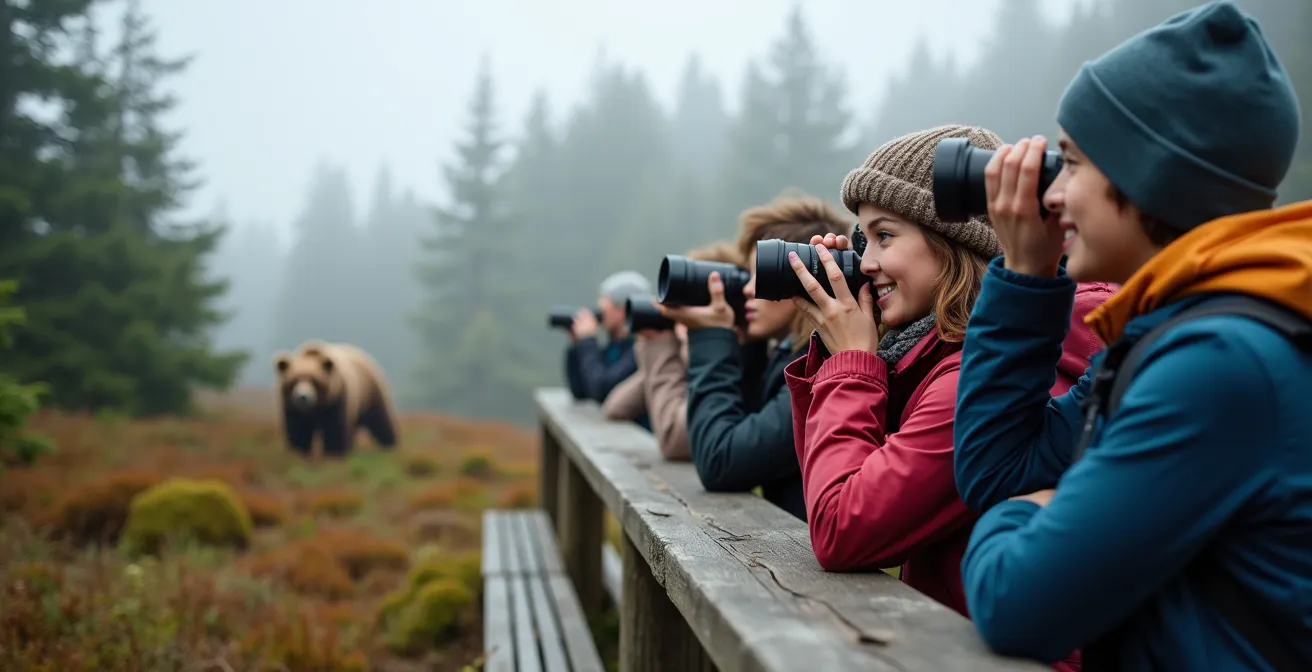
A private tour takes this a step further, offering maximum flexibility and customization, but at a significantly higher cost. For most travelers, a well-run small group tour offers the best balance of value and opportunity. When auditing a $200 tour, ask about the maximum group size. If the operator cannot guarantee a small number, you should question what their premium price is actually paying for.
The Cancellation Clause That Costs You 100% of Your Deposit?
The most overlooked part of any tour booking is the fine print in the cancellation policy, yet it can be the most costly. Yes, it is absolutely possible for a cancellation to cost you 100% of your money, especially with premium tours. The value you are auditing here is flexibility and risk mitigation. A standard, low-cost tour booked on an aggregator site might offer a full refund up to 24 hours in advance. However, a specialized $200 tour often involves higher upfront costs for the operator—such as non-refundable permits, guide reservations, and equipment rentals—leading to stricter policies.
You will often encounter a tiered cancellation policy. This is a common and fair practice, but you must understand its terms. A typical structure might look like this: cancel 60+ days before the tour for a 90% refund; 30-59 days for a 50% refund; and less than 30 days for no refund at all. The closer you get to the date, the less likely the operator is to fill your spot, hence the higher penalty. Before paying, you must find this policy and ask yourself if the risk level aligns with your travel plans.
The most critical element to watch for are the exclusions. Most standard cancellation policies do not cover “Acts of God.” In the context of Canadian travel, this is a major concern. Think of the widespread wildfire smoke in British Columbia and Alberta that can lead to hazardous air quality or the unpredictable Atlantic weather that can ground boat tours in Newfoundland. If your tour is cancelled for these reasons, you may not be entitled to a refund from the operator. This is where travel insurance becomes an essential part of your cost-benefit analysis. For a $200 tour, a comprehensive insurance policy that specifically covers cancellations due to unforeseen weather or environmental events is not a luxury; it’s a necessary protection for your investment.
Direct Operator vs Agency: How to Save 15% on Your Excursion Booking?
Where you book your tour has a direct impact on its cost and the value you receive. In your audit of the $200 price tag, you must determine who you are paying: the person running the tour (the direct operator), a local company that packages tours (a Canadian agency), or a global website that lists thousands of options (an international aggregator). Booking directly with the local tour operator is almost always the cheapest way, often saving you the 10-20% commission that agencies and aggregators add on top.
However, the lowest price isn’t always the best value. Agencies and aggregators can provide significant benefits. An international aggregator like GetYourGuide or Viator offers a vast selection, user reviews, and instant booking convenience, making comparison shopping easy. A Canadian travel agency offers a higher level of service, often vetting operators for quality and safety, bundling multi-day itineraries, and providing leverage if something goes wrong. This peace of mind can be worth the 10-15% commission, especially for complex or multi-day trips.
The key is to match your booking method to your needs. For a straightforward, single-day excursion like a whale-watching trip, booking direct is a smart way to save money. For a more complex backcountry trip requiring logistics and multiple components, an agency might be a wise investment. The following table illustrates where your money goes and what you get in return.
| Booking Type | Best For | Typical Cost | Advantages |
|---|---|---|---|
| Direct Operator | Single-day tours, local experiences | Base price (save 10-15%) | Lower cost, direct communication, local expertise |
| Canadian Agency | Multi-day itineraries, complex logistics | Base + 10-15% commission | Package deals, rebooking leverage, vetted operators, peace of mind |
| International Aggregator | Quick comparison shopping | Base + 15-20% markup | Wide selection, user reviews, instant booking |
How to Get a Refund if the Icebergs Drift South of St. John’s?
Nature-based tours, like iceberg hunting in Newfoundland, come with an inherent uncertainty: nature itself is unpredictable. A common question from travelers is what happens if the main attraction doesn’t show up. The hard truth, as any seasoned Newfoundland tourism expert will tell you, is that you are not guaranteed a refund. The operator’s value proposition is not the sighting itself, but the professional effort to find it.
You are paying for the boat journey, the captain’s time, and the guide’s expertise in searching for icebergs, not a guarantee of a sighting
– Newfoundland Tourism Expert, Setting Realistic Expectations for Nature Tours
This is where the $200 price tag of a premium operator proves its worth. A cheap boat ride will take you out and bring you back, and if there are no icebergs, you’re out of luck. A high-value operator, however, justifies their cost through superior technology and a robust Plan B. These top-tier companies invest in access to Canadian Ice Service satellite maps and maintain networks with local fishers to get real-time iceberg location data, maximizing your chances of a sighting. Their guides are expert storytellers who can enrich the journey with tales of Newfoundland’s fishing history and coastal geology.
Most importantly, they have a seamless pivot strategy. When icebergs are scarce, a premium tour doesn’t just end in disappointment. The captain will skillfully transition the excursion into an equally compelling wildlife tour. They might head to the Witless Bay Ecological Reserve to see puffin colonies, search for humpback whales that frequent the same cold waters, or conduct an impromptu coastal geology tour. You are paying for a guaranteed quality experience, even if the specific attraction is unavailable. When auditing the tour, ask directly: “What is the plan if we don’t find any icebergs?” A confident, detailed answer is the sign of a truly premium operator.
How to Book the Lake Louise Shuttle Without Waking Up at 3 AM?
Sometimes, the value of a $200 tour isn’t about expertise or ethics, but about pure, unadulterated access. In Banff National Park, visiting the iconic Moraine Lake and Lake Louise has become a logistical nightmare for independent travelers. The public shuttle service run by Parks Canada sells out instantly, often requiring people to be online at dawn, weeks in advance, to secure a spot. This is a classic case of “access arbitrage,” where guided tours offer a solution to a problem they didn’t create.
Premium tour operators justify their price by completely bypassing this frustrating public system. They hold a special Moraine Lake Road Licence of Occupation or have agreements with Parks Canada that grant them guaranteed access. When you book a tour, you are not just paying for a guide; you are paying to avoid the 3 AM alarm and the frantic scramble for shuttle tickets. You are buying certainty and ease. Instead of a crowded public bus, you travel in a comfortable van or minibus, often with added perks like a knowledgeable guide and curated stops at less-crowded viewpoints.
Imagine the ease of boarding a comfortable, pre-booked tour bus in the calm of the early morning, bypassing the stress entirely. This convenience is a tangible, high-demand commodity.
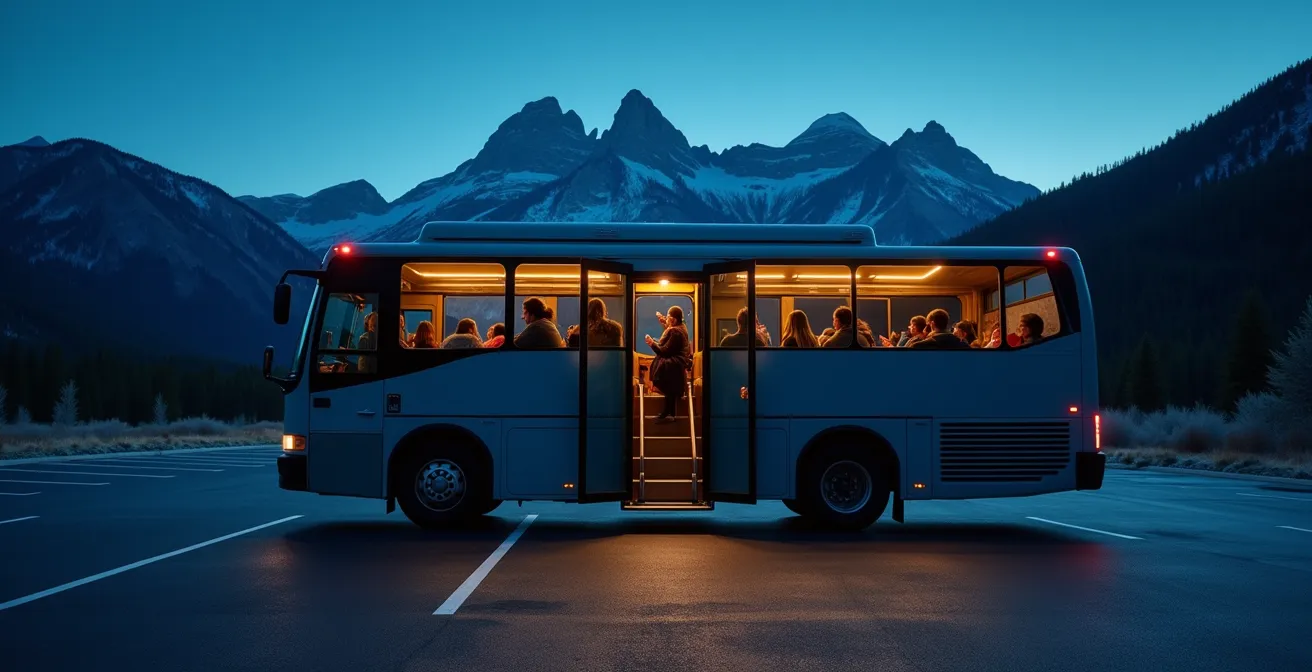
If the public shuttle seems impossible to book, a guided tour becomes one of the most practical solutions. Here are several alternative methods that a premium tour might leverage, all of which bypass the main public booking system:
- Booking with licensed commercial operators who have privileged road access.
- Utilizing the Roam Transit system with a reservable Super Pass for guaranteed seats.
- Joining specialized sunrise hiking or e-bike tours that include transportation as part of the package.
- Choosing a package that combines the tour with a stay at a nearby lodge with its own private shuttle service.
Key Takeaways
- Verify Guide Credentials: The highest value is in safety; for mountain terrain, an ACMG certification is the non-negotiable gold standard.
- Analyze the Booking Channel: Booking direct with an operator is often 10-15% cheaper, but agencies can offer valuable security and vetting for complex trips.
- Audit the Fine Print: Scrutinize cancellation policies for “Act of God” clauses (like wildfire smoke) and confirm you are covered by travel insurance.
How to Kayak Near Orcas Without Violating the 400-Meter Distance Rule?
The final, and perhaps most important, piece of the value puzzle is ethics. When participating in wildlife tours, especially with sensitive species like orcas in British Columbia, you are paying a premium for an operator who respects the law and the animals’ well-being. Ignorance is no excuse, and budget operators who flaunt the rules not only endanger the wildlife but also put you at risk of fines. In Canada, the rules are clear: Canada’s Fisheries Act mandates a minimum distance of 400 meters from all killer whales in B.C. and the Pacific Ocean.
A $200+ tour price often reflects an operator’s deep commitment to this regulation. They invest in high-quality binoculars and telephoto lenses so you can get a spectacular view from a safe, legal distance. More importantly, their guides are experts in animal behavior. They understand currents, pod movements, and feeding patterns. This allows them to position the group not in pursuit of the animals, but in their likely path, creating an ethical “pass-by” encounter. As the Pacific Whale Watch Association emphasizes, this responsible approach is the hallmark of a professional.
The value of a $200+ tour is a guide who respects this law implicitly. They use high-quality binoculars and expert knowledge of currents and pod behavior to position the group for ethical ‘pass-bys’—where the whales approach on their own terms, not the other way around
– Pacific Whale Watch Association, Ethical Wildlife Viewing Guidelines
Paying for an ethical tour is an investment in sustainable tourism. It ensures the animals you’ve traveled so far to see will still be there for future generations. Choosing an operator who prioritizes ethics is a fundamental part of being a responsible traveler, and finding them requires a bit of due diligence.
Action Plan: Vet Your Tour Operator
- Check for Local Roots: Look for a local Canadian address and phone number on the website, not just a generic contact form. True operators are based in the community.
- Review the ‘About Us’ Page: Do they provide detailed guide biographies with certifications and experience? A quality operator is proud of their team’s expertise.
- Verify Permits and Affiliations: Search for proof of official permits from bodies like Parks Canada or membership in local tourism associations. This shows they are a legitimate, accountable business.
- Analyze Their Specialization: Does the company specialize in a specific region and activity (e.g., “kayaking in Johnstone Strait”) or do they offer generic tours in hundreds of cities? Specialization indicates deep expertise.
- Assess Their Content: Look for a blog or social media presence with original, local content and insider tips. This demonstrates a genuine passion and connection to their area.
Armed with this auditing framework, you are no longer a passive consumer but an empowered traveler. The next time you face a $200 price tag, you can confidently dissect its components—from guide certification to ethical commitments—and make a decision that guarantees every dollar spent is a direct investment in a safe, exclusive, and genuinely valuable experience.