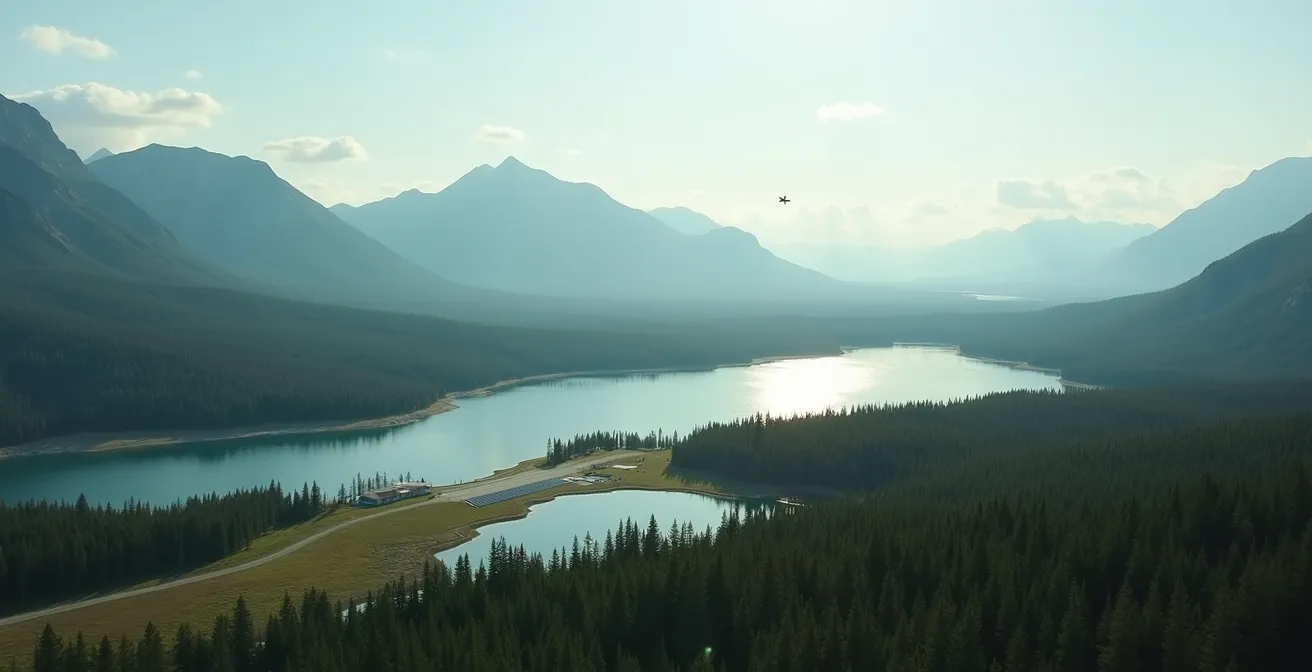
The guilt of flying across Canada can be transformed into a powerful force for good by shifting your focus from simply offsetting carbon to actively contributing to on-the-ground conservation.
- Your actions—from cleaning your hiking boots to choosing the right certified hotel—have a direct and measurable impact on protecting Canada’s unique biodiversity.
- Engaging with citizen science and supporting Indigenous-led conservation initiatives makes you a partner, not just a tourist.
Recommendation: On your next trip, prioritize one tangible action from this guide, such as participating in a citizen science project or donating to a specific park’s ‘Friends’ organization, to make your travel a net positive for Canada.
The sheer scale of Canada is both its greatest allure and a source of deep conflict for the environmentally conscious traveler. You want to explore the rugged coasts of Newfoundland and the majestic Rockies of Alberta, but the long flights required to traverse this vast nation come with a heavy carbon footprint and a side of eco-guilt. The common advice—pack light, buy carbon offsets—feels like a small bandage on a large wound. It addresses the symptom, but not the core desire to make a real, positive difference.
While these tips have their place, they often overlook the immense potential for impact you have once your plane has landed. What if the true power to counteract your travel footprint isn’t just about mitigation, but about active, on-the-ground stewardship? What if your trip could become a direct investment in the biodiversity and ecological integrity of the very places you’ve come to admire? This is the shift from a mindset of “doing less harm” to one of “creating tangible good.”
This guide moves beyond the platitudes of carbon offsetting. It provides a framework for transforming your journey into an act of conservation. We will explore how your park fees are utilized, how to make sustainable choices in remote areas, and how simple, informed actions can protect vulnerable ecosystems. By the end, you will have an actionable plan to travel not just as a visitor, but as a valued partner in protecting Canada’s natural heritage.
To navigate this approach, this article breaks down the essential actions and knowledge you need. The following sections provide a clear roadmap for making your Canadian travels a force for conservation, from understanding the systems in place to your personal role within them.
Summary: A Guide to Impactful Travel in Canada
- Where Does Your Park Entry Fee Go: Conservation or Administration?
- How to Travel Plastic-Free in Rural Areas With Limited Recycling?
- Why You Should Slow Down in Marked Wildlife Zones Even if You See Nothing?
- Green Key Global vs Green Globe: Which Certification Actually Matters in Canada?
- The Campfire Mistake: Why Burning Food Scraps Harms the Ecosystem?
- The Boot Cleaning Mistake: How Hikers Spread Invasive Seeds Between Provinces?
- The Bear Safety Error That Could Cost You a $25,000 Fine in National Parks
- How to Travel in Canada While Actively Contributing to Biodiversity Protection?
Where Does Your Park Entry Fee Go: Conservation or Administration?
It’s a fair question every visitor asks when paying at the gate: is this fee truly funding conservation, or just keeping the lights on? The good news is that a significant portion directly supports the protection of Canada’s natural and cultural heritage. Your contribution is not just a simple access charge; it’s an initial investment in the system of stewardship. For instance, Parks Canada’s recent plans detail substantial commitments to on-the-ground work.
To be specific, this isn’t just a vague promise. The agency actively allocates funds to critical projects. In a recent departmental report, it was confirmed that Parks Canada invested $23 million in 56 conservation projects aimed at improving ecological integrity across the country. These projects range from habitat restoration for species at risk to monitoring ecosystem health in the face of climate change. Your entry fee is a foundational part of this funding model.
However, for the traveler wanting to make a deeper impact, the entry fee is just the beginning. True conservation agency comes from understanding and supporting the system more directly. Government budgets have limits, and many targeted projects rely on additional support. This is where you can move from a passive visitor to an active contributor, directly funding initiatives that protect specific ecosystems you care about.
This shift in perspective is the first step towards transforming your travel guilt into positive action. By seeing your fee as the start, not the end, of your contribution, you open the door to more meaningful engagement with Canadian conservation efforts.
How to Travel Plastic-Free in Rural Areas With Limited Recycling?
One of the biggest challenges for a sustainable traveler in Canada is navigating the vast rural and remote areas where recycling infrastructure is often limited or non-existent. While you may have a perfect zero-waste system in a major city, small towns in the Prairies or outport communities in Newfoundland present a different reality. The key is shifting from a reliance on local disposal systems to a strategy of self-sufficient waste management.
This approach requires preparation and a dedicated travel kit. The David Suzuki Foundation’s work on sustainable travel highlights practical strategies for this exact scenario. They emphasize researching the locations of stores like Bulk Barn, which are found even in smaller Canadian towns and allow for package-free snack purchases. Furthermore, bringing your own reusable containers for restaurant leftovers is critical in areas where Styrofoam is still the norm. The goal is to refuse single-use plastics at the source.

As the image above suggests, a well-prepared kit is your best tool. This includes a reusable water bottle, solid toiletry bars to eliminate plastic bottles, and collapsible containers. But the most crucial strategy, as advocated by sustainability experts, is “Pack It In, Pack It Out… Further.” This means you should be prepared to carry any non-recyclable or hard-to-recycle items with you until you reach a major urban centre with proper disposal facilities. This act of hyper-local responsibility ensures your travel convenience doesn’t become a remote community’s long-term waste problem.
By adopting this mindset, you take full ownership of your consumption footprint, ensuring that your visit leaves nothing behind but positive memories and economic benefit for the local community.
Why You Should Slow Down in Marked Wildlife Zones Even if You See Nothing?
It’s tempting to maintain your speed in a designated wildlife zone when the forest on either side of the highway appears empty. The common assumption is that these zones are solely about preventing collisions. While that’s a factor, the more profound reason to slow down is to mitigate the invisible stress your vehicle imposes on the ecosystem. The primary threat is not always impact, but noise.
Research on Canadian wildlife shows that vehicle noise creates an ‘Acoustic Shadow’—a bubble of sound that disrupts natural behaviours far beyond the roadside. This noise can mask the sounds of predators or prey, interfering with hunting, and disrupt communication during sensitive breeding seasons. For many shy species, the constant roar of traffic effectively shrinks their usable habitat, pushing them away from critical resources near roadways even if they are physically safe from collision.
The success of wildlife mitigation strategies in Canada proves these zones are based on predictable animal behaviour. The world-renowned wildlife overpasses and underpasses in Banff National Park are a prime example. These structures, combined with fencing and reduced speed zones, have been demonstrably successful in reducing road mortality for numerous species, including grizzly bears and wolves. They prove that animals *do* use these corridors and that human behaviour, like speed, directly impacts their survival.
Slowing down is an act of respect for the unseen life of the forest. It’s a small sacrifice of time that pays significant dividends for the ecological integrity of the park, ensuring that animals can feed, breed, and move without the chronic stress induced by your presence. It’s a simple action that makes you a guardian of the wilderness, not just a passenger passing through it.
Green Key Global vs Green Globe: Which Certification Actually Matters in Canada?
For the conscious traveler, choosing a “green” hotel can feel like navigating a hall of mirrors. With numerous certifications available, how do you know which label represents a genuine commitment to sustainability versus mere greenwashing? In Canada, understanding the origin and focus of the certification is key to making an impactful choice.
Not all certifications are created equal, especially within the Canadian context. While international labels like Green Globe have a presence, they may not be as finely tuned to Canadian regulations and environmental priorities. This is where a Canadian-born system offers a distinct advantage. As AHLA President & CEO Chip Rogers notes regarding a key partnership, ” Green Key Global provides important third-party validation for hotels’ sustainability efforts.” This highlights the industry’s trust in a program tailored to the local landscape.
The following table breaks down the key players in the Canadian sustainable hospitality scene, revealing why local and specific certifications often carry more weight.
| Certification | Canadian Presence | Key Features | Verification Method |
|---|---|---|---|
| Green Key Global | Canadian-born (1994), managed by Hotel Association of Canada | Aligned with UN’s 17 SDGs, tailored to Canadian regulations | Self-assessment with 20% annual inspections |
| Green Globe | International presence, less Canada-specific | 44 core criteria, 380+ compliance indicators | Independent on-site audit every 2 years |
| Biosphere Sustainable | Adopted by regions like Thompson Okanagan, BC | Regional focus, community integration | Third-party verification |
| ITAC Standards | Indigenous Tourism Association of Canada | Holistic evaluation: environmental, cultural, community impact | Indigenous-led assessment |
For a traveler in Canada, prioritizing hotels certified by Green Key Global offers assurance that the standards are relevant to the country’s environmental laws and goals. Even more impactful is choosing operators certified by the Indigenous Tourism Association of Canada (ITAC), as their holistic standards ensure that your stay supports not only environmental sustainability but also cultural preservation and community well-being. This is a clear example of making a systemic contribution with your travel dollars.
The Campfire Mistake: Why Burning Food Scraps Harms the Ecosystem?
After a long day of hiking, it seems practical to toss your apple core and leftover pasta into the campfire. It feels cleaner than packing out sticky garbage, and the common myth is that it “all returns to nature.” However, this seemingly harmless act is a critical mistake that can have cascading negative effects on the local ecosystem and wildlife.
The primary danger is the creation of an ‘Olfactory Trap’. Even when food is burned, it releases powerful, lingering scents that human noses might not detect but which act as a powerful attractant for wildlife, especially bears. A bear drawn to a campsite by the smell of a previous night’s burnt dinner is more likely to become habituated to humans and seek food from future campers, creating a dangerous cycle that often ends with the animal’s relocation or destruction. Furthermore, burning anything other than clean firewood can release harmful chemicals into the soil and air, violating the very principles of leaving no trace.
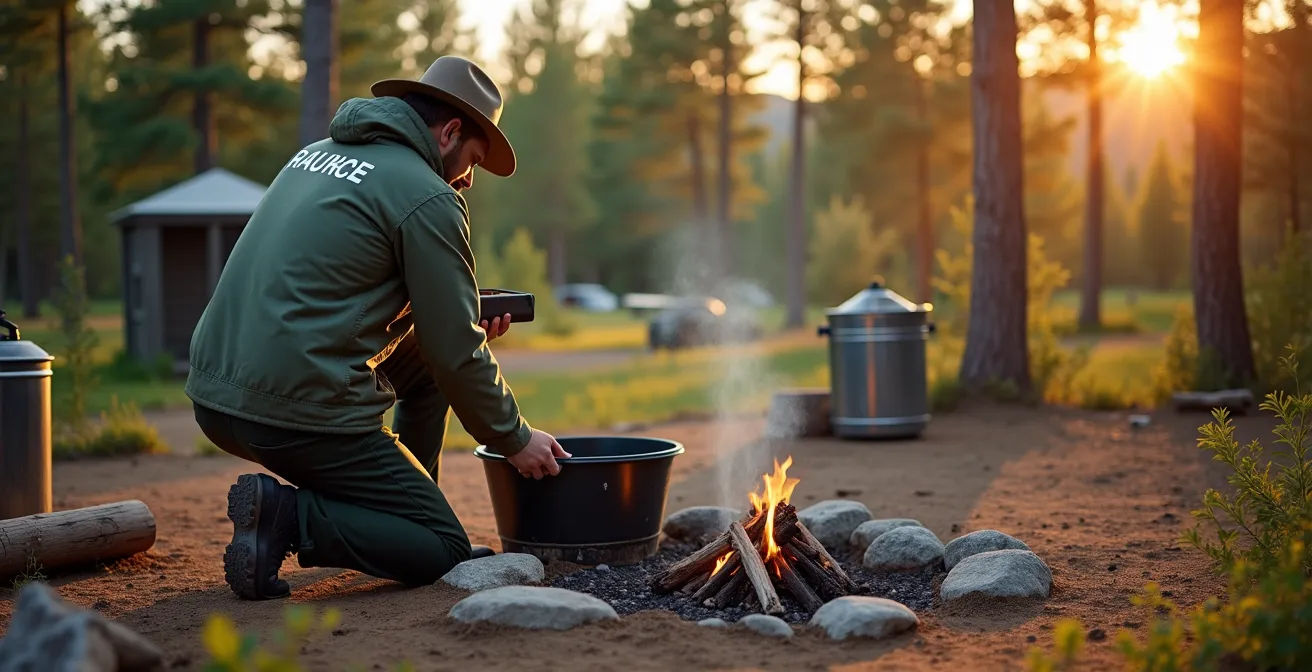
Proper food waste disposal is a non-negotiable rule of backcountry and even frontcountry camping in Canada. As shown in the image, a clean campsite is a safe campsite. In designated frontcountry campgrounds, all garbage must be secured in provided bear-proof containers. In the backcountry, the rule is absolute: what you pack in, you must pack out. There are no exceptions. This includes all food scraps, wrappers, and even grey water from washing dishes, which should be disposed of in designated areas away from water sources.
Failing to follow these rules isn’t just poor etiquette; it’s illegal under the Canada National Parks Act and can lead to severe consequences. The responsibility to protect wildlife from our impact is paramount, and it begins with managing our waste correctly.
The Boot Cleaning Mistake: How Hikers Spread Invasive Seeds Between Provinces?
The concept of “biosecurity” might sound like something for a laboratory, but for a traveler crossing Canada’s diverse ecosystems, it’s a critical personal responsibility. One of the most significant and overlooked ways that travelers harm local environments is by acting as an unwitting invasive species vector. The mud on your hiking boots or the seeds caught in your bike tires can carry aggressive, non-native species from one province to another, with devastating consequences.
This is not a theoretical threat. According to a Parks Canada report on environmental threats, this cross-contamination is a documented problem. Himalayan Balsam, for example, can travel from a British Columbia riverbank to an Alberta trail via a single pair of contaminated boots. Similarly, Garlic Mustard can spread from an Ontario forest into Quebec’s Gatineau Park. The problem extends beyond hiking; improperly cleaned boats are responsible for spreading zebra mussels from the Great Lakes into the prairie provinces, causing millions in infrastructure damage.
Your role as a conservation partner is to break this chain of transmission. Parks Canada has installed boot-brushing stations at many trailheads for this very reason. Using them before and after every hike is the single most effective action you can take. To make this a core part of your travel practice, follow this simple audit.
Your Inter-Provincial Biosecurity Checklist
- Points of Contact: Before travel, list all gear that will touch the environment: boot treads, bike tires, kayak/canoe hulls, and even pet fur.
- Collect & Clean: Inventory and use your cleaning kit (stiff brush, water spray) at every trailhead’s boot-brushing station, before and after your activity.
- Check for Coherence: Cross-reference your route with provincial invasive species alerts (e.g., zebra mussel zones) to understand specific, localized threats.
- Create a Mnemonic: Adopt the “PlayCleanGo” mantra as a mental trigger to inspect clothing, pets, and gear for seeds or mud before leaving any recreational site.
- Integrate into Your Plan: Schedule a 30-minute “biosecurity stop” at a car wash or designated cleaning station when crossing provincial borders to thoroughly decontaminate vehicles and watercraft.
By treating your gear with the same care you’d give to customs declarations, you actively protect the unique biodiversity of each region you have the privilege of visiting.
The Bear Safety Error That Could Cost You a $25,000 Fine in National Parks
Seeing a bear in the wild is an unforgettable Canadian experience, but it’s a privilege that comes with immense responsibility. The most common and dangerous error a traveler can make is forgetting that these are powerful, wild animals. Improper food storage, leaving scented items unattended, or approaching a bear for a photo are not just foolish—they are illegal acts that endanger both you and the animal, and carry steep penalties.
Under the Canada National Parks Act, disturbing wildlife is a serious offense. While penalties vary, fines for wildlife disturbance can range from $7,500 to $1,000,000 depending on the severity of the act. A fine of up to $25,000 for feeding or harassing wildlife is a very real possibility, a price that underscores the gravity of the situation. These laws exist because a bear that becomes habituated to humans and their food is a bear that is likely to be killed.
Furthermore, bear safety protocols are not one-size-fits-all across Canada. The correct response to an encounter depends on the species and the region, making hyper-local responsibility essential.
| Park Region | Bear Type | Recommended Response | Key Safety Equipment |
|---|---|---|---|
| Ontario’s Algonquin Park | Black Bear | Make noise, appear large, back away slowly, never run | Bear spray, noise makers |
| Yoho National Park, BC | Grizzly Bear | Avoid eye contact, back away slowly, play dead if attacked | Bear spray mandatory, bear-proof containers |
| Jasper/Banff Parks | Both species | Maintain 100m distance, use designated pullouts only | Bear spray, ‘bare campsite’ compliance |
| Northern Parks | Polar Bears | Special firearms permits for authorized users only | Professional guides, restricted access |
As Parks Canada states in its official guidelines, “Seeing a bear in the wild is truly a unique and remarkable sight. This rare privilege comes with important responsibilities.” Carrying bear spray and knowing how to use it, maintaining a bare campsite, and keeping a respectful distance are not optional—they are the fundamental duties of anyone venturing into Canada’s bear country.
Key Takeaways
- Your park fee is a starting point; direct support for conservation projects and Indigenous-led initiatives provides a greater impact.
- Biosecurity is your personal responsibility—cleaning boots and gear between provinces is crucial to protecting Canada’s unique ecosystems.
- True sustainable travel in Canada means making informed choices, from the hotel certification you trust (Green Key Global) to your on-the-ground actions like proper food storage and respecting wildlife zones.
How to Travel in Canada While Actively Contributing to Biodiversity Protection?
We’ve established a new framework: your Canadian journey is an opportunity not just to see, but to serve. Moving beyond the passive act of offsetting your flight’s carbon, you can become an active force for conservation. The final step is to integrate this stewardship role into your travel itinerary through direct participation and support for the systems that protect Canada’s biodiversity.
One of the most powerful ways to contribute is by becoming a citizen scientist. Your smartphone can be a valuable data collection tool for researchers. Apps like iNaturalist Canada allow you to log species sightings, while eBird helps track bird populations. By simply documenting the wildlife you encounter, you contribute to massive databases that inform conservation policy and scientific research across the country. This transforms a simple nature walk into a meaningful act of data gathering.
Another crucial avenue for systemic contribution is supporting Indigenous-led conservation. Indigenous communities are at the forefront of protecting Canada’s lands and waters, blending traditional knowledge with modern science. According to Parks Canada’s departmental plan, their commitment to reconciliation shows that by March 2024, there will be at least 27 natural heritage places being managed cooperatively with Indigenous peoples. You can support this vital work by choosing tourism operators certified by the Indigenous Tourism Association of Canada (ITAC), where your money directly funds land stewardship and cultural preservation.
By embracing these actions—practicing citizen science, supporting Indigenous guardians, and adhering to the principles of biosecurity and wildlife safety—you complete the transformation. Your travel is no longer a source of guilt, but a demonstration of your commitment to the wild places you love.
Start planning your next Canadian journey not just as a tourist, but as a dedicated partner in conservation. Choose one specific action from this guide and make it the cornerstone of your trip.
Frequently Asked Questions About Food Waste in Canadian Parks
What’s the difference between frontcountry and backcountry food waste disposal?
In frontcountry areas, all food and garbage must be stored or disposed of in bear-proof containers. In the backcountry, all food and garbage must be packed out.
Why is burning food waste illegal in national parks?
Burning food creates an ‘Olfactory Trap’ with lingering scents that attract bears and wildlife to campsites. Additionally, burning anything other than clean firewood releases toxic chemicals into soil, violating the Canada National Parks Act’s General Regulations.
What are the consequences of improper food disposal in parks?
Canadian National Park offences can carry heavy fines and could result in jail time or restitution. For some offences, such as poaching or pollution, fines can be in excess of $250,000.