
In summary:
- Toronto’s vast multiculturalism can be conquered in a weekend without a car by using a strategic transit plan.
- The Bloor-Danforth subway line (Line 2) is your primary cultural corridor, connecting distinct neighborhoods efficiently.
- Beyond food, true immersion comes from understanding local etiquette for tipping, photography, and language.
- Authentic experiences are found by looking for community signals, not just following tourist-heavy guides.
You’ve landed in Toronto, a city that prides itself on being a world within a city. The promise is intoxicating: wander from Italy to Korea, from Portugal to India, all in a few city blocks. But the reality can be overwhelming. Standard guides offer a simple directory of neighborhoods, treating culture like a checklist of restaurants. They often ignore the real challenge: how do you navigate this sprawling cultural matrix efficiently and authentically, especially without a car?
Most tourists stick to the obvious, sampling pasta in one district and souvlaki in another, but they miss the deeper currents of the city. They experience the surface, not the soul. But what if the key wasn’t just knowing *where* to go, but *how* to move and interact within these spaces? What if public transit wasn’t a chore, but a strategic tool for cultural exploration? This is the urban explorer’s mindset. It’s about trading a vague itinerary for a tactical mission.
This guide is your operational blueprint. We’re rejecting the simple food tour and embracing a full-immersion strategy. We will build a plan around a single transit line, master the unwritten rules of social etiquette, and learn to spot the signals of true authenticity. This is how you go beyond tourism and truly connect with the vibrant, living cultures that make Toronto unique. Forget the rental car; your transit pass is your passport.
This article breaks down your weekend mission into a clear, actionable strategy. Follow this framework to navigate Toronto’s cultural diversity with the confidence and insight of a local explorer.
Summary: Your Tactical Guide to Toronto’s Cultural Matrix
- The Transit Route That Connects Little Italy, Koreatown, and Greektown Quickly?
- Is Tipping the Same for a Vietnamese Pho as for a Portuguese Chicken Spot?
- How to Find the Genuine Local Festival vs the Corporate-Sponsored Event?
- The Photography Rule for Religious Sites in Montreal’s Diverse Neighbourhoods?
- When is it Appropriate to Address Someone in French in Western Canada?
- Where to Find True Jamaican Patties West of Yonge Street?
- How to Practice Intermediate Spanish in Toronto’s Little Portugal?
- How to Navigate Toronto’s Little India for Authentic 1990s Bollywood Music?
The Transit Route That Connects Little Italy, Koreatown, and Greektown Quickly?
Forget rideshares and complex bus routes. Your entire multicultural mission can be anchored to a single, powerful transit corridor: the TTC’s Line 2 Bloor-Danforth subway. This is the artery that pumps life through some of Toronto’s most iconic cultural neighborhoods. Thinking like an urban explorer means using this line as your strategic backbone, allowing you to hop between worlds with maximum efficiency.
First, let’s talk logistics. If you’re making more than four separate trips in a day, the financial choice is clear. A single ride with a PRESTO card costs around $3.35, but you can get $13.50 for unlimited daily travel with a Day Pass. This pass liberates you from transaction anxiety, encouraging spontaneous detours and short hops. It’s not a cost; it’s an investment in freedom. The PRESTO card’s two-hour transfer window is also a powerful tool for short bursts of exploration within a neighborhood cluster.
Here is the tactical breakdown for your Line 2 journey:
- Little Italy: Exit at Ossington Station. Walk south on Ossington Avenue to College Street, the heart of the neighborhood.
- Koreatown: Get back on Line 2 and travel two stops east to Christie Station. You’ll emerge directly into the vibrant signage and energy of Koreatown on Bloor Street West.
- Greektown (The Danforth): Head east again on Line 2. After crossing the Prince Edward Viaduct, exit at Pape Station. You are now in the centre of North America’s largest Greektown.
This entire chain of travel—from Italian espresso to Korean BBQ to Greek pastries—can be accomplished in under 30 minutes of actual transit time. For hyper-local exploration, consider grabbing a Bike Share Toronto cycle, with docks conveniently located near all major subway stops. It’s the perfect way to explore the residential streets just off the main drag.
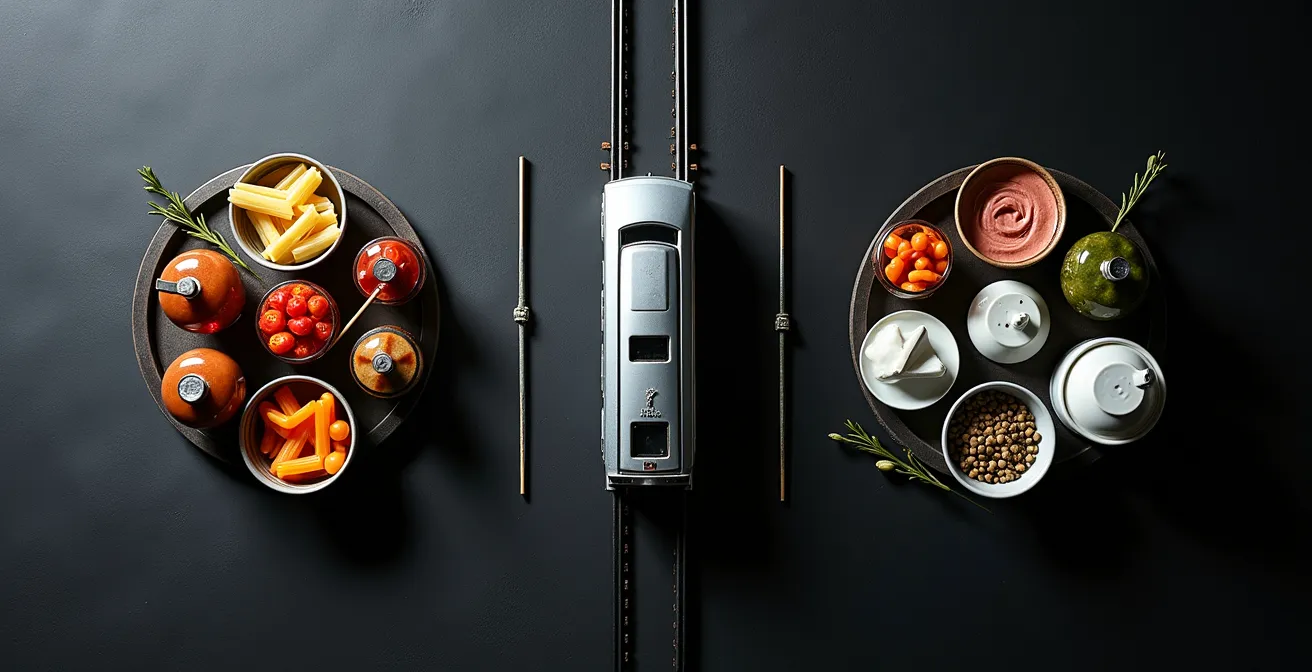
This visualization captures the essence of your mission: distinct cultural worlds, all connected by the simple, elegant line of the subway. Note that while Pape and Ossington stations are accessible with elevators, Christie Station currently requires stair access, a key piece of information for planning your mobility.
Is Tipping the Same for a Vietnamese Pho as for a Portuguese Chicken Spot?
This is a classic urban explorer’s question and a perfect example of where cultural literacy trumps assumption. In Toronto, the tipping custom is not dictated by the ethnicity of the cuisine, but by the style of service you receive. Understanding this distinction is a key part of the “Urban Explorer’s Code” and will help you navigate any dining situation with confidence, whether you’re at a casual pho joint or a full-service Italian restaurant.
Many visitors, and even some locals, get this wrong. They might over-tip at a counter-service spot or under-tip where full table service is the norm, causing awkwardness. The confusion is amplified by payment terminals, which often default to high percentage prompts (18%, 20%, 25%) regardless of the service context. Your job is to ignore the machine’s suggestion and apply the correct local custom based on your actual experience.
This is not just about money; it’s a form of non-verbal communication that shows respect and understanding of the local economic culture. The unspoken rule is that a tip rewards the labour of service, not just the quality of the food. As a topic often discussed in local guides, grasping this nuance is crucial for smooth interactions.
| Service Style | Common in | Typical Tip Range | Payment Terminal Default |
|---|---|---|---|
| Counter Service | Pho shops, Patty shops, Bakeries | 0-10% (optional) | Often prompts 15-20% |
| Full Table Service | Sit-down restaurants | 15-20% (expected) | 18%, 20%, 25% options |
| Takeout Only | Most casual spots | 0-10% (discretionary) | Same as dine-in prompts |
| Hospitality-Included | Progressive restaurants | 0% (included in price) | No tip prompt |
As the table shows, a quick-service patty shop and a sit-down Portuguese restaurant have different expectations. At a counter, a small tip is a welcome gesture but not an obligation. At a table-service restaurant, 15-20% is the standard expectation for good service. Being aware of the rare but growing “hospitality-included” model, where prices are higher to provide staff with a living wage, also marks you as an informed patron.
How to Find the Genuine Local Festival vs the Corporate-Sponsored Event?
Toronto’s reputation for multiculturalism is well-earned, with dozens of annual cultural festivals populating the city’s calendar. But this abundance presents a challenge: how do you distinguish a genuine, community-led celebration from a commercialized event wrapped in a cultural flag? The answer lies in looking for specific “authenticity signals” that corporate events can’t replicate.
Big-name events like a generic “Taste of…” festival can be fun, but they often feature the same handful of food trucks and a heavy corporate presence. True cultural immersion happens at events organized by and for the community itself. These are the places where you’ll hear traditional music, see elders sharing stories, and taste family recipes. Finding them requires a bit of detective work, moving beyond the first page of Google search results and looking for information at a grassroots level.
Your primary tool in this search will be the local Business Improvement Area (BIA). These are organizations run by local business owners, and their websites and street-level notice boards are goldmines for authentic event information. They have a vested interest in promoting genuine local culture, not just selling sponsorships. By focusing on these sources, you bypass the marketing noise and connect directly with the community’s own programming.
Your Action Plan for Finding Authentic Festivals
- Search for Business Improvement Area (BIA) websites – ‘Greektown on the Danforth BIA’ and ‘Koreatown BIA’ organize the most authentic local festivals.
- Visit religious institutions and cultural centers – temples, churches, and gurdwaras host genuine community celebrations rarely found in tourist guides.
- Check community newspapers in ethnic grocery stores – Portuguese, Korean, and Tamil publications list authentic local events.
- Look for religious/national holiday celebrations like Taste of the Danforth rather than generic ‘Taste of…’ corporate events.
- Follow local community centers’ social media for announcements of traditional celebrations and cultural gatherings.
This approach requires you to step off the beaten path. It means walking into a grocery store to look at a bulletin board or checking the website of a local mandir or church. This is the work of an urban explorer. The reward is an experience that feels earned and real—a genuine glimpse into the vibrant heart of a community, far from the polished veneer of a corporate-sponsored street party.
The Photography Rule for Religious Sites in Montreal’s Diverse Neighbourhoods?
While the question specifically mentions Montreal, the principles of respectful photography at religious sites are universal and critically important for any urban explorer in Canada. In Toronto, a city with a breathtaking diversity of faiths, understanding this etiquette is a non-negotiable part of your cultural literacy. The rules are not about restriction; they are about respect and mindfulness. Each sacred space, from a cathedral to a mandir, operates under its own set of protocols.
The biggest mistake a visitor can make is assuming a single rule applies everywhere. What is permissible in a Catholic cathedral may be deeply disrespectful in a Hindu temple. The key is to always assume photography is *not* allowed until you see explicit permission. Look for signage at the entrance. If there are no signs, the most respectful action is to put your camera or phone away, or to quietly and privately ask a staff member or volunteer. Never use a flash, even where photography is permitted, as it is universally disruptive.
Your goal is to be an observer, not a consumer of images. As you can find in resources from organizations like the University of Toronto’s relocation services, many communities are open and welcoming, but that welcome is predicated on mutual respect. The dress code is often linked to photo etiquette; covering shoulders and knees is a common requirement that signals your respect before you even think about taking a photo.

Focus your lens on the exterior architectural details, which are almost always acceptable to photograph. Capturing the textures, patterns, and craftsmanship from a public space is a beautiful and respectful way to document your visit without intruding on sacred practices. Below is a general guide for some of Toronto’s major sites, but remember: when in doubt, ask or abstain.
| Religious Site | Interior Photography | Dress Code | Special Requirements |
|---|---|---|---|
| BAPS Shri Swaminarayan Mandir (Hindu) | Not permitted | Strict – covered shoulders/knees | Shoes must be removed |
| St. Michael’s Cathedral (Catholic) | Allowed without flash | Respectful attire | Silent during services |
| Local Gurdwaras (Sikh) | Generally permitted | Head covering required | Shoes removed, ask permission first |
| Buddhist Temples | Varies by temple | Modest clothing | Remove shoes, bow respectfully |
h2>
When is it Appropriate to Address Someone in French in Western Canada?
That question points to a broader Canadian reality of linguistic dualism, but let’s focus on the ground truth for your mission in Toronto. In this city, the question isn’t about a simple English-French binary. Toronto is a tapestry woven from over 140 languages. Here, cultural literacy means recognizing that French is one of many important threads, and the “appropriate” time to use any language is all about reading the immediate context—the neighborhood, the business, and the person in front of you.
Unlike Montreal or parts of Western Canada with deep historical Francophone roots, French in Toronto is more of a discovered language, present in vibrant but specific pockets. As CFACToronto notes, “Toronto’s multiculturalism is visible at every turn,” and this applies to its linguistic landscape as well. Attempting to speak Italian in Little Italy or Portuguese in Little Portugal can be a wonderful gesture of respect, but it’s not always expected, especially with younger, English-speaking staff in modern establishments.
The urban explorer’s strategy is to target places where language is functional, not just decorative. Think less about trendy restaurants and more about the bakeries, butchers, and community social clubs that have served a neighborhood for generations. These are the places where hearing and speaking a heritage language is a daily norm. Here’s a practical guide to language etiquette in Toronto’s heritage neighborhoods:
- In Little Italy, greet older shopkeepers with ‘Buongiorno’ — younger staff typically respond in English.
- Target functional businesses (bakeries, butchers, social clubs) for authentic language practice rather than trendy restaurants.
- In Little Portugal, practice ordering at a ‘padaria’ (bakery) with ‘Queria um pastel de nata, por favor’.
- For dedicated French practice, seek out cultural hubs like the Théâtre français de Toronto or visit cafés in historic Francophone areas like Cabbagetown.
- Remember that with over 140 languages spoken, language diversity is celebrated, and a polite “hello” in English is always a safe and respectful start.
The key is to offer the greeting as a gift, without expectation. A simple ‘Buongiorno’ or ‘Olá’ signals respect for the neighborhood’s heritage. The response you get—whether it’s in Italian, Portuguese, or English—is your cue. It’s a dance, not a test. This approach transforms a simple transaction into a moment of genuine human connection.
Where to Find True Jamaican Patties West of Yonge Street?
This is a perfect urban explorer’s mission. While you can find generic, mass-produced patties in any subway station, finding an *authentic* Jamaican patty is a quest for the heart of Toronto’s Caribbean culture. The geographical clue is in the history: the true hub of Jamaican food culture isn’t downtown, but further west and north, in neighborhoods like Little Jamaica on Eglinton West and the communities in Rexdale. These areas are where family-run bakeries have been perfecting their recipes for generations, far from the downtown tourist trail.
So, what makes a patty “authentically Jamaican” in Toronto? The local debate is fierce, but it boils down to three critical factors. First is the crust: is it a flaky, layered pastry that shatters on first bite, or a heavier, shortcrust-style dough? Purists swear by the flaky version. Second is the spice: the filling must have a genuine, creeping heat from scotch bonnet peppers, not just a generic peppery flavor. Finally, there’s the serving style. You can eat it plain, but the ultimate local move is to order your patty “in a coco bread”—a slightly sweet, pillowy bread that transforms the snack into a satisfying sandwich.
Case Study: Toronto’s Authentic Caribbean Food Geography
The annual Toronto Caribbean Carnival is a massive celebration, but the everyday pulse of the community’s food scene is found in specific neighborhoods. The stretch of Eglinton Avenue West known as Little Jamaica, as well as parts of Rexdale, became hubs for Caribbean immigrants in the latter half of the 20th century. Consequently, the city’s most revered patty shops, jerk chicken spots, and West Indian grocers are concentrated here, often clustered around major transit stops like Eglinton West Station, serving the daily commuter crowd with food that tastes like home.
To find the best spots, your strategy is to follow the commuters. Many of the most beloved patty shops are strategically located right near the entrances to major transit hubs like Warden, Bathurst, and along the Eglinton West corridor. They are designed for speed and authenticity, serving a clientele that knows the difference. Asking for it in a coco bread is more than just an order; it’s a password that signals you’re not just a tourist, you’re an explorer who has done their homework.
How to Practice Intermediate Spanish in Toronto’s Little Portugal?
At first glance, this question seems like a geographical mistake. But for the savvy urban explorer, it reveals a fundamental truth about Toronto’s cultural matrix: the neighborhoods are not monolithic. They are vibrant, overlapping ecosystems. The presence of a thriving Latin American community in and around the historic core of Little Portugal is a perfect example of this cultural layering.
Toronto is one of the most multicultural cities in the world… The neighborhood has a rich history of immigration, with communities from Portugal, the Caribbean, East Asia, Latin America, and Africa contributing to its vibrant cultural tapestry.
– Meghan the Traveling Teacher
This insight from Meghan the Traveling Teacher is key. Little Portugal is the historic anchor, but decades of immigration have created a diverse community fabric. This means you will absolutely hear and find opportunities to speak Spanish, but you need to know where to look. Your mission is to find the Latin American nodes within this broader Lusophone (Portuguese-speaking) neighborhood.
Instead of randomly trying your Spanish in a Portuguese bakery, your target should be the area just to the north and east: Kensington Market. This National Historic Site is less a single-culture neighborhood and more of a microcosm of Toronto’s global diversity, and it bleeds right into the northern edge of the areas historically settled by Portuguese and Latin American immigrants.
Case Study: Language Practice in Kensington Market
Kensington Market is the unofficial heart of Toronto’s downtown Latin American community. Your primary destination for practice is the ‘Comercio Popular’ and other Latin American grocers and food stalls. Here, ordering empanadas, asking about different types of chili peppers, or buying products imported from Colombia or Mexico provides a natural and welcome context for speaking Spanish. For a more structured approach, the nearby Centre for Spanish Speaking Peoples often hosts community events and language exchange evenings, offering a direct path to conversation with native speakers in a supportive environment.
This strategy of looking for “nested” communities is far more effective than simply walking down the main street of a neighborhood. It requires you to see the city not as a collection of distinct boxes, but as a fluid map of overlapping diasporas. By targeting a place like Kensington Market, you are stepping into a natural hub of Spanish-language commerce and community life.
Key Takeaways
- Your public transit pass is your most powerful tool for efficient, car-free cultural exploration in Toronto.
- Mastering local etiquette—from tipping by service style to respectful photography—is the key to genuine interaction.
- Authenticity is found at the community level: seek out BIA events, local newspapers, and grassroots celebrations.
How to Navigate Toronto’s Little India for Authentic 1990s Bollywood Music?
This is the ultimate urban explorer deep cut—a quest for a specific sound from a specific era. Toronto’s Little India, centred on Gerrard Street East, is a sensory explosion of sights, smells, and sounds. But to find a specific vein of 1990s Bollywood nostalgia, you need to look beyond the main street and even beyond the neighborhood itself. The geography of the South Asian diaspora has shifted over the decades.
While Gerrard Street remains the historic and symbolic heart, demographic data reveals a crucial insight. According to analysis from organizations like Toronto Global, the GTA’s largest and most vibrant South Asian communities are now found in the 905 region, particularly in cities like Markham and Brampton in the 905 region. For a serious collector, these areas offer larger specialty stores that cater to a massive local audience with deep cultural roots. For the weekend explorer, however, Gerrard Street still holds the treasures if you know how to look.
Your mission is to tune out the modern noise and listen for the echoes of the past. The key is to look up and listen in. Many of the most dedicated specialty shops are not at street level. Here’s your treasure map for that golden age of Bollywood sound:
- Look for narrow staircases on Gerrard Street East. These often lead to hidden, second-floor music shops that haven’t changed their inventory in decades.
- Listen for the ambient music playing from ‘mithai’ (sweet) shops and small grocers. Many owners play the same beloved 90s playlists they’ve had on for years.
- If you venture to the suburbs, explore the major plazas in Brampton for much larger selections of CDs, vinyl, and even cassette tapes.
- Check listings for cinemas in Scarborough and Brampton, which sometimes host ‘retro’ 90s Bollywood film screenings, complete with the iconic music.
- Visit during the evening. After work, many shop owners play nostalgic music to create a welcoming atmosphere for the local community.
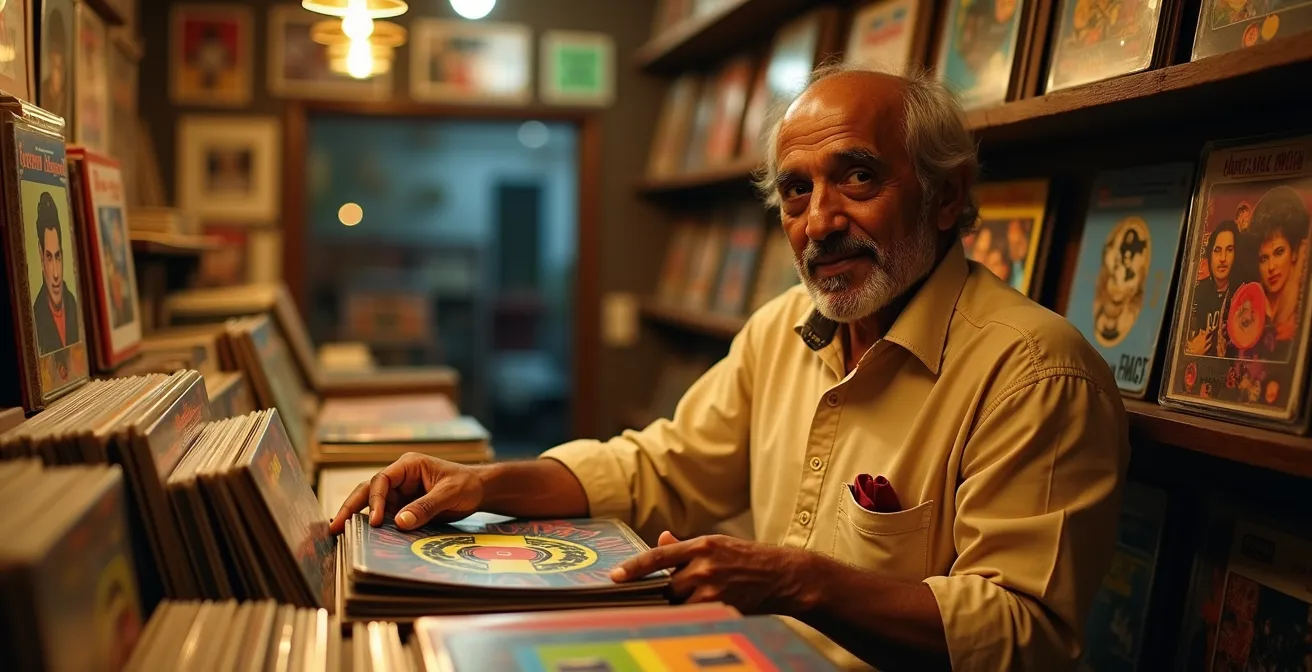
This is not a shopping trip; it’s an act of cultural archaeology. It’s about finding the places that time has, in some ways, forgotten. It’s in these small, family-run establishments that the pure, unmixed soundtrack of the 1990s still plays, a living link to a beloved era.
Now, grab your PRESTO pass, plot your course using the Line 2 corridor, and start your own exploration of Toronto’s incredible cultural matrix. The city is waiting to be discovered.