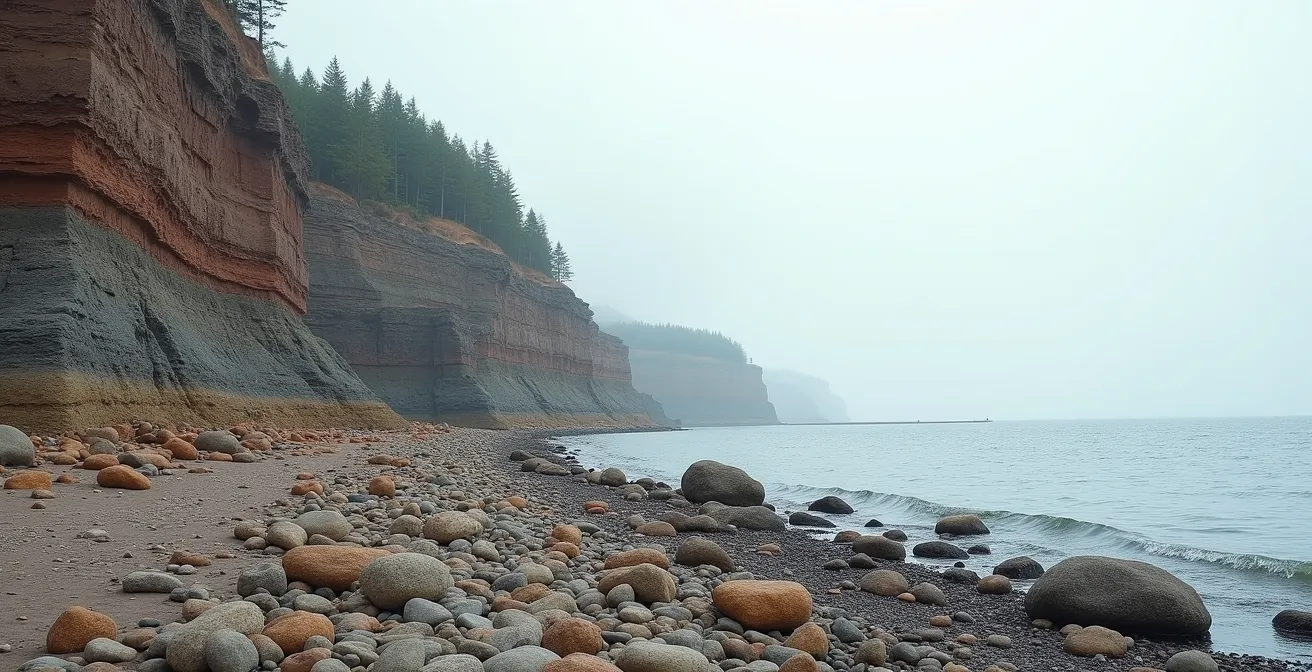
The greatest discovery you can make at the Joggins Fossil Cliffs is the one you leave behind for science; collecting fossils here is strictly prohibited and for good reason.
- The site is a protected UNESCO World Heritage location, not a public collecting beach, due to its unique “in-situ” fossil record.
- Safety is paramount; the powerful Bay of Fundy tides are extremely dangerous and require strict adherence to tide schedules.
- The real reward is shifting from a “treasure hunter” to a “citizen scientist,” contributing to the preservation of a 300-million-year-old story.
Recommendation: Before your visit, commit to the “look, don’t take” principle and master the tide safety rules outlined in this guide to have a memorable, legal, and meaningful family experience.
For many families visiting the Bay of Fundy, the idea of fossil hunting at the Joggins Fossil Cliffs conjures images of an epic treasure hunt, a chance to bring home a piece of prehistory. This desire is understandable; who wouldn’t want a 300-million-year-old souvenir? However, this common assumption leads to the single most significant misunderstanding about this globally important site. While guides and articles often mention the incredible fossils and the world’s highest tides, they sometimes fail to emphasize the most critical rule: you are not allowed to take any fossils from the beach. This isn’t just a friendly suggestion; it’s a matter of heritage law.
As the manager of a site like this, my primary concern is balancing visitor experience with absolute preservation. The cliffs and beach at Joggins are not a quarry; they are an active, open-air museum and scientific laboratory. The value of the fossils here lies in their context—where they are found, in what layer of rock, and next to what other specimens. Removing a fossil, no matter how small, is like tearing a page out of the only copy of an ancient book. It erases a piece of a story that scientists are still learning to read.
But what if the goal wasn’t to *collect*, but to *discover*? This guide re-frames the Joggins experience. It moves beyond the simple “don’t take fossils” warning to explain the profound scientific reason *why*. We will explore the powerful forces that shape this landscape, the specific safety protocols you must follow to explore it, and how to teach your children the difference between a souvenir and a scientific discovery. By the end, your family will be equipped not just to find fossils legally, but to act as stewards of this incredible Canadian treasure, participating in science rather than consuming a resource.
To help you plan your visit with this new perspective, this article will guide you through the key natural phenomena of the Bay of Fundy and how they directly relate to a safe and responsible experience at Joggins. We’ll cover the forces that shape the coastline, the importance of timing, and the specific rules that protect both you and the irreplaceable fossil record.
Summary: A Guide to Responsible Discovery at Joggins Fossil Cliffs
- Why the Flowerpot Rocks Are Doomed to Collapse Eventually?
- New Brunswick or Nova Scotia: Which Side of the Bay Has Better Whale Watching?
- The Trail Difficulty Trap: Is the Fundy Footpath Too Hard for Beginners?
- How to Surf the Tidal Bore in Moncton: Gear and Timing?
- Slack Water Viewing: Why Timing Is Everything at the Reversing Falls?
- Why are the Gros Morne Cliffs So Steep: Tectonic Plates or Glacial Scouring?
- Why the “Rule of Twelfths” Matters for Your Beach Walk Safety?
- How to Drive the Entire Cabot Trail in One Day Without Rushing the Views?
Why the Flowerpot Rocks Are Doomed to Collapse Eventually?
The iconic Hopewell Rocks, or “Flowerpot Rocks,” in New Brunswick are a dramatic testament to the raw power of the Bay of Fundy tides. Twice a day, they are transformed from towering sea stacks you can walk around into small islands in a vast expanse of water. Their eventual collapse is inevitable, carved by the same immense force that makes Joggins a world-class fossil site: erosion. The Bay of Fundy is a natural amplifier for the Atlantic Ocean’s tide, creating a phenomenon of incredible scale. In some parts of the bay, the maximum tidal range during perigean-spring tides can reach an astonishing 16.5 metres (54 feet).
This daily scouring by trillions of tonnes of water is what shapes the entire coastline. While this force is slowly grinding the Hopewell Rocks into sand, at Joggins, it serves a different purpose. The 15 kilometres of cliffs at Joggins are composed of sedimentary rock from the Carboniferous Period. The relentless tidal action constantly erodes the base of these cliffs, causing sections to shear off and fall to the beach below. Every storm and every spring tide reveals a fresh layer of rock, exposing new fossils that were locked away for over 300 million years.
Understanding this process is the first step to appreciating the “look, don’t take” rule. The beach is not a static collection of old rocks; it’s a dynamic, constantly refreshing conveyor belt of scientific data. The same forces that doom the Flowerpot Rocks are what make Joggins a living, breathing fossil exhibit. Your family isn’t just walking on a beach; you are walking through freshly exposed pages of Earth’s history, revealed by the most powerful tides on the planet.
New Brunswick or Nova Scotia: Which Side of the Bay Has Better Whale Watching?
The Bay of Fundy is a world-renowned destination for wildlife enthusiasts, famously hosting a summer population of between 300-400 whales, including Humpbacks, Finbacks, and the critically endangered North Atlantic Right Whale. Both the New Brunswick and Nova Scotia sides offer incredible tours, with departure points like St. Andrews (NB) and Brier Island (NS) providing different experiences. The ethics of observing these living giants are governed by strict regulations; Fisheries and Oceans Canada (DFO) mandates a minimum approach distance of 100 metres to protect the animals from stress.
This principle of respectful observation offers a perfect analogy for your visit to Joggins. While the whales are the living titans of the Bay, the fossils at Joggins represent the titans of a much more ancient world. Just as we have a heritage protocol to protect living whales, we have one to protect these irreplaceable records of past life. The DFO’s 100-metre rule for whales and Joggins’ “no-take” rule for fossils stem from the same core value: a profound respect for a natural wonder and a commitment to its preservation for future generations and scientific study.
So while one family might choose a Zodiac tour to see a breaching Humpback, your family’s expedition to Joggins is a different kind of safari—a journey back in time. Your “prey” is not a living creature, but the delicate trace of one. The thrill is in the in-situ discovery: spotting the faint outline of a plant stem, the track of an ancient amphibian, or the skeletal fragment of a creature that has not seen sunlight in 300 million years. The ethical framework is the same: observe, document, and leave it undisturbed for the next observer and for the scientific record.
The Trail Difficulty Trap: Is the Fundy Footpath Too Hard for Beginners?
When planning a trip to the Bay of Fundy, it’s crucial to match the activity to your family’s capabilities. At one end of the spectrum is the Fundy Footpath, a gruelling multi-day wilderness trek renowned as one of the most challenging hikes in Eastern Canada. It’s strictly for experienced, fully prepared backcountry hikers. At the other end is the Joggins Fossil Cliffs. The site offers family-friendly beach access via a set of stairs (seasonally from May to October), making the physical challenge minimal. However, this accessibility presents a “difficulty trap” of a different kind.
The challenge at Joggins is not physical but intellectual and ethical. While anyone can walk down the stairs to the beach, not everyone arrives prepared for the two most critical rules: tide safety and fossil preservation. The ease of access can create a false sense of security. The Fundy Footpath demands respect for its rugged terrain; Joggins demands respect for its powerful tides and irreplaceable heritage. A mistake on the Footpath could lead to exhaustion or a twisted ankle. A mistake at Joggins could mean being trapped by a rapidly rising tide or damaging a globally significant fossil.
Therefore, preparing for Joggins means preparing your mindset. It involves a family discussion before you even leave the car. Explain that the easy walk on the beach is a privilege that comes with the serious responsibility of acting as temporary custodians of the site. It’s a perfect opportunity to teach children that some adventures are about conquering a mountain, while others, like Joggins, are about carefully and respectfully exploring an out-door museum.
How to Surf the Tidal Bore in Moncton: Gear and Timing?
The tidal bore on the Petitcodiac River near Moncton is another of the Bay of Fundy’s signature phenomena. It’s a visible wave that travels up the river against the current, heralding the arrival of the massive incoming tide. For surfers, timing the bore’s arrival is everything. This event is a perfect, tangible illustration of the bay’s relentless rhythm—a predictable 12.4-hour tidal cycle that governs every activity along its coast, most importantly, your visit to the Joggins Fossil Cliffs.
Just as a surfer must know the exact time the bore will arrive at a specific point on the river, your family must know the exact times of low and high tide for the Joggins beach. This is not optional; it is the most important safety rule. The tide at Joggins doesn’t gently lap at the shore; it advances with astonishing speed across the flat beach, capable of cutting off your exit back to the stairs in a matter of minutes. The same natural forces that create a surfable wave on the Petitcodiac create a potentially hazardous situation on the Joggins beach.
Think of the official tide chart as your most essential piece of gear. Before descending the stairs, check it, understand it, and make a plan. Know the exact time of high tide and set an alarm on your phone to begin your return to the stairs well in advance. The tidal bore makes the tide’s arrival a dramatic spectacle; at Joggins, its arrival is silent but much more dangerous. The rhythm is the same, and respecting it is the key to a safe and enjoyable discovery.
Slack Water Viewing: Why Timing Is Everything at the Reversing Falls?
At the Reversing Falls in Saint John, “timing is everything” takes on a different meaning. The spectacle is not just the tide’s power, but the brief, calm moment of “slack water” when the immense flow of water—where approximately 100 billion tons of water rise and fall twice daily—comes to a halt before reversing direction. This quiet interlude between two periods of violent churning is your window for safe exploration at Joggins.
Your time on the Joggins beach is the equivalent of this slack water period. You are exploring in the brief, few-hour window of low tide before the bay’s immense power returns to reclaim the shoreline. As paleontologist and expert Dr. Roy Bishop explains, the scale of this tide is immense. He notes:
The vertical tidal range is about 2 metres in the open Atlantic Ocean. Compare this with an average of 12 metres (40 feet) in the Minas Basin. It can even reach 16.5 metres (54 feet) on a perigean-spring tide!
– Dr. Roy Bishop, Fundy Discovery Site
This massive volume of water doesn’t just rise vertically; it floods horizontally across the wide, flat beaches at Joggins with deceptive speed. Your fossil hunting expedition is a race against this clock. The “slack water” at low tide provides a vast area to explore, but as the tide begins to turn and flow back in, that area shrinks rapidly. Your visit must be planned to begin as the tide is going out and end long before it reaches its peak inflow speed, ensuring you are safely back at the top of the cliffs.
Why are the Gros Morne Cliffs So Steep: Tectonic Plates or Glacial Scouring?
To understand why the “no-take” rule at Joggins is so absolute, it helps to compare it to Canada’s other geological UNESCO wonder, Gros Morne National Park. While both are recognized for their incredible geology, they tell vastly different chapters of Earth’s history. Gros Morne’s stark cliffs expose the Earth’s mantle, providing dramatic proof of plate tectonics. Joggins, in contrast, offers a much more delicate and detailed story: the most complete fossil record of the “Coal Age” found anywhere in the world.
This is not just a collection of random fossils; it’s a snapshot of an entire ecosystem. As the UNESCO committee states, Joggins is of Outstanding Universal Value because it is where you can find the first reptiles in Earth’s history. This is a monumental moment in evolution.
The site bears witness to the first reptiles in Earth history, which are the earliest representatives of the amniotes, a group of animals that includes reptiles, dinosaurs, birds, and mammals.
– UNESCO World Heritage Committee, UNESCO World Heritage Centre
The following table puts the significance of Joggins into perspective:
| Aspect | Joggins Fossil Cliffs | Gros Morne (Context) |
|---|---|---|
| UNESCO Designation | 2008 | 1987 |
| Geological Period | Pennsylvanian/Carboniferous (318-303 million years) | Plate tectonics/Earth’s mantle exposed |
| Key Feature | World’s most complete Coal Age fossil record | Ancient oceanic crust and mantle rock |
| Scientific Significance | First reptiles in Earth history (Hylonomus lyelli) | Evidence for plate tectonic theory |
| Formation Process | Sedimentary layers, tidal erosion exposure | Tectonic uplift plus glacial scouring |
A fossil’s value is multiplied exponentially when it is found “in-situ”—in its original rock layer. This context tells paleontologists about the environment it lived in, what plants grew nearby, and what other animals existed. When a fossil is removed, all of that data is permanently lost. This is why every discovery, no matter how small, must be left for documentation. You are not simply finding a rock; you are finding a clue in a 300-million-year-old crime scene, and the clues must not be disturbed.
Why the “Rule of Twelfths” Matters for Your Beach Walk Safety?
This is the most critical, non-negotiable part of your visit to Joggins: understanding the tide’s movement for your family’s safety. The “Rule of Twelfths” is a maritime guideline that estimates the rate of flow of the tide. For the Bay of Fundy, it’s a rule for survival. The tide does not rise at a steady pace. It moves slowest at the beginning and end of its cycle (at low and high tide) and fastest in the middle hours (the 3rd and 4th hours). This is the danger zone.
On the vast, flat beach at Joggins, this acceleration means the water can suddenly begin rushing in much faster than you can walk. This is why local authorities and the Joggins Fossil Centre are adamant that visitors must be safely back above the high-water mark at least 2.5-3 hours before high tide. You cannot wait until you see the water getting close; by then, it may be too late, as channels can fill in behind you, cutting off your escape route to the stairs.

Before you descend to the beach, you must internalize this timeline and make it your plan. As the on-site manager, I implore you to treat this not as a suggestion, but as a life-saving procedure. The power that uncovers these incredible fossils is indifferent to human presence, and underestimating it is the biggest mistake a visitor can make.
Action Plan: Applying the Rule of Twelfths for Joggins Safety
- Hour 1 (after low tide): The tide rises by 1/12th. This is the prime time for exploration; the beach is at its most exposed.
- Hour 2: The tide rises by another 2/12ths. Beach access is still excellent. Continue your discovery, but remain aware of your time.
- Hour 3: The tide rises by 3/12ths. The water is now moving at its fastest. You must begin your walk back to the stairs now. This is not negotiable.
- Hour 4: The tide rises by another 3/12ths. This is the most critical danger period. You must be off the beach and heading up the stairs.
- Hour 5 & 6: The tide rises by the final 2/12ths and 1/12th. The beach areas you were exploring are now completely submerged.
Key Takeaways
- The “no take” rule is absolute. Removing fossils from Joggins is illegal and destroys irreplaceable scientific context.
- Tide safety is your #1 priority. You must be off the beach 3 hours before high tide, following the “Rule of Twelfths.”
- Shift your family’s goal from “collecting treasure” to “participating in discovery,” acting as citizen scientists and stewards of the site.
How to Drive the Entire Cabot Trail in One Day Without Rushing the Views?
The Cabot Trail in Cape Breton is another of Nova Scotia’s world-famous attractions, a winding road where the main advice is to “slow down and not rush the views.” Rushing the Cabot Trail means you’ll see the road but miss the breathtaking lookouts, the charming villages, and the unique culture. This philosophy of “slow looking” is the perfect mindset to bring to your fossil-hunting expedition at Joggins.
A rushed visit to Joggins, focused on a frantic “treasure hunt” to find something to take home, will miss the real story. You might walk right past the delicate frond of a 300-million-year-old fern, or the subtle trackway of an ancient amphibian, because you’re only looking for big, obvious bones. Scientific stewardship begins with slowing down. It’s about kneeling on the beach, running your fingers over the different textures of the rocks, and learning to see the difference between a simple crack and the fossilized bark of a ‘scale tree’.
Teach your children this art of slow looking. Encourage them to find patterns. Ask them to describe the shapes they see. Take pictures of your discoveries. This is how you “collect” memories and data without breaking the law. A photo of a fossil, with a GPS tag, shared with the Joggins Fossil Centre, is infinitely more valuable to science than a rock in your pocket. Just as the best Cabot Trail experience involves pulling over at the designated lookouts, the best Joggins experience involves stopping, looking closely, and appreciating the discovery in its original, rightful place.
Your visit to the Joggins Fossil Cliffs can be one of the most educational and memorable experiences your family will ever have. By following the critical safety protocols and embracing the role of a citizen scientist, you contribute to the protection of this extraordinary site. Now that you understand the rules and the reasons behind them, the next step is to check the official tide times for your planned date and prepare your family for an adventure in deep time.
Frequently asked questions about How to Find Fossils at Joggins Fossil Cliffs Without Breaking the Law?
What’s the total distance of the Cabot Trail?
The Cabot Trail is a 185-mile (298 km) loop around the tip of Cape Breton Island.
Which direction should I drive for best views?
Counter-clockwise keeps the ocean on the driver’s side and provides optimal evening light for photography at western lookouts.
Can I see whales from the Cabot Trail?
Yes, the Cabot Trail offers whale watching opportunities, especially from elevated viewpoints along the Atlantic Coast sections.