
The fastest route from Pearson Airport isn’t always the best; strategic use of GO Transit and the TTC can save significant money and unlock local experiences, sometimes even beating the UP Express on total journey time depending on your final destination.
- GO Transit often beats the UP Express on cost for families and offers comparable travel times to Union Station.
- TTC bus routes like the 900 Airport Express can double as “cultural corridors,” turning a simple transfer into a food tour for a single fare.
Recommendation: Re-evaluate your airport transfer as the first strategic decision of your trip, not just a necessary commute.
For most travelers landing at Toronto Pearson International Airport (YYZ), the decision seems simple. The sleek, well-marketed UP Express train promises a 25-minute ride straight to Union Station in the heart of the city. It’s fast, efficient, and presented as the default premium choice. On the other end of the spectrum is the TTC, often painted as the slow but cheap option, while taxis and rideshares represent a costly, traffic-dependent convenience. This limited framework, however, misses the entire point of navigating a city as complex and sprawling as Toronto.
The conventional wisdom focuses solely on getting from Point A (YYZ) to Point B (Union Station). But what if your final destination isn’t next to Union? What if your trip could start with an authentic culinary experience before you even check into your hotel? The real key to mastering Toronto transit isn’t just comparing speed and price; it’s about adopting a strategic mindset. It’s about understanding the network’s nuances to optimize for your specific itinerary, budget, and desired experience.
But what if the fundamental assumption is wrong? What if, for certain travelers, the UP Express isn’t even the fastest or most efficient choice? This guide moves beyond the tourist-level comparisons. We will analyze the transit network from a local perspective, revealing how leveraging GO Transit, understanding fare integration, and embracing counter-intuitive routes can deliver a superior travel experience. We will explore how your airport transfer can become the first, and smartest, strategic move of your entire Toronto visit.
This article provides a detailed analysis of your options, breaking down costs, hidden benefits, and strategic trade-offs. The following sections will equip you with the knowledge to navigate Toronto’s transit system like a seasoned local, from choosing the right train for your family to finding the city’s best-kept secrets along the way.
Summary: Smarter Routes from YYZ to Toronto and Beyond
- GO Train vs UP Express: Which is Cheaper for a Family of Four?
- Where to Find True Jamaican Patties West of Yonge Street?
- The Best Free Spot Near the Financial District to Photograph the CN Tower?
- How Does the Ontario Line Subway Construction Affect North-South Pedestrian Flow?
- The Guest Mistake: Are You Allowed to Have More Than 4 Guests in Your Airbnb Suite?
- The Transit Route That Connects Little Italy, Koreatown, and Greektown Quickly?
- Day Trip or Overnight: Is the Falls Illumination Worth Staying Late For?
- How to Experience Niagara Falls Without Feeling Like a Sardine in a Crowd?
GO Train vs UP Express: Which is Cheaper for a Family of Four?
The primary value proposition of the UP Express is its speed: a guaranteed 25-minute trip to Union Station. For a solo business traveler, this is often the optimal choice. However, for a family or a group, the cost-benefit analysis shifts dramatically. The UP Express fare structure, while simple, can be significantly more expensive than the less-advertised GO Transit alternative. A common misconception is that GO Transit is purely a suburban commuter service, but its Kitchener Line provides a direct and highly economical link that savvy travelers can exploit.
The key difference lies in accessing the GO network. Unlike the UP Express, which has a dedicated station inside Terminal 1, reaching the GO Train requires a short 5-7 minute taxi or rideshare to the nearby Malton GO Station. While this adds a minor step and cost, the overall savings for a group can be substantial, often cutting the total transit expense in half. Furthermore, travel times are highly competitive. While the GO Train itself is slightly longer, the total journey to Union Station is often in the 35-40 minute range, a negligible difference for many leisure travelers when weighed against the cost savings.
This comparison shows that for a family of four, choosing the GO Train over the UP Express can save around $10-12, money that can be reallocated to other parts of the trip. Both services allow children under 12 to travel free, but the lower adult base fare on GO makes it the clear winner for budget-conscious groups.
The following table breaks down the direct costs for a family of two adults and two children under 12, illustrating the clear financial advantage of the GO Transit strategy. As data from Metrolinx shows, multiple viable rail options exist for airport access.
| Transit Option | Adult Fare | Children Under 12 | Family of 4 Total | Travel Time |
|---|---|---|---|---|
| UP Express | $12.35 | Free | $24.70 | 25 minutes |
| GO Train (Malton) | $6-8 | Free | $12-16 | 35-40 minutes |
| TTC Bus 900 | $3.35 | Free | $6.70 | 45 minutes |
Action Plan: Using GO Transit from Pearson Airport
- Initial Connection: Take a short taxi or Uber ride from your arrivals terminal (1 or 3) to Malton GO Station. This typically takes 5-7 minutes and costs between $10-$15.
- Fare Payment: Purchase PRESTO cards for all travelers over 12 at a station vending machine or use your contactless credit/debit card to tap on the PRESTO reader before boarding.
- Boarding the Train: Board any Kitchener Line GO Train heading eastbound towards Union Station. Check schedules ahead of time as frequency varies.
- Transfer Discounts: If transferring to the TTC subway at Union Station, the GO co-fare discount will automatically apply when you tap your PRESTO card, making the TTC portion of your trip free.
- Weekend Travel: If arriving on a weekend, consider purchasing a $10 one-day pass per adult for unlimited travel across the entire GO network, offering exceptional value.
Where to Find True Jamaican Patties West of Yonge Street?
A truly strategic approach to transit goes beyond simple A-to-B travel; it integrates cultural experiences into the journey itself. While most tourists default to the UP Express or a taxi, they miss a unique opportunity built into Toronto’s public transit system: the ability to turn a mundane airport transfer into a culinary tour. This is the concept of maximizing your “experience-per-fare.” For those seeking authentic Jamaican patties, a staple of Toronto’s food scene, the most efficient route is not the fastest train but the humble TTC bus.
The key is the 900 Airport Express bus. This route connects Pearson Airport directly to Kipling Station, the western terminus of the Bloor-Danforth (Line 2) subway. The journey takes only 20-25 minutes. More importantly, it places you in the heart of Etobicoke, a borough with a rich Caribbean heritage and numerous legendary bakeries. By taking this route, a traveler can hop off near Islington Station—just one subway stop from Kipling—and be minutes away from some of the city’s best, most authentic patties, long before they even reach their downtown hotel.
This “patty route” strategy transforms the airport transfer. Instead of a sterile commute, it becomes an immediate immersion into Toronto’s local culture. The cost is a single TTC fare, which includes a two-hour transfer window, allowing for a quick bakery stop without any additional expense. For a food-focused traveler, this route delivers an experience the UP Express simply cannot match.

This approach highlights a core principle of savvy Toronto travel: the most direct route is not always the most rewarding. By understanding the city’s neighborhood geography in relation to its transit lines, you can unlock experiences that are both authentic and efficient.
Case Study: The 900 Airport Express Patty Route Strategy
The 900 Airport Express bus from Pearson to Kipling Station offers a unique opportunity for food-focused travelers. By taking this route (20-25 minutes, single TTC fare), passengers can stop at the Islington Station area, home to several authentic Caribbean bakeries in Etobicoke. This transforms a simple airport transfer into a cultural food experience while potentially saving time compared to the UP Express when factoring in TTC connections from Union Station to a final destination further west.
The Best Free Spot Near the Financial District to Photograph the CN Tower?
Once you’ve navigated your way from the airport, the next challenge is exploring the downtown core efficiently. The CN Tower is Toronto’s most iconic landmark, but getting that perfect, unobstructed photograph without fighting crowds can be a frustrating experience. The most obvious vantage points, like Roundhouse Park or the base of the tower itself, are often packed with tourists. A strategic traveler, however, knows that the best shots are often found in less-obvious, publicly accessible spaces that locals use every day.
Instead of heading straight for the tower, consider using the city’s unique infrastructure to your advantage. The Financial District’s density and waterfront proximity create several “hidden gem” locations for photography. These spots not only offer better framing and fewer people but also tell a more interesting story about the city. For example, using the reflective surfaces of modern buildings or the elevated perspective of a pedestrian overpass can yield more artistic and memorable photos than the standard postcard view.
Accessing these locations is often a matter of a short 5-10 minute walk from Union Station. This makes it an easy and free activity to incorporate into your arrival day. By thinking vertically and looking for reflections and elevated lines of sight, you can capture a unique perspective of the CN Tower that most visitors will miss. Here are a few top-tier, free spots easily accessible on foot from the downtown core:
- PATH Exit Secret: Exit the underground PATH system at RBC WaterPark Place (85 Harbour Street) for a perfectly framed, upward-looking shot of the CN Tower with minimal pedestrian traffic.
- Jack Layton Ferry Terminal Park: A short walk from Union Station, the public green space just before the ferry ticket booths provides stunning waterfront views, framing the tower against the lake.
- David Pecaut Square Reflection: For a more artistic shot, use the curved glass surfaces of Roy Thomson Hall to capture creative reflections of the CN Tower, especially effective during the golden hour just before sunset.
- Front & Spadina Overpass: Temporary construction overpasses can offer unique, elevated perspectives that won’t exist permanently. These provide a gritty, urban frame for the iconic landmark.
- Harbour Street Bridge: The pedestrian bridge crossing Harbour Street offers clean, unobstructed views and connects directly to the city’s waterfront trail system.
How Does the Ontario Line Subway Construction Affect North-South Pedestrian Flow?
A major challenge for any visitor to Toronto in the coming years is the extensive construction for the new Ontario Line subway. This project significantly impacts the area around Queen Street, a major east-west artery, disrupting traffic and, more importantly, north-south pedestrian flow. Navigating from the Financial District north towards the Eaton Centre or other attractions can become a confusing maze of detours and closures. While the 25-minute UP Express journey remains unaffected, construction can easily add 10-15 minutes to your total journey time if you need to transfer at a disrupted station like Queen.
The strategic solution to this surface-level chaos lies beneath your feet: Toronto’s PATH system. This vast underground network of pedestrian tunnels connects over 75 buildings, including major office towers, hotels, shopping centres, and five subway stations in the downtown core. For a visitor, it’s more than just a way to avoid winter cold; it’s a critical tool for bypassing construction disruptions. The PATH offers a weather-proof, direct, and often faster way to move north-south, completely avoiding the sidewalk closures and congestion at street level.
Learning to navigate the PATH is a quintessential Toronto skill. While its signage can be intimidating at first, focusing on the major landmarks (like the CN Tower, Scotiabank Arena, or Union Station) as anchors can help you orient yourself. Using the PATH allows you to walk from Union Station to the Eaton Centre or City Hall in about 15-20 minutes without ever stepping outside. It’s the ultimate local hack for maintaining efficiency and avoiding frustration during this period of intense urban development.
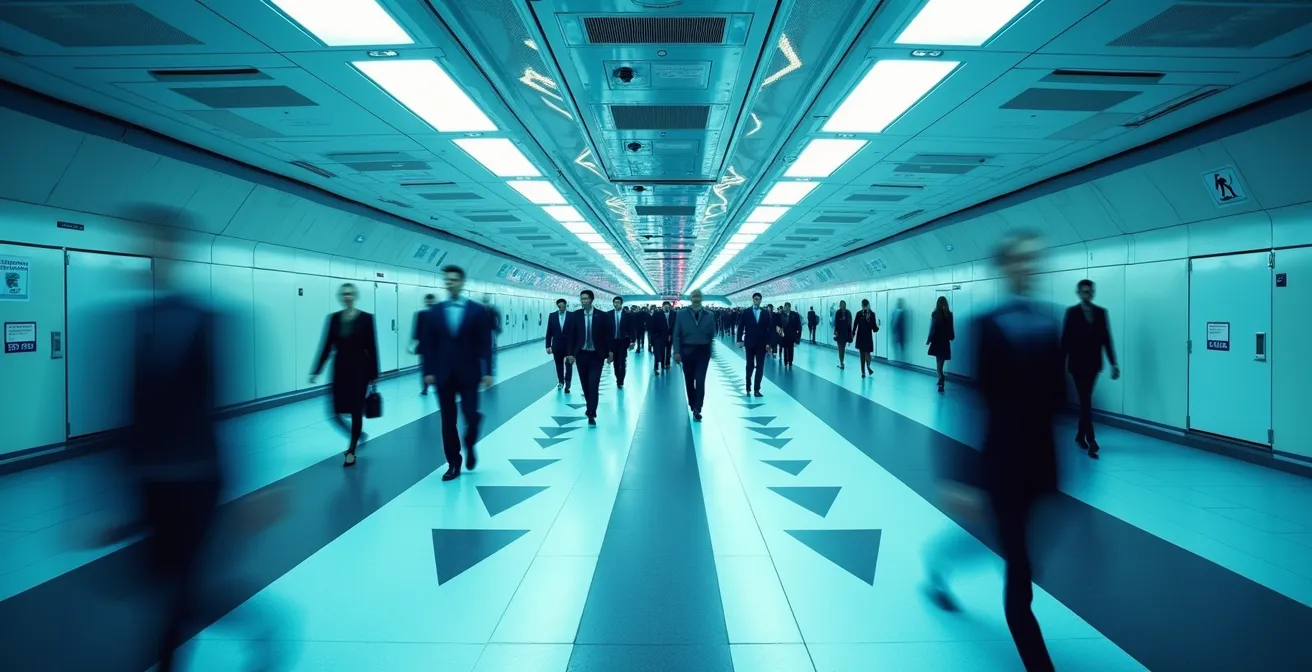
By treating the PATH not as a confusing maze but as a strategic asset, you can turn a major city-wide disruption into a minor inconvenience, demonstrating a high level of travel savvy. It is the perfect example of using hidden infrastructure to maintain your itinerary’s efficiency.
The Guest Mistake: Are You Allowed to Have More Than 4 Guests in Your Airbnb Suite?
Your strategic planning shouldn’t stop at transit. Choosing accommodation involves navigating another layer of local regulations, particularly concerning short-term rentals like Airbnb. A common mistake visitors make is assuming that a listing’s stated capacity is the only rule that matters. In Toronto, strict municipal bylaws are in place to curb the proliferation of “ghost hotels” and preserve housing for residents, and these rules have direct implications for travelers, especially larger groups.
The most important regulation is the principal residence rule. In Toronto, hosts are only legally permitted to rent out the property where they live for most of the year. This has significantly reduced the availability of large, multi-room units that can accommodate big groups or parties, as most of these were investment properties, not primary homes. This means that if you find a listing for a massive condo that seems to be available year-round, it may be operating illegally, putting your booking at risk of cancellation.
Furthermore, exceeding the registered number of guests on a booking carries significant risks beyond just violating platform rules. Toronto condo boards have their own occupancy limits, and building security can deny entry to unregistered guests. More critically, from an insurance perspective, having unregistered individuals in the unit can create a major liability. Under many Canadian insurance policies, any incident or injury involving an unregistered guest may not be covered, exposing both the host and the booking guest to immense financial risk. Before booking a large space or planning to have extra visitors, it’s crucial to communicate clearly with the host and understand the legal and insurance landscape in Toronto.
The Transit Route That Connects Little Italy, Koreatown, and Greektown Quickly?
For the culturally curious traveler, Toronto’s greatest asset is its collection of vibrant, distinct neighborhoods. Exploring Little Italy, Koreatown, and Greektown offers a world tour in a single afternoon. The challenge is doing so efficiently. A common tourist approach might involve separate, time-consuming trips from a downtown hotel base. However, a much smarter strategy uses a single transit artery as a “Cultural Corridor,” turning a simple subway line into an efficient tool for neighborhood-hopping.
The key to this strategy is the Bloor-Danforth subway (Line 2). This single east-west line directly connects all three of these iconic neighborhoods. Once you are on this line—for instance, after taking the 900 Airport Express bus to Kipling Station—you can move between these cultural hubs with incredible ease. Exit at Ossington Station for the heart of Little Italy’s trattorias on College Street. Hop back on and go two stops east to Christie Station for the bustling restaurants and shops of Koreatown. Continue east to Pape Station to immerse yourself in the traditional tavernas and bakeries of Greektown on the Danforth.
What makes this strategy so powerful is Toronto’s fare integration system. The PRESTO card system enables a single $3.35 TTC fare to allow unlimited transfers within 2 hours. This means you can complete this entire multi-neighborhood tour for the price of one ride, provided you move efficiently. This “Triple-Culture Airport Express Route” is the epitome of strategic transit: it’s economical, efficient, and transforms a logistical challenge into a rich cultural experience. It’s a prime example of leveraging local transit knowledge to build a better itinerary, something a simple UP Express ride to Union Station can never offer.
Day Trip or Overnight: Is the Falls Illumination Worth Staying Late For?
The strategic mindset developed for navigating Toronto is equally valuable when planning the quintessential side trip to Niagara Falls. The most common question travelers face is whether to make it a long day trip or invest in an overnight stay. The answer depends on a careful cost-benefit analysis, weighing transportation costs against the value of the evening and early morning experiences. The nightly Falls Illumination is a major draw, but staying for it carries logistical and financial implications that must be considered.
A day trip is the most straightforward option, typically utilizing the GO Train for a round trip. It’s cost-effective and allows you to see the main attraction. However, it means you’ll be there during peak crowd hours and will almost certainly miss the evening illumination, as the last trains back to Toronto often depart before the light show concludes. Missing the last train forces a traveler into an expensive emergency taxi or rideshare, a costly mistake that can ruin a budget.
An overnight stay, while more expensive upfront due to accommodation costs, unlocks significant value. It allows you to experience the Falls Illumination without the stress of a looming departure. It also grants you access to Clifton Hill’s nightlife and, most importantly, the opportunity to see the falls in the early morning. Viewing the falls before 8 AM, enveloped in morning mist and free from the throngs of tour buses, is a magical experience that day-trippers miss entirely. By booking a hotel within walking distance, you also eliminate local parking and transportation hassles.
The following table provides a clear financial and experiential comparison to help you make the right decision for your travel style and budget. The analysis shows that while an overnight stay costs more, the added benefits can easily justify the expense.
| Option | Transportation Cost | Accommodation | Total Cost | Experience Benefits |
|---|---|---|---|---|
| Day Trip | $30-40 GO Train round trip | $0 | $30-40 | Falls viewing, limited attractions |
| Overnight | $15-20 GO Train one-way | $80-120 budget hotel | $95-140 | Illumination, Clifton Hill nightlife, morning mist viewing |
| Late Return Risk | $150+ emergency taxi | $0 | $150+ | Stress of missing last train |
For those choosing to stay, a well-planned itinerary is key. Arriving mid-afternoon, enjoying the evening, and experiencing the quiet morning before taking a late morning train back to Toronto is the optimal approach for maximizing the value of an overnight trip.
Key Takeaways
- Think Beyond Union Station: Your true destination is your hotel or first activity, not the central station. Choose the transit option that gets you closer to it.
- Value Experience, Not Just Speed: The “best” route might be the one that lets you grab an authentic meal or see a unique sight along the way. Calculate your “experience-per-fare.”
- Leverage Local Infrastructure: Use tools like the PATH system and multi-hour fare transfers to overcome obstacles and unlock efficiencies that tourists often miss.
How to Experience Niagara Falls Without Feeling Like a Sardine in a Crowd?
The single biggest complaint about visiting Niagara Falls is the crowds. During peak season, the main viewing areas can feel overwhelming, detracting from the natural wonder. While traveling off-season is the most obvious advice, it’s not always practical. The true strategic solution involves a counter-intuitive approach to timing and logistics: the “Reverse Commute” strategy. This method avoids crowds by flipping the typical tourist schedule on its head.
Instead of going from Toronto to Niagara during the day with everyone else, consider driving or taking a car service directly from Pearson Airport (YYZ) to Niagara Falls upon landing. This takes advantage of reverse traffic patterns, avoiding the notorious rush hour congestion heading into Toronto. You arrive at the falls in the late afternoon as the day-trippers are beginning to leave. This allows you to check into your hotel, have a relaxed dinner, and enjoy the evening Falls Illumination with significantly smaller crowds.
The real magic happens the next morning. By waking early, you can experience the falls between 7 AM and 9 AM, a time when the viewing platforms are virtually empty. You get the iconic morning mist photos without a single tour bus in sight. After a leisurely morning, you then travel from Niagara into Toronto late in the morning, once again avoiding the peak inbound rush hour. This strategy not only provides the best possible viewing experience at the falls but also makes the travel to and from Toronto far less stressful. For maximum effect, tourism data indicates that mid-week visits in May see 60% fewer visitors compared to summer weekends, making this the absolute optimal time to execute this strategy.
To further escape the crowds, explore beyond the main promenade. The Niagara Glen Nature Centre offers stunning hiking trails down into the gorge, providing a completely different and more intimate perspective of the powerful Niagara River rapids, far from the packed railings above.
By applying this analytical and strategic approach to every leg of your journey, from the moment you land at YYZ to your side trips, you transform a standard vacation into a masterclass in efficient, experience-rich travel.
Frequently Asked Questions About Toronto Travel Logistics
What is Toronto’s principal residence rule for short-term rentals?
Hosts can only rent out their principal residence, meaning the property where they live most of the year. This city bylaw significantly limits the availability of large, party-sized suites and makes listings for entire homes that are always available potentially illegal.
How can I identify potentially illegal ‘ghost hotel’ listings?
Be wary of hosts managing multiple properties, listings with generic stock photos, a missing or invalid city-issued license number, and properties that appear to be permanently available for rent. These are all red flags for non-compliant listings that could be shut down.
What are the insurance risks of having unregistered guests?
If an unregistered guest is injured in the rental unit, both the host’s property insurance and potentially the booking guest’s travel insurance may be voided under Canadian insurance regulations. This creates a significant personal liability risk for the person who made the booking.