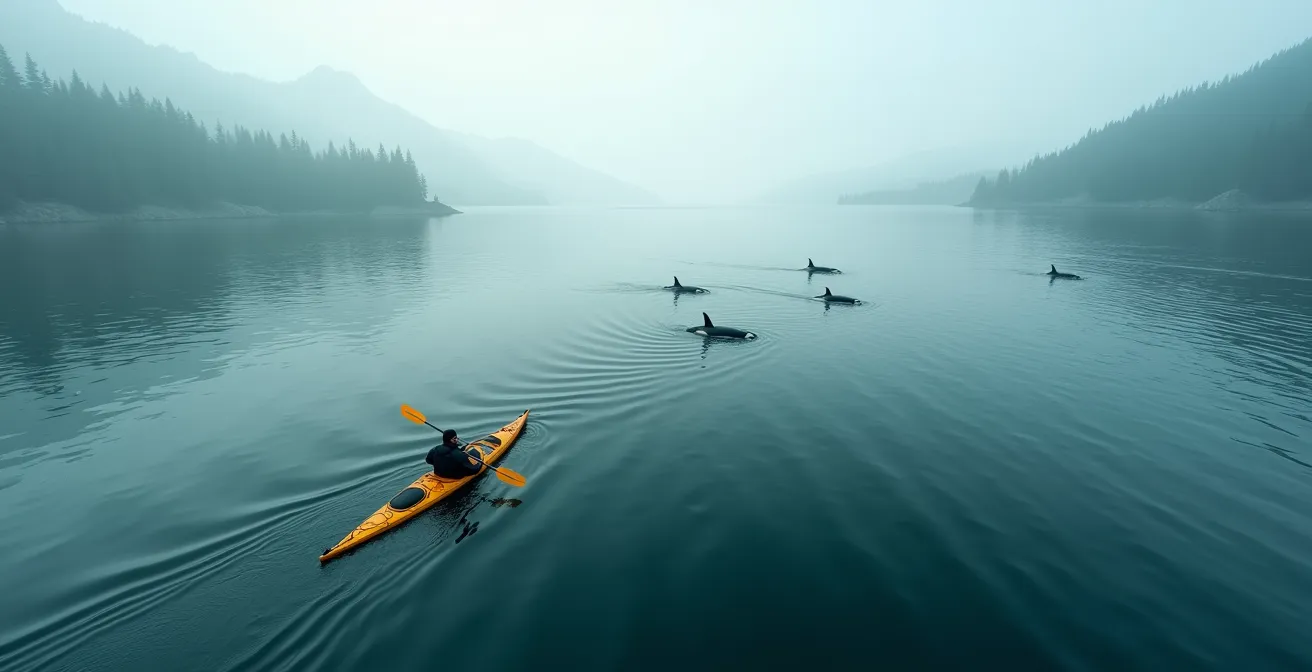
Operating a kayak in orca territory is not a tourist activity; it is a regulated undertaking where the whale’s welfare supersedes your desire for a close encounter.
- The 400-meter approach distance is a federal law in Canada, not a suggestion. Violations carry significant penalties.
- Your survival depends on mandatory skills and specialized gear (drysuits, not just PFDs) to counteract the lethal threat of cold water shock.
Recommendation: Do not attempt to paddle in known orca waters without certified training, proper cold-water immersion gear, and a complete understanding of your legal obligations under Canada’s Marine Mammal Regulations.
The allure is undeniable: the sleek black dorsal fin slicing through the steely waters of the Pacific Northwest. For an adventure kayaker, the dream of paddling in the presence of orcas is a powerful one. However, this dream is turning into a significant problem for marine enforcement. Many paddlers, driven by enthusiasm and a lack of understanding, are dangerously misinterpreting the realities of this environment. They believe a life jacket and a bit of luck are sufficient. They think that “respecting the whales” is a matter of personal judgment.
They are wrong. In Canadian waters, your interaction with marine mammals, particularly the vulnerable killer whale populations, is governed by strict federal law. The thrill of the experience does not exempt you from regulatory compliance. The core principle is not about getting a good photo; it’s about mitigating the acoustic and physical stress that your presence causes. The 400-meter minimum approach distance is not a guideline to be negotiated; it is a hard boundary with legal consequences.
This document is not a guide to finding whales. It is a briefing on your legal and ethical obligations as a vessel operator in their critical habitat. We will dissect the mandatory skills you must possess before even considering launching, the gear that is essential for survival, not comfort, and the specific regulations you are required to follow. This is about shifting your mindset from a thrill-seeker to a responsible operator who understands that the ocean is the orcas’ home, and you are merely a visitor with a duty of care.
The following sections will detail the non-negotiable requirements for operating a kayak in these protected waters. This information is designed to ensure the safety of the whales and, secondarily, your own. Pay close attention, as ignorance of the law is not a defence.
Summary: A Kayaker’s Compliance Briefing for Orca Waters
- Why a Wet Exit Skill is Mandatory Before Kayaking in Orca Waters?
- Telegraph Cove vs Victoria: Which Launch Site Has Higher Orca Probability?
- Dry Suit or Wetsuit: What is Necessary for Pacific Ocean Paddling?
- Transient vs Resident Orcas: Which Pods Are Less Predictable for Kayakers?
- Solo Paddling: Why Going Alone in the Johnstone Strait is a Bad Idea?
- How Long Can You Survive in 5°C Water Without a Survival Suit?
- Slack Tide vs Mid-Tide: When Is It Safe to Kayak Through Narrow Channels?
- How to Kayak from Downtown Vancouver to Stanley Park in Under 2 Hours?
Why a Wet Exit Skill is Mandatory Before Kayaking in Orca Waters?
Let’s be unequivocally clear: if you cannot flawlessly execute a wet exit from your kayak, you have no business being in cold, open water where orcas are present. This is not a “nice to have” skill; it is the absolute foundation of your survival protocol. In the event of a capsize—caused by a sudden rogue wave, a loss of balance, or even the wake from a distant vessel—your ability to get out of an overturned boat is the first step in a life-or-death sequence. The frigid Pacific water is an immediate and lethal threat. The initial gasp reflex from cold shock can cause you to drown instantly if your head is submerged. In fact, research from the Sea Kayak Association of BC shows that 20% of cold water deaths occur within the first two minutes of immersion, often before hypothermia even begins.
A wet exit is your only defence against being trapped and disoriented underwater. It involves remaining calm, pulling the grab loop on your spray skirt, and pushing yourself free from the cockpit. Without practice, panic is almost a certainty. You will fumble with the grab loop, your breath will run out, and the situation will escalate catastrophically. Proficiency isn’t about knowing the steps in theory; it’s about having the muscle memory to perform them under the extreme duress of being upside down in freezing, dark water.
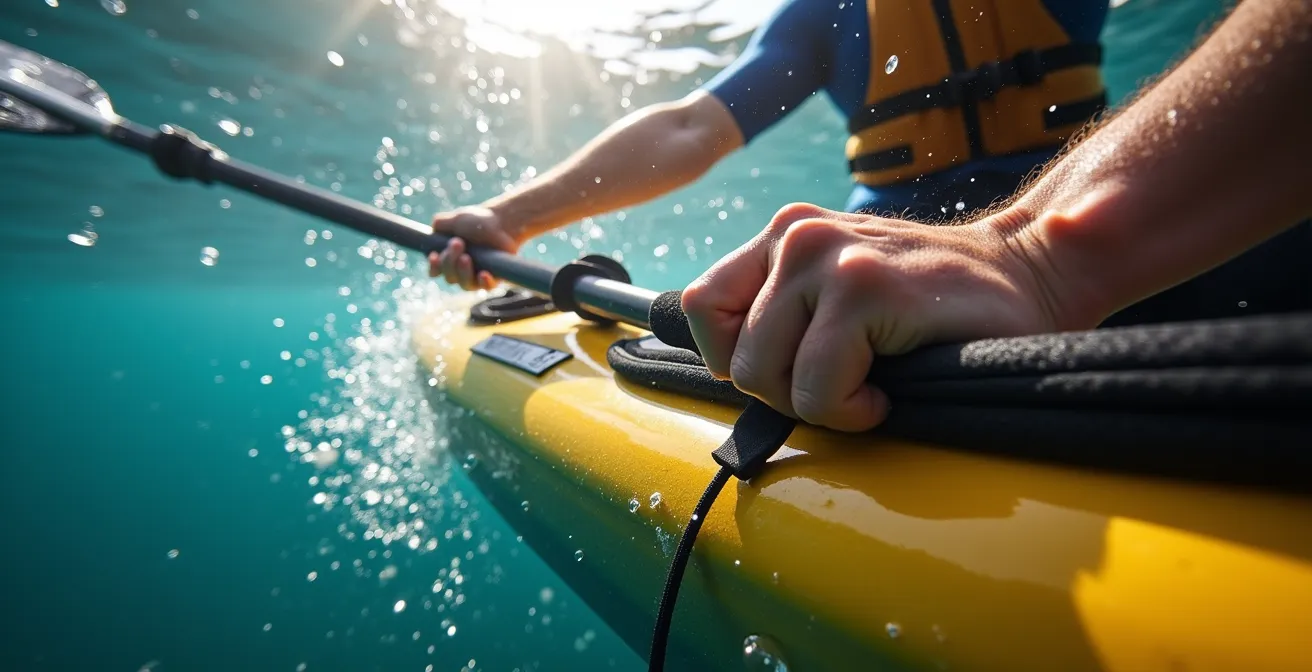
As the image above illustrates, the maneuver requires a calm, deliberate action in a completely disorienting environment. This is why certification and training in a controlled setting, like a pool, are not optional. You must prove your competence before you expose yourself to the unforgiving reality of the open ocean. Your life depends on this single, fundamental skill. It is the prerequisite for everything that follows.
Your Mandatory Wet Exit Proficiency Checklist: Required Milestones
- Practice wet exit in warm pool water with an instructor beside you.
- Demonstrate the ability to swim one length of the pool with any stroke, wearing your paddling gear.
- Practice comfort maneuvers with a PFD: roll face-down in the water, then calmly rotate to a face-up position.
- Execute a wet exit independently, demonstrating proper spray skirt removal technique.
- Progress to cold water practice while wearing your full drysuit or wetsuit ensemble.
Telegraph Cove vs Victoria: Which Launch Site Has Higher Orca Probability?
Choosing a launch site is not about convenience; it’s a strategic decision that dictates the type of encounter you may have and the specific regulations you’ll face. The two primary hubs for orca-related kayaking in British Columbia, Telegraph Cove and Victoria, offer vastly different environmental and biological contexts. From an enforcement perspective, it’s crucial to understand that a higher probability of sightings also means a higher probability of accidental non-compliance. Johnstone Strait, accessed from Telegraph Cove, is arguably the most reliable place in the world to see Northern Resident orcas. This is not by chance. The area is a critical salmon migration route and features unique “rubbing beaches” that attract over 200 members of the northern resident community. The predictability of these fish-eating whales makes for a high success rate for sightings, but also concentrates a high volume of marine traffic in a sensitive area.
In contrast, the waters around Victoria are the core critical habitat for the endangered Southern Resident Killer Whales (SRKW). While sightings are possible, they are less predictable, and the pods are under extreme environmental stress. This has led to the establishment of multiple legal sanctuary zones where vessel traffic is strictly prohibited. The regulatory landscape here is more complex and fraught with legal peril for the uninformed paddler.
The following table breaks down the key factors. It is your responsibility to understand these differences to inform your trip plan and ensure compliance.
| Factor | Telegraph Cove/Johnstone Strait | Victoria Waters |
|---|---|---|
| Orca Success Rate | 90%+ during peak season | Variable, lower overall |
| Primary Whale Type | Northern Residents + Bigg’s (Transients) | Southern Residents (endangered) |
| Legal Distance Required | 400m for all orcas | 400m for all orcas |
| Peak Season | Mid-July to mid-September | May to October |
| Critical Habitat Zones | Robson Bight Reserve nearby | Multiple SRKW sanctuary zones |
| Water Temperature | 8-12°C summer average | 10-14°C summer average |
Dry Suit or Wetsuit: What is Necessary for Pacific Ocean Paddling?
This is not a debate about comfort. It is a matter of survival. The average summer water temperature in British Columbia’s core kayaking areas hovers between 8°C and 14°C. Immersion in water this cold is a medical emergency from the first second. A common misconception among recreational paddlers is that a standard PFD (Personal Flotation Device) is sufficient protection. It is not. A PFD will keep you afloat, but it offers almost no thermal protection. Without proper immersion gear, you are facing a rapid, predictable progression toward death. Cold shock, cold incapacitation, and then hypothermia will set in. According to Canadian water safety guidelines, cardiac arrest is possible within minutes in water below 15°C.
The choice is between a wetsuit and a drysuit. A wetsuit works by trapping a thin layer of water against your skin, which is then warmed by your body. It can extend your functional survival time significantly. However, it is not a perfect solution, as you are still wet and will eventually succumb to the cold. A drysuit is the superior—and for serious paddling in these waters, the necessary—piece of equipment. It keeps you completely dry, and when paired with appropriate insulating layers underneath, it provides the maximum possible protection. The difference in survival time is not academic; it’s the difference between self-rescue being possible versus becoming a body recovery mission.
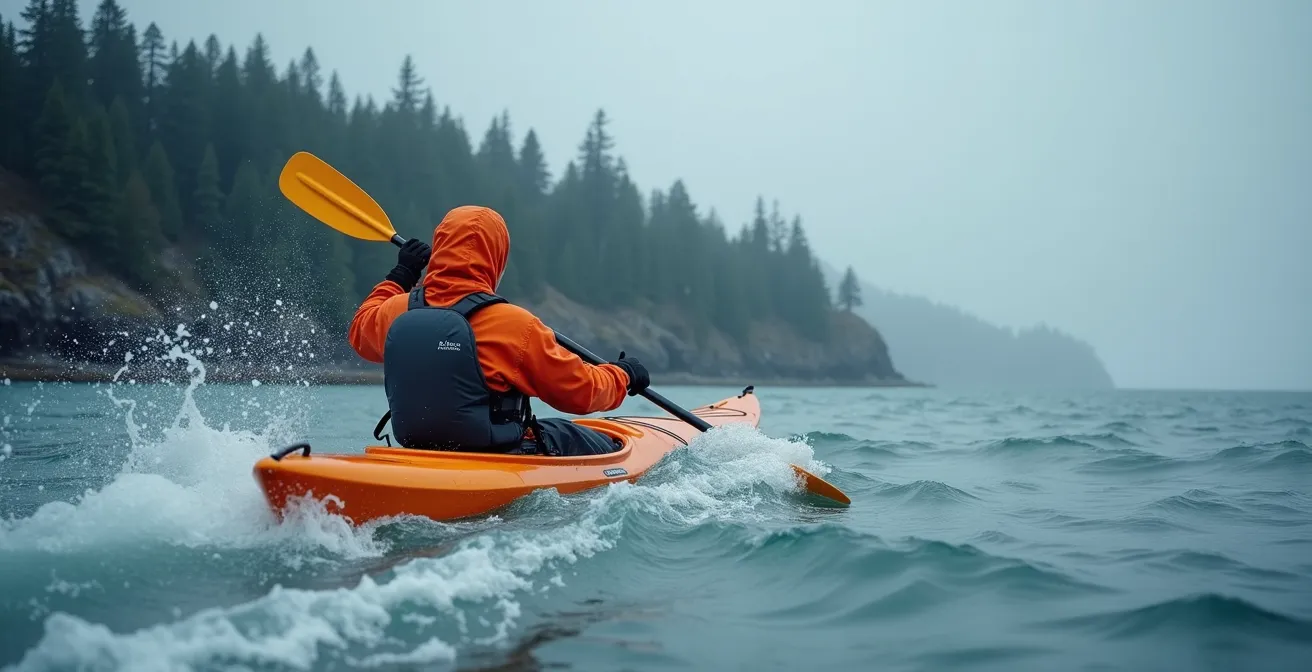
As Transport Canada states in its official safety materials, the consequences of inadequate gear are dire. The following is not an opinion; it is a statement of fact from a federal authority:
Without a wetsuit/drysuit you will likely go into cardiac arrest after about an hour in cold water. A wet suit can add many hours survival time and a dry suit with proper layers can add well over a day.
– Transport Canada Safety Guide, as cited in OutdoorsNB Water and Cold Water Safety Guide
Transient vs Resident Orcas: Which Pods Are Less Predictable for Kayakers?
Not all orcas are the same, and your ability to comply with the 400-meter approach distance depends heavily on understanding their fundamental behavioural differences. The orcas of the Salish Sea are primarily divided into two ecotypes: the fish-eating Residents (Northern and Southern) and the mammal-eating Bigg’s Killer Whales (also known as Transients). From a kayaker’s perspective, the Bigg’s Killer Whales are significantly more dangerous and less predictable.
Resident orcas, whose diet consists almost entirely of salmon, travel in larger, more social family groups. They use complex echolocation clicks and calls to find their prey and communicate. This makes them more acoustically “visible” and their travel patterns, which often follow predictable salmon migration routes, are better understood. While their presence is never guaranteed, experienced guides and researchers have a solid grasp of where the over 230 Northern Resident orcas that visit Johnstone Strait are likely to be in the summer.
In stark contrast, Bigg’s Killer Whales are stealth hunters. Their prey—seals, sea lions, and porpoises—have excellent hearing. To avoid detection, Bigg’s orcas travel in smaller, tighter groups and are often acoustically silent for long periods. They use passive listening to find their prey, ambushing them in shallow coastal areas. This “stealth mode” behaviour is what makes them so unpredictable for a kayaker. A silent pod can surface without warning, placing a paddler in immediate violation of the 400-meter rule and, more critically, in the middle of a hunt. Marine biologists have documented this behaviour extensively; kayakers may inadvertently surprise a silent-running pod near shorelines where seals congregate, creating a dangerous and illegal situation for both whale and human.
Solo Paddling: Why Going Alone in the Johnstone Strait is a Bad Idea?
The decision to paddle solo in a remote, dynamic environment like the Johnstone Strait is not a display of skill; it is an act of recklessness. From a regulatory and safety standpoint, solo paddling removes all layers of redundancy that are critical for survival and compliance in orca territory. You are a single point of failure in a system that demands backups. If you capsize, there is no one to assist with a rescue. If you have a medical emergency, there is no one to call for help. If you lose or break your paddle, there is no spare. Most importantly, when it comes to wildlife, a solo paddler is less visible to whales and other boaters and has no second pair of eyes to verify distances and monitor for approaching animals.
Group paddling is not about socializing; it is a formal safety protocol. An effective group acts as a single, more visible unit and has a structured plan for managing risk. This includes:
- Designating a lead spotter to constantly scan for whale blows and dorsal fins.
- Maintaining constant visual and voice contact between all kayaks.
- Rafting kayaks together to create a larger, more stable, and more visible profile when orcas are present.
- Establishing pre-agreed hand signals for silent communication to avoid disturbing whales.
- Practicing assisted rescue techniques (T-rescues) until they are second nature *before* entering orca territory.
Professional guides, who spend their lives in these waters, are unanimous in their assessment of the risks. Larry Roy, a veteran guide in Telegraph Cove since 1986, emphasizes the critical safety net that only a group can provide.
Larry Roy…emphasizing that solo paddlers lack the critical safety redundancy that group dynamics provide, especially regarding emergency response and wildlife distance compliance verification.
– Larry Roy, owner of Discovery Kayaking Ltd.
How Long Can You Survive in 5°C Water Without a Survival Suit?
The answer is brutally simple: not long. To be precise, you should measure your survival time in minutes, not hours. The fantasy of a hearty individual with strong willpower surviving for an extended period in 5°C water is a dangerous myth. The physiological response to sudden cold water immersion is involuntary, immediate, and violent. It is not something you can control through mental toughness. The first stage is cold shock, which occurs in the first 1-3 minutes. It consists of an uncontrollable gasp for air followed by hyperventilation. As cold water safety expert Moulton Avery warns, the consequences are often immediate.
If your mouth is underwater when you gasp, you will immediately drown. Many kayakers have been found upside down, still inside their boats, because they died before they could even wet exit.
– Moulton Avery, National Center for Cold Water Safety
If you survive the initial cold shock, you enter the second stage: cold incapacitation. Over the next 5 to 15 minutes, the cold water will drastically cool your peripheral tissues. Your arm and leg muscles will lose function. Your hands will become useless claws, unable to grip a paddle, operate a radio, or deploy a flare. You will lose the ability to swim and keep your head above water, even with a PFD, as you can no longer control your body position. This is why the “swim to shore” mentality is so deadly; your functional swimming distance in 5°C water is likely less than 100 meters, regardless of your fitness level.
Only after these first two stages does hypothermia, the cooling of your body’s core, become the primary threat. This process can take 30 minutes or more to lead to unconsciousness. The stark reality is that most cold water fatalities are not due to hypothermia. They are deaths by drowning, triggered by the immediate and disabling effects of cold shock and incapacitation. A survival suit (drysuit) is the only tool that gives you a fighting chance by keeping you dry and delaying this deadly sequence.
Slack Tide vs Mid-Tide: When Is It Safe to Kayak Through Narrow Channels?
Tidal currents are an invisible but powerful force that can render your best intentions to respect the 400-meter rule completely meaningless. In the narrow channels and passes common in British Columbia, currents can run faster than a kayaker can paddle. Attempting to hold your position against a 3-knot current is exhausting; against a 5-knot current, it is impossible. This is why timing your passage through these areas is not just a good idea—it is a critical component of regulatory compliance. A strong ebb or flood tide can push you inside the legal 400-meter buffer zone in a matter of minutes, turning you from a law-abiding observer into an offender, with no ability to extricate yourself.
The only safe time to navigate narrow or constricted channels is during slack tide. This is the short period, often lasting only 20-30 minutes, between the flood and ebb tides when the water is still. During slack, your position is manageable, and you have full control of your vessel to maintain legal distances. Paddling at mid-tide, when the current is running at or near its maximum speed, is an invitation for disaster. The ecological reserve at Race Rocks near Victoria is a prime example. It is a critical habitat for Southern Resident killer whales where the 400m distance rule is strictly enforced, but currents can exceed 7 knots. DFO enforcement has noted multiple unintentional breaches here by vessel operators who misjudged the power of the tide.
This table quantifies the risk. It illustrates how quickly tidal currents can move a drifting kayak, demonstrating why positioning during mid-tide is a losing battle.
| Tide State | Current Speed | Drift in 2 Minutes | Compliance Risk |
|---|---|---|---|
| Slack Tide | 0-1 knot | 0-60 meters | Low – Manageable positioning |
| Mid-Tide (Ebb) | 3-4 knots | 180-240 meters | High – May breach 400m buffer |
| Max Current | 5-6 knots | 300-360 meters | Critical – Loss of control likely |
| Race/Rapids | 8+ knots | 480+ meters | Extreme – Avoid completely |
Key Takeaways
- The 400-meter approach distance for all orcas in Canadian Pacific waters is a non-negotiable federal law.
- Your gear, specifically a drysuit or wetsuit, is survival equipment, not for comfort. Its purpose is to defeat the lethal effects of cold water shock.
- Solo paddling is forbidden by logic and best practice. Group paddling with established communication and rescue protocols is the minimum operational standard.
How to Kayak from Downtown Vancouver to Stanley Park in Under 2 Hours?
While the route from downtown Vancouver around Stanley Park may seem like a simple urban paddle, it is governed by the same federal laws and exposed to the same potential wildlife encounters as remote wilderness areas. Burrard Inlet is a busy commercial harbour, but it is also a dynamic marine ecosystem. Whales, including orcas and humpbacks, are increasingly sighted in these waters. The assumption that city paddling is “safer” or exempt from wildlife regulations is dangerously false. The law is the law, everywhere. As confirmed by a recent bulletin, Transport Canada’s 2024 regulations confirm a 400m minimum distance must be maintained from all killer whales, even within the port’s boundaries.
Paddling this route requires a dual awareness: you must manage the risks of a busy industrial port while simultaneously being prepared for a sudden wildlife encounter. This involves constant vigilance, communication, and a clear understanding of the specific protocols for urban waterways. Unlike a remote channel, you are sharing the water with freighters, cruise ships, floatplanes, and fast-moving water taxis. Your primary responsibility is to be predictable and stay out of their way, typically by hugging the shoreline. Your secondary, but equally important, responsibility is to follow the established wildlife reporting and avoidance protocol for the harbour.
If you choose to operate in this complex environment, you must adhere to the following Urban Harbour Wildlife Protocol:
- Monitor VHF Marine Radio Channel 16 for safety announcements and Channel 12 for Vancouver Harbour Traffic updates.
- Report any whale sighting immediately to the Coast Guard or harbour authorities via VHF radio.
- If whales appear on your route, move to the nearest shoreline or marina breakwater and wait for them to pass. Do not attempt to follow or intercept them.
- Signal your awareness to larger vessels by holding your paddle vertically if you are in a potentially confusing situation.
- Maintain the 400-meter distance, even if it feels restrictive in the confined spaces of the harbour.
- Submit your sighting details to the B.C. Cetacean Sightings Network via their WhaleReport app to contribute to crucial research data.
Your responsibility as a kayaker is to be an asset to marine safety, not a liability. This requires training, the correct equipment, and an unwavering commitment to respecting the laws designed to protect these vulnerable marine mammals. Before you next plan a trip, ensure you have met every requirement outlined in this briefing. The whales’ survival depends on it.