In summary:
- Choose footwear for grip, not just warmth, with flexible rubber soles and deep treads to handle uneven, icy cobblestones.
- Proactively treat leather boots with water and stain protectors to combat the chemical assault of Montreal’s road salt.
- Use the RESO (Underground City) as a strategic network to bypass the worst weather and festival crowds.
- Understand that street signs are in French by law to preserve cultural heritage, not to confuse visitors.
- Recognize that authentic poutine sauce is a complex stock-based creation, not just a simple beef gravy.
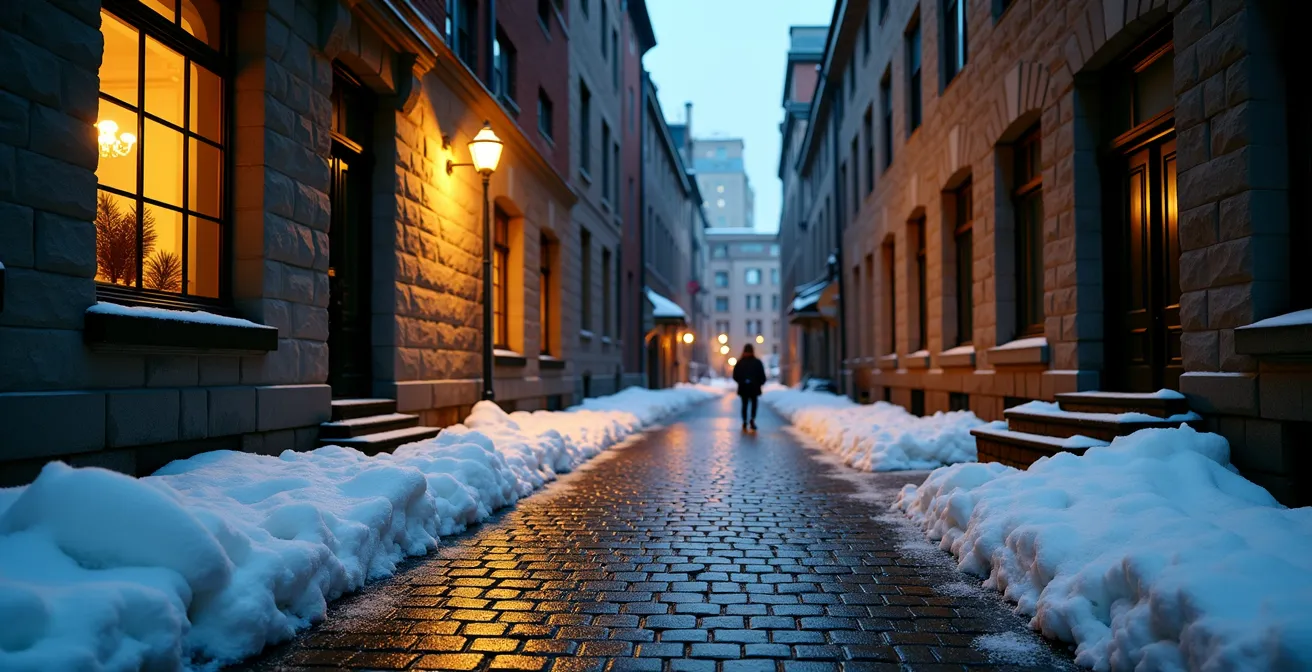
The postcard image of Old Montreal in winter is intoxicating: gas lamps casting a golden glow on a fresh blanket of snow, the stone facades of historic buildings dusted in white. But for the unprepared tourist, this romantic scene quickly gives way to a harsh reality—the treacherous physics of walking on centuries-old cobblestones slick with ice. Most advice boils down to generic platitudes like “wear warm boots” or “be careful.” While well-intentioned, this ignores the unique challenge. Navigating this environment isn’t about braving the cold; it’s about mastering a specific, unforgiving terrain where uneven surfaces meet black ice and corrosive de-icing chemicals.
The true key to conquering Montreal’s winter streets lies in a form of terrain intelligence. It’s about understanding why certain boot treads fail while others grip, how to wage a preventative war against the salt that devours leather, and when to abandon the charming streets for the city’s secret subterranean network. This is more than a walking tour; it’s a lesson in urban winter survival. This guide will equip you with that knowledge, moving beyond the obvious to provide a strategic system for footwear, movement, and cultural navigation. We will explore the science of ice stability, the legal reasons behind the city’s linguistic landscape, and even where to find the perfect reward—a truly authentic poutine—after a day of savvy exploration.
To help you navigate this comprehensive guide, the summary below outlines the key topics we will cover, from practical travel tips to deep dives into Montreal’s unique cultural fabric.
Summary : A Strategic Guide to Montreal’s Winter Charms and Challenges
- Where Are the Best Unpretentious, Traditional French Bistros in the Plateau?
- Why Are Some Street Signs Only in French in Old Montreal?
- The Best Metro Exit to Reach the Underground City from Place des Arts?
- The Salt Stain Error: How to Protect Leather Shoes from Montreal’s Winter Chemicals?
- How to Walk Through the Latin Quarter During Just For Laughs Without Getting Stuck?
- January or March: Which Month Offers the Best Ice Structure Stability?
- The Photography Rule for Religious Sites in Montreal’s Diverse Neighbourhoods?
- What is the Secret Ingredient That Makes Quebec Poutine Sauce Unique?
Where Are the Best Unpretentious, Traditional French Bistros in the Plateau?
After a day of careful navigation, a comforting meal is in order. The Plateau Mont-Royal, with its bohemian vibe and European feel, is a prime location for finding an authentic French bistro. The key is knowing how to separate the tourist traps from the treasured local spots. The neighbourhood’s design is your first clue; it is intentionally built for pedestrians. In fact, local data confirms the Plateau achieves a Walk Score of 92 out of 100, making it one of Montreal’s most walkable districts. This density and walkability foster an environment where small, family-run establishments can thrive, often hidden in plain sight.
Forget generic online searches. Finding a truly unpretentious bistro requires a bit of on-the-ground detective work. These places rely on local regulars, not flashy marketing. They are often tucked away in the ground floors of the Plateau’s iconic “plex” apartment buildings, with simple awnings and menus that prioritize classic dishes over fleeting trends. Your best bet is to wander the side streets branching off the main arteries of Boulevard Saint-Laurent and Rue Saint-Denis, where lower rents allow for more reasonable prices and a commitment to tradition. If you see a cozy spot bustling with locals during lunchtime, you’ve likely found your destination.
Your Action Plan: Locating an Authentic Plateau Bistro
- Focus your search on streets with mixed residential-commercial zoning, particularly along Boulevard Saint-Laurent and Rue Saint-Denis.
- Look for establishments in ground-floor spaces of traditional ‘plex’ buildings, as these typically house family-run bistros.
- Walk the side streets off main arteries where rent is lower, allowing traditional bistros to maintain reasonable prices.
- Visit during lunch hours when locals frequent these establishments, which indicates they are authentic neighbourhood favourites.
- Ask residents living above commercial spaces, as they know which bistros have maintained quality and tradition over time.
Ultimately, the most authentic experiences are found by observing local life, not by following the most obvious signs. This principle applies to dining as much as it does to navigating the city itself.
Why Are Some Street Signs Only in French in Old Montreal?
As you navigate the historic streets of Old Montreal, you’ll quickly notice that the street signs—”Rue Saint-Paul,” “Place Jacques-Cartier”—are exclusively in French. For a first-time visitor, this can seem like an oversight in a city known for its bilingualism. However, this is not an error; it is a deliberate and legally mandated act of cultural preservation. This linguistic landscape is a direct result of Quebec’s Charter of the French Language (Bill 101), which governs everything from commercial signage to official place names (toponymy).
The city’s urban planning policies reinforce this charter, especially in designated heritage districts. A deeper look into Montreal’s approach reveals that historical place names are classified as protected cultural elements, integral to the identity of the area. According to urban planning documents, these French-only zones correspond precisely with heritage conservation areas. This demonstrates an intentional strategy to preserve the city’s linguistic identity through urban design. The French names are not just descriptors; they are historical artifacts, connecting the modern streetscape to its French colonial origins. Viewing them in this context transforms them from a navigational hurdle into a living museum exhibit.
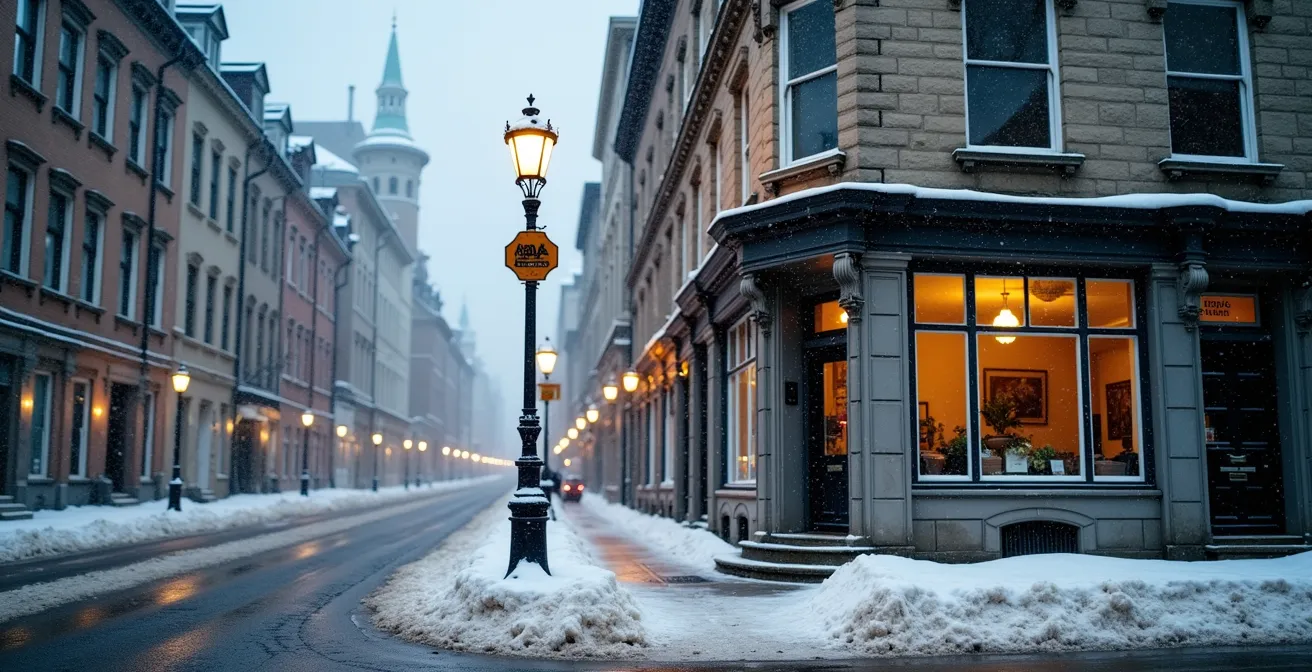
This commitment to heritage is what gives the district its unique atmosphere, especially in winter. The stone, the snow, and the French typography work together to create a scene that feels authentically rooted in its history, offering a deeper sense of place than a simple bilingual sign ever could.
So, when you see “Rue de la Commune,” you are not just seeing a street name; you are seeing a piece of legislated history, a testament to Quebec’s dedication to its unique cultural identity.
The Best Metro Exit to Reach the Underground City from Place des Arts?
When the wind whips down Sainte-Catherine Street and the sidewalks become a patchwork of ice, Montreal’s RESO, or Underground City, is a savoir. This subterranean network is not just a shopping mall; it is a critical piece of urban infrastructure. Spanning over 33 kilometers of tunnels, it connects metro stations, commercial centres, and office towers, allowing you to traverse a significant portion of downtown without ever stepping outside. For a tourist, the Place des Arts metro station is a key gateway to this network, but choosing the right exit is the difference between a seamless indoor journey and a frustrating, cold detour.
Not all exits are created equal. While the main exit for Place des Arts puts you on the street, forcing an outdoor crossing, other options provide direct, climate-controlled access to the RESO. The most efficient choice is the exit leading to Complexe Desjardins. This route is fully indoors, equipped with elevators, and requires no navigating of stairs or icy sidewalks. It deposits you directly into a major hub of the underground network, from which you can continue your journey. The following table breaks down the options, making the strategic choice clear.
As this comparative analysis of winter activities shows, leveraging the city’s infrastructure is key to a pleasant visit.
| Exit Point | Distance to RESO | Accessibility Features | Winter Protection |
|---|---|---|---|
| Exit to Complexe Desjardins | Direct connection | Elevators available, no stairs required | Fully indoor route |
| Exit to Place des Arts (main) | 200m outdoor | Escalators only, multiple level changes | Requires outdoor crossing |
| Exit to UQAM Pavilion | 100m tunnel | One elevator, then stairs | Heated tunnel connection |
By making the right choice at Place des Arts, you transform the metro from a simple transport method into a launchpad for a warm and efficient exploration of the city centre.
The Salt Stain Error: How to Protect Leather Shoes from Montreal’s Winter Chemicals?
The single greatest threat to your footwear in Montreal isn’t the snow or the ice—it’s the salt. The city employs a potent mix of road salt and calcium chloride to keep streets and sidewalks clear, and this chemical cocktail is ruthlessly efficient at destroying leather. It works by drawing out the natural oils and moisture, leaving behind brittle, cracked material and the infamous white “tide lines.” Many tourists make the fatal error of waiting until these stains appear to act, but by then, the damage has already begun. The proper approach is not treatment, but preventative chemical warfare.
Your defence strategy must begin before you even step outside. A high-quality water and stain protector, specifically one formulated to create a barrier against salt, is non-negotiable. This invisible shield is your first and most important line of defence. However, the battle doesn’t end there. Diligence is key. The moment you come indoors, you must wipe your boots clean with a damp cloth to remove any salty residue before it has time to penetrate the leather. Leaving them to dry overnight is the fastest way to permanent damage. This daily, weekly, and monthly maintenance protocol is what separates seasoned winter veterans from a tourist with ruined shoes.
ň
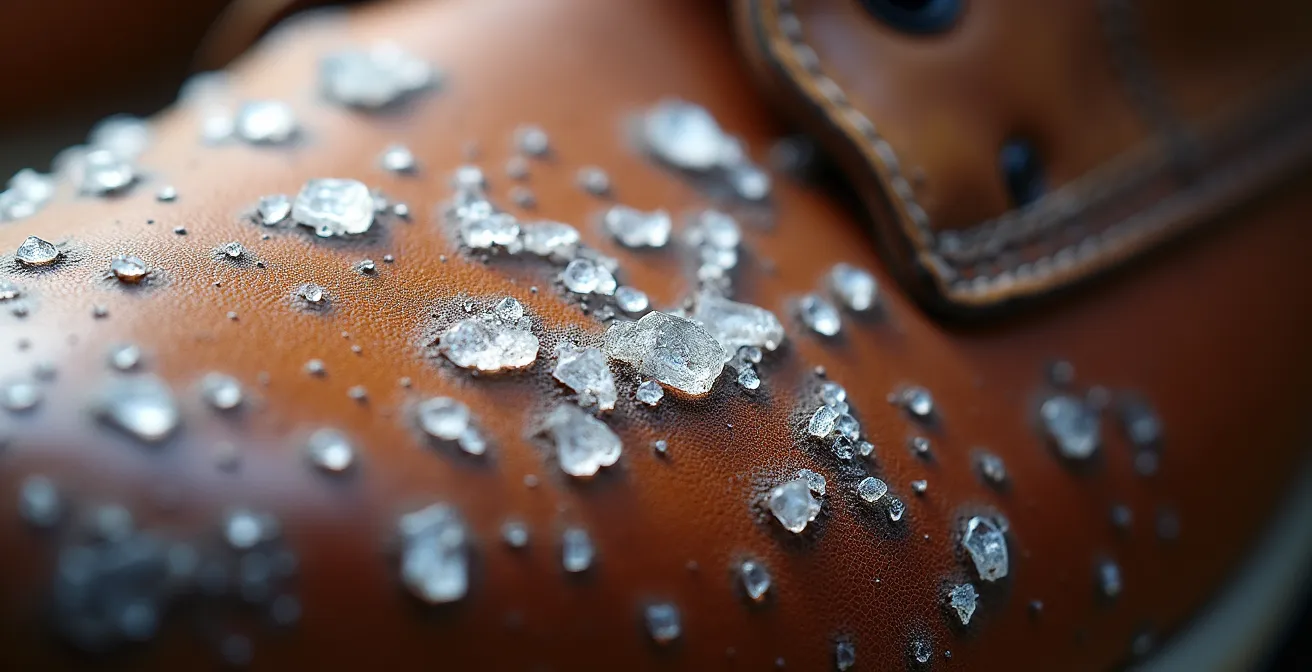
The protocol below outlines a professional-grade system for preserving your leather. For severe cases or end-of-season care, entrusting your boots to a local expert like Cordonnerie Rockland or Atelier Carinthia can restore them, but following these steps will minimize the need for such interventions.
Your Action Plan: Montreal Winter Shoe Protection Protocol
- Daily: Keep a towel by your door and dab boots dry immediately after entering, as salt damage occurs when left overnight.
- Weekly: Apply a water and stain protector like PRO-TEX to create an invisible shield against Montreal’s road salt and calcium chloride mix.
- Bi-weekly: Clean with a specialized salt remover, or a mix of one part white vinegar to three parts water for an emergency treatment.
- Monthly: Condition the leather with cream-based products to replace oils stripped by de-icing chemicals.
- Seasonal: Take your boots to a Montreal cobbler for professional treatment; recommended shops include Cordonnerie Rockland or Atelier Carinthia.
Think of your boots not as disposable items, but as critical equipment that requires maintenance to survive the uniquely harsh chemical environment of a Montreal winter.
How to Walk Through the Latin Quarter During Just For Laughs Without Getting Stuck?
In July, the Latin Quarter transforms. Rue Saint-Denis, its main artery, becomes a pedestrian-only zone, packed shoulder-to-shoulder with crowds for the Just For Laughs festival. Trying to move through this dense sea of people can be an exercise in futility. The secret to navigating this area during a major festival is not to push through the crowd, but to go *under* it. Once again, the RESO underground network acts as a strategic bypass route, allowing for swift movement parallel to the chaos happening at street level.
This strategy is particularly effective for moving between the festival’s main hubs. By entering the metro system at Berri-UQAM station, you can use the climate-controlled tunnels to travel west, beneath the most congested parts of Rue Saint-Denis. These passages connect directly to UQAM university buildings and, further on, to Complexe Desjardins and Place des Arts. This allows you to surface at strategic points, emerging just steps from your destination without having to battle the main festival crowds. It’s a classic Montreal move: using the city’s hidden infrastructure to outsmart the masses.
Of course, sometimes you need to be at street level. For those moments, timing is everything. The crowds are typically thinnest in the morning, before noon. During the afternoon, using parallel streets like Rue Saint-Hubert and only crossing over to Saint-Denis at your exact destination can save significant time. By evening, when the crowds are at their peak, the underground route becomes essential. After 11 PM, as the outdoor shows wind down and people move to indoor venues, the main streets become much more manageable again. Combining these timing strategies with the RESO bypass gives you complete control over your movement.
This multi-level approach to navigation is the ultimate proof of an experienced Montreal visitor, turning a potentially frustrating experience into a seamless one.
January or March: Which Month Offers the Best Ice Structure Stability?
For visitors drawn to Montreal’s winter festivals and their magnificent ice and snow sculptures, timing is everything. The visual difference between an ice castle in January and one in March can be dramatic. The stability and clarity of these frozen structures are entirely dependent on temperature consistency. Without question, January offers the most stable conditions. This is the heart of the deep freeze, a period when temperatures reliably stay well below freezing, often dipping below -15°C. This consistent cold is essential for both building and maintaining large-scale ice structures.
The organizers of the Fête des Neiges, Montreal’s premier snow festival, have perfected this timing. The festival is strategically scheduled for weekends throughout January and early February, deliberately avoiding the volatility of March. Construction of the ice slides and sculptures begins during January’s coldest spells. A mixture of dry, powdery snow and water is packed into molds and frozen solid during the frigid overnight hours. This process creates dense, strong ice capable of supporting significant weight and withstanding the wear and tear of festival-goers. It’s also a time when Montreal can experience major snowfalls of 30-40 cm in 24 hours, providing ample raw material.
In contrast, March is a month of transition. It is characterized by freeze-thaw cycles, where daytime temperatures can rise above 0°C, melting the surface of the ice, only for it to refreeze at night. This repeated melting and refreezing compromises the structural integrity of the ice, making it brittle, cloudy, and unsafe. Festival organizers typically begin dismantling the largest structures by late February to preempt this instability. For a tourist wanting to see the ice sculptures at their crystalline best, January is the clear winner.
What appears to be a simple creative choice in festival scheduling is, in fact, a carefully calculated decision based on the unforgiving principles of thermodynamics.
The Photography Rule for Religious Sites in Montreal’s Diverse Neighbourhoods?
Montreal’s skyline is punctuated by a stunning variety of religious buildings, from the grand Catholic basilicas of Old Montreal to the neighbourhood synagogues of Outremont and Hindu temples of Parc-Extension. For a photographer, these sites are incredibly alluring, but capturing them requires a deep sense of respect and an understanding of varying rules. There is no single photography policy; the “rule” is that each faith and community sets its own boundaries, and it is the visitor’s responsibility to know and respect them.
As a general guideline, the grand, historic Catholic churches like the Notre-Dame Basilica and St. Joseph’s Oratory, which are also major tourist attractions, typically permit interior photography, often in exchange for an admission fee or donation. However, photography is almost universally prohibited during services. In contrast, smaller community-focused places of worship, such as the synagogues in Outremont, generally forbid interior photography altogether to maintain the sanctity of the space. For these sites, your photography should be limited to the exterior, taken respectfully from public property. This distinction is legally important, as an interpretation of the Canadian Copyright Act states:
The exterior of a building, visible from public property, is generally permissible to photograph under Canadian law
– Canadian Copyright Act interpretation, Freedom of panorama provisions in Canadian law
This table provides a helpful overview, but the ultimate rule is to always look for signage at the entrance. If no signs are present and you are unsure, the most respectful course of action is to refrain from taking pictures or to quietly ask a staff member or volunteer if it is permitted.
| Religious Site Type | Interior Photography | During Services | Tourist Policy |
|---|---|---|---|
| Historic Catholic (Notre-Dame, St. Joseph’s) | Allowed with fee/donation | Prohibited | Official photo tours available |
| Neighborhood synagogues (Outremont) | Generally prohibited | Strictly forbidden | Exterior only from public property |
| Hindu/Buddhist temples (Parc-Extension) | Case-by-case basis | Not permitted | Shoes must be removed |
| Protestant churches | Usually permitted | No flash during service | Respectful distance required |
Ultimately, the best photograph is one that is taken with permission and respect, preserving the moment without disrupting the sanctity of the space.
Key takeaways
- Your primary defence against Montreal’s winter terrain is footwear with flexible rubber soles and deep, multi-directional treads for grip on uneven, icy cobblestones.
- Actively protect leather boots by applying a salt-specific protector weekly and wiping them clean of chemical residue immediately after coming indoors.
- Leverage the RESO (Underground City) not just for warmth, but as a strategic tool to bypass the most challenging weather and densest festival crowds.
What is the Secret Ingredient That Makes Quebec Poutine Sauce Unique?
After a day spent mastering the art of winter walking, there is no better reward than a steaming plate of poutine. Yet, many visitors are disappointed when they try versions outside of Quebec, finding the sauce to be a simple, salty beef gravy. They are left wondering what the secret is to an authentic Quebec poutine sauce. The answer is that there is no single “secret ingredient.” Rather, the uniqueness lies in its traditional culinary base: a complex, light-brown sauce made from a combination of chicken and veal stock, thickened with a light roux.
This foundation is fundamentally different from the heavy beef gravy often used as a shortcut. Authentic poutine sauce, or *sauce brune*, stems from Quebec’s tradition of *cuisine de réconfort* (comfort food), where rich, stock-based sauces were used to elevate simple, hearty ingredients. The flavour profile is more nuanced, seasoned with little more than black pepper and perhaps a hint of paprika, allowing the taste of the dual stocks to come through. The physics of the sauce are also critical: it must be hot enough to soften the fresh cheese curds so they “squeak,” but not so hot that it melts them into a greasy pool. Its viscosity must be perfect—thick enough to coat the fries, but not so thick that it turns them into a soggy mass.
For a tourist, identifying an authentic poutine comes down to a few key observations. The colour is the first clue: it should be a lighter, more golden brown than typical beef gravy. The reaction of the cheese is another: the curds should soften and stretch, not dissolve. Finally, the taste should have a savoury complexity that goes beyond just salt. Traditional establishments, or *cantines*, pride themselves on making their sauce fresh daily, never from a powder mix.
Your Action Plan: Identifying Authentic Poutine Sauce
- Check the color: Authentic sauce is a lighter brown than beef gravy due to its chicken and veal base.
- Test the consistency: It should coat the back of a spoon but still pour smoothly.
- Observe the cheese reaction: Proper temperature makes the curds soften and stretch, not melt completely.
- Taste for complexity: Multiple stock flavors should be detectable, not just salt and beef.
- Ask about the preparation: Traditional establishments make their sauce fresh daily, never from a powder.
Now that you’re equipped with the knowledge to navigate Montreal’s winter streets, culture, and cuisine, you can start planning your itinerary with the confidence of a local.