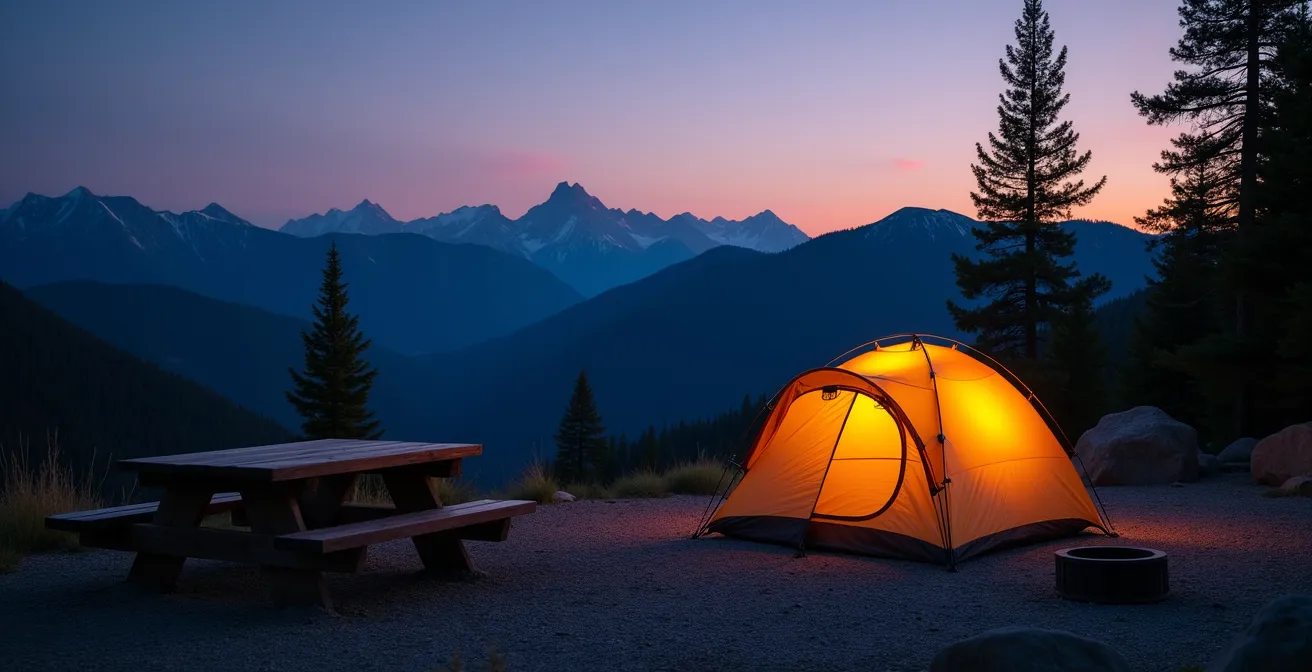
Securing a last-minute trip to the Canadian Rockies isn’t about luck; it’s about outsmarting the system with precision tactics.
- Master the two-stage shuttle release system, where 60% of tickets become available 48 hours in advance.
- Use “strategic basecamps” like Canmore or Golden, BC to bypass fully booked Banff accommodations.
- Understand that non-compliance with bear safety isn’t just dangerous—it’s a trip-ending liability with a massive fine.
Recommendation: Stop refreshing the reservation page randomly. Instead, set calendar alerts for specific dates and times outlined in this guide to act decisively and secure your spot.
You’ve seen the photos: the impossible turquoise of Moraine Lake, the majestic grizzly ambling along the roadside, the perfect family moment by a crackling campfire. You set your alarm for 8:00 AM MDT, fingers poised over the keyboard. And in ten minutes, it’s over. Every desirable campsite in Banff National Park is gone for the entire month of July. This frustrating ritual has become the standard for planning a trip to the Canadian Rockies, leaving countless families feeling defeated before they even start.
Most guides will offer the same tired advice: “be persistent,” “check for cancellations,” or “travel in the off-season.” But that doesn’t help when you have a fixed summer vacation window and a deep desire to experience the park’s iconic peaks. The problem isn’t a lack of trying; it’s a lack of the right strategy. You’re playing a game without knowing all the rules, especially when it comes to related logistics like the mandatory shuttles to Lake Louise or the nuances of wildlife viewing in Jasper versus Banff.
But what if the key wasn’t to fight the system, but to master its mechanics? This guide abandons generic advice for a tactical playbook. We’re approaching this challenge from the inside, focusing on the specific rules, timings, and strategic loopholes that turn frustration into a successful booking. It’s time to move beyond hope and into a concrete, actionable plan.
This article provides a complete strategic overview, from understanding the true value of park passes to knowing exactly which alternative towns to book when Banff is full. Follow these steps to build a resilient and successful Rockies vacation plan, even when it seems like everything is sold out.
Summary: Your Insider’s Playbook for the Canadian Rockies
- Why Buying a Discovery Pass Saves You Over $140 on a 7-Day Family Trip?
- How to Book the Lake Louise Shuttle Without Waking Up at 3 AM?
- Jasper vs Banff: Which Town Offers Better Access for Wildlife Viewing?
- The Bear Safety Error That Could Cost You a $25,000 Fine in National Parks
- What to Do When Every Hotel in Banff Is Fully Booked for Your Dates?
- How to Score a Spot on the Moraine Lake Shuttle When Tickets Are Sold Out?
- The Cancellation Clause That Costs You 100% of Your Deposit?
- RV vs Rental Car: Which is the Best Way to Drive the Canadian Rockies?
Why Buying a Discovery Pass Saves You Over $140 on a 7-Day Family Trip?
This question is a common point of confusion, and the direct answer is that for a single seven-day trip staying only within Banff, it likely won’t save you that much. However, treating the Discovery Pass as a simple break-even calculation is the first mistake many planners make. The pass’s real value lies in the operational freedom and flexibility it provides, which is where the significant savings are realized over a typical Rockies itinerary.
A family or group daily pass is $22.00. Over seven days, that’s $154.00. The Parks Canada Discovery Pass for a family/group is priced at $151.25 for 2025. On the surface, the savings are minimal. But a Rockies trip rarely involves just one park. The Icefields Parkway drive connects Banff to Jasper. A day trip to Yoho National Park (to see Emerald Lake or Takakkaw Falls) is a classic excursion. Each time you enter a new national park, the daily fee clock starts ticking. With a Discovery Pass, you drive seamlessly between Banff, Jasper, Yoho, Kootenay, and more without ever stopping at a gate or paying another fee.
The “over $140” saving materializes when you factor in a realistic multi-park, multi-day itinerary common for a family trip. More importantly, it eliminates the mental burden of tracking days and fees. It’s an investment in convenience, encouraging exploration beyond Banff’s borders. Think of it less as a discount coupon and more as an all-access key to the mountains for an entire year.
This table breaks down the direct cost comparison for a simple, seven-day trip confined to one park, illustrating why looking beyond this basic math is essential for a true Rockies adventure.
| Pass Type | Daily Cost | 7-Day Total | Discovery Pass Cost | Savings |
|---|---|---|---|---|
| Family/Group Daily | $22.00 | $154.00 | $151.25 | $2.75 |
| 2 Adults Daily | $22.00 | $154.00 | $151.25 | $2.75 |
| 3+ Adults Daily | $22.00 | $154.00 | $151.25 | Substantial savings |
How to Book the Lake Louise Shuttle Without Waking Up at 3 AM?
You book the shuttle by mastering the Parks Canada two-stage reservation system, which strategically releases seats at different times. Forget the legends of 3 AM wake-up calls; the key is knowing that only 40% of seats are released at the start of the season, with the majority held back for short-notice planners. This is a deliberate system designed to allow for more spontaneous travel.
Your first critical date is in the spring. For the 2025 season, for example, set a calendar alert for April 16 at 8 AM MDT. This is when that initial 40% block of inventory for the entire summer becomes available. This is your best chance for booking well in advance, but it’s not your only chance. The real tactical advantage comes from the second stage: according to the official Parks Canada shuttle schedule, the remaining 60% of seats for any given day are released exactly 48 hours prior to that day, again at 8 AM MDT. This is your golden window. If you want to go to Lake Louise on July 20th, your alarm should be set for 8 AM MDT on July 18th.
This tiered system is your first major “loophole.” While everyone else gives up after the initial booking day, the tactical planner knows to target these 48-hour windows. The goal is to see that iconic turquoise water and the Victoria Glacier, and the shuttle is now the only reliable way to do so since private vehicles are no longer permitted on the Moraine Lake road. The view is absolutely worth the planning.
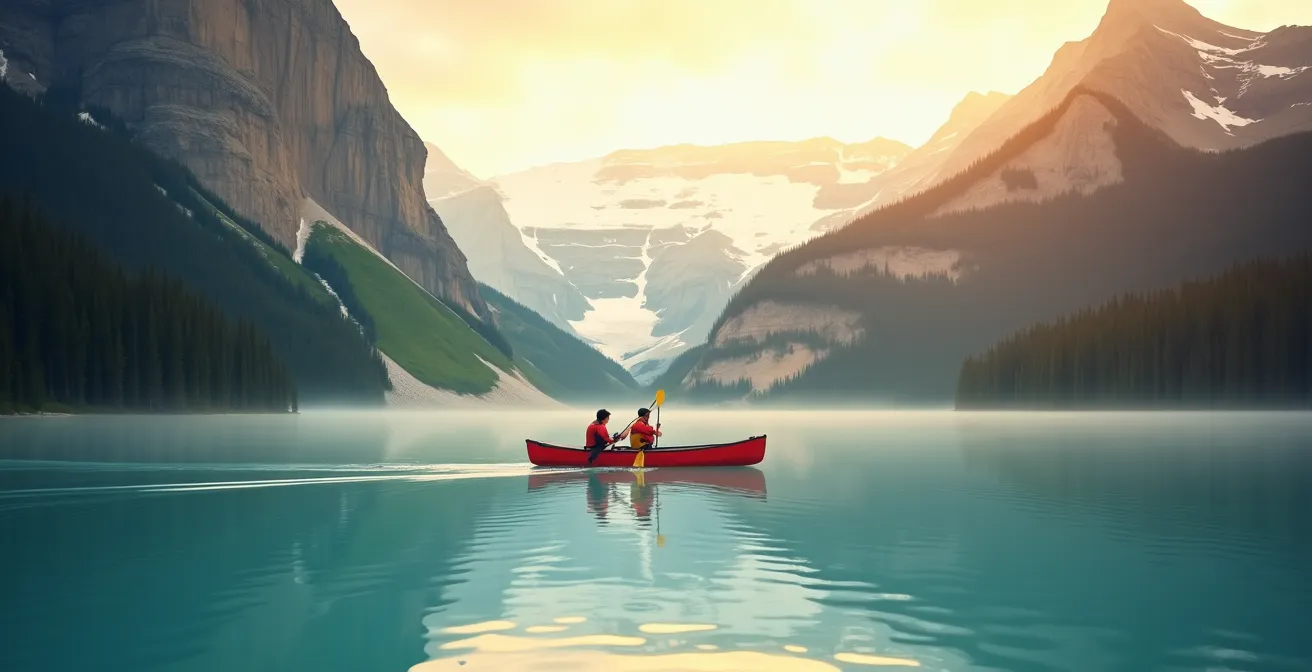
As you can see, the tranquility and beauty of the lake are unparalleled, especially in the early morning light. If the Parks Canada shuttle still proves elusive, don’t despair. Your backup plan involves third-party options. Consider the Roam Transit Reservable Super Pass, which includes access to the Lake Connector shuttle, or book with one of the many private shuttle companies that have emerged to fill this demand. This is about having layers of options.
Jasper vs Banff: Which Town Offers Better Access for Wildlife Viewing?
For consistent, high-quality wildlife viewing opportunities, especially for iconic megafauna like bears and moose, Jasper has a distinct advantage over Banff. This is not due to a lack of animals in Banff, but a crucial difference in park management strategies regarding seasonal wildlife corridor closures. Your chances of a memorable sighting are statistically higher in Jasper throughout the main tourist season.
The critical factor is road access. In Banff, a primary wildlife viewing artery, the eastern section of the Bow Valley Parkway, is under a mandatory seasonal closure from March 1st to June 25th to protect animals during their sensitive breeding and birthing season. This effectively removes one of the best, most accessible corridors for wildlife watching during a popular part of the spring and early summer. While you can still see wildlife on other roads, this closure significantly concentrates tourist traffic elsewhere.
In contrast, Jasper’s key wildlife corridors remain far more accessible year-round. Roads like the Maligne Lake Road and the areas around Medicine Lake are notorious hotspots for black bears, grizzly bears, and moose. Parks Canada’s official guidance and frequent visitor reports confirm that these routes offer more consistent viewing opportunities from spring through fall. The park’s layout and road network in Jasper simply provide better funnels for animal activity that are open to vehicles.
So, if your family’s primary goal is to see a bear or a moose in its natural habitat, structuring your trip with more time in Jasper is a sound strategy. While Banff offers unparalleled mountain vistas and iconic lakes, Jasper provides a wilder, more accessible stage for the Rockies’ incredible animal residents.
The Bear Safety Error That Could Cost You a $25,000 Fine in National Parks
The most critical error you can make is failing to maintain a “bare campsite,” and it’s a mistake enforced with extreme prejudice. Leaving out any food, coolers, dishes, or scented items (including toothpaste) when you are not present is a violation that can result in the immediate revocation of your camping permit and a fine that can reach a staggering maximum. This isn’t just a suggestion; it’s a non-negotiable condition of your stay.
Many visitors underestimate the seriousness of this rule. They might think a quick trip to the washroom or a short walk away from the site with a cooler left on the picnic table is harmless. It is not. This single act can lead to a bear becoming habituated to human food, a scenario that often ends with the bear being destroyed. To prevent this, park wardens have zero tolerance. The maximum fine for feeding wildlife in a national park is up to $25,000 under the Canada National Parks Act. While a first offense for an untidy campsite is unlikely to reach the maximum, it underscores the legal gravity of the situation.
Parks Canada’s own regulations put it in stark, unequivocal terms. As their official guidance for Banff campers states:
The ‘Bare’ Campsite program is in place for your safety, and to help keep the wildlife in our National Parks alive and wild. Campers who fail to comply with keeping a clean site and other regulations may have their camping permit revoked without a refund.
– Parks Canada, Banff National Park Camping Regulations
This means your dream vacation could end abruptly, with you being escorted out of the campground, simply for leaving a bag of marshmallows out. The only acceptable place for these items is inside your hard-sided vehicle or in the designated wildlife-proof storage lockers provided at the campsite. Treat this not as a chore, but as the most important tactic for ensuring your trip continues.
Your ‘Bare Campsite’ Compliance Checklist: Daily Protocol
- Item Inventory: List every item with a scent or that is food-related: coolers, stoves, dishes, garbage, toiletries, pet food bowls.
- Secure Storage: Before leaving the site or going to sleep, confirm every single inventoried item is inside your locked vehicle or a provided bear locker.
- Table & Ground Sweep: Visually inspect the picnic table, fire pit, and ground for any dropped food scraps or wrappers. Leave nothing behind.
- Garbage Disposal: Dispose of all garbage immediately in the designated wildlife-proof bins located throughout the campground. Do not store garbage at your site.
- Final Check: Before zipping up the tent for the night, do one last walk around your site. Is it “bare”? Could a warden find any fault?
What to Do When Every Hotel in Banff Is Fully Booked for Your Dates?
When Banff is at 100% capacity, you pivot to a “strategic basecamp” model. Instead of fruitlessly refreshing hotel websites, you look to surrounding communities that offer better availability, lower prices, and unique advantages. Your two primary strategic alternatives are Canmore, Alberta, and Golden, British Columbia.
Canmore, located just a 20-minute drive east of Banff, is the most popular alternative. It has shed its reputation as a mere suburb and has become a destination in its own right, with a vibrant downtown, superior dining options, and numerous local breweries. For families, it offers more grocery store choices and slightly less frantic energy than Banff townsite. Crucially, it provides direct access to Kananaskis Country, a provincial park system with stunning hikes and fewer crowds.
Golden, BC, requires a bigger mental shift but offers greater rewards. It’s a 1.5-hour drive west of Lake Louise, but that distance is its strength. Accommodation costs are significantly lower, and because it’s in the Pacific Time Zone, you gain an hour on your drive east into the parks. More importantly, Golden serves as a perfect hub for exploring not just Banff, but also the less-crowded but equally spectacular Yoho and Glacier National Parks. It positions you perfectly for a more diverse Rockies experience.
The key is to reframe your thinking: you are not “settling” for Canmore or Golden. You are making a tactical choice to optimize your trip for cost, access, and experience. Other options, like staying at the Lake Louise village or booking a Parks Canada oTENTik (a permanent tent-cabin hybrid), also exist but face the same high-demand issues as Banff hotels. The following table from an analysis by the official tourism board helps compare these zones.
| Location | Distance from Banff | Key Advantages | Access Benefits |
|---|---|---|---|
| Canmore | 20 minutes | Superior dining, local breweries | Direct Kananaskis access |
| Golden, BC | 1.5 hours | Lower costs, Pacific Time zone | Yoho & Glacier Parks access |
| Lake Louise | 45 minutes | Central location | Direct lake access |
| Parks Canada oTENTiks | In-park | Unique experience | Prime locations |
How to Score a Spot on the Moraine Lake Shuttle When Tickets Are Sold Out?
When the official Parks Canada shuttle is sold out, you pivot immediately to the robust network of private operators and the little-known Roam Transit Super Pass strategy. Giving up is not an option. The private market has expanded significantly to meet demand, offering more flexibility, different time slots (including sunrise), and often a more premium experience than the standard park bus.
Your first move is to explore the private shuttle companies. Each has a slightly different value proposition:
- Moraine Lake Bus Company: A top choice for photographers and early risers, offering shuttles that get you to the lake for sunrise, long before the Parks Canada buses start running.
- Fairview Limousine: Runs frequent, reliable shuttles every 1 hour and 15 minutes from the Lake Louise area, making it a good option if you’re already staying nearby.
- Via Via: Offers guided service with departures from both Canmore and Banff, handling all the logistics for a stress-free day.
- Ten Peaks Shuttle: A convenient option picking up from the Sunshine Village ski resort base, which can be easier to access and park at than Lake Louise.
The second, and perhaps most powerful “hack,” is the Roam Transit Super Pass. As detailed in guides covering shuttle alternatives, this $30 one-day pass gives you unlimited travel on all Roam routes in the Bow Valley. Crucially, it is the *only* fare option that also grants you access to the Parks Canada Lake Connector shuttle. This means you can take a Roam bus to the Lake Louise lakeshore and then use the Super Pass to hop on the connector shuttle to get to Moraine Lake. This is a backdoor route that many travelers completely overlook.
The Cancellation Clause That Costs You 100% of Your Deposit?
The most unforgiving cancellation clause in the Rockies is found with Parks Canada’s backcountry permits, which are 100% non-refundable and non-modifiable from the moment you book. Unlike frontcountry campsites or hotels that offer a window for changes, once you commit to a backcountry trip, your money is gone, regardless of weather, illness, or change of plans. This is a critical distinction that can cost you hundreds of dollars if you’re not prepared.
This strict policy exists because backcountry sites are extremely limited and in high demand. A cancellation represents a lost opportunity for another hiker that the park service cannot easily refill. While a frontcountry campsite cancellation within three days of arrival typically only results in forfeiting your reservation fee, the penalty for backcountry is absolute. This harsh reality must factor into your planning; only book backcountry permits when you are certain of your dates and your group’s ability to complete the trip.
This policy is the most extreme example, but it highlights a broader theme: every accommodation provider in the Rockies has its own specific set of rules. Hotels in Banff often have a 24 to 72-hour cancellation window, after which you forfeit the cost of the first night. Alberta Parks’ policies differ slightly from Parks Canada’s. Your job as the planner is to know these details *before* you click “confirm.”
The following table provides a general comparison of cancellation policies you’re likely to encounter. Always read the fine print for your specific booking, but use this as a guide to understand the landscape of financial risk.
| Provider | Cancellation Window | Penalty Type | First Night Policy |
|---|---|---|---|
| Parks Canada Frontcountry | 3 days | Reservation fee only | Always forfeited |
| Parks Canada Backcountry | No refunds | 100% penalty | N/A |
| Alberta Parks | 3 days | Processing fee | Varies by site |
| Typical Banff Hotel | 24-72 hours | First night | Non-refundable |
Key takeaways
- Mastering the two-stage shuttle and camping reservation system is more effective than random refreshing.
- Alternative towns like Canmore and Golden are strategic assets, not compromises, for bypassing sold-out accommodations.
- Strict compliance with bear safety rules is a non-negotiable tactic to prevent trip-ending fines and permit revocation.
RV vs Rental Car: Which is the Best Way to Drive the Canadian Rockies?
The best choice between an RV and a rental car depends entirely on your travel priorities, specifically your preference for flexibility versus self-containment. A rental car offers unparalleled freedom to navigate tight parking lots, access any trailhead, and make spontaneous decisions, while an RV provides a mobile home base but comes with significant logistical constraints in the high season.
Choosing a rental car is the tactical choice for the agile traveler. Parking at popular sites like the Lake Louise lakeshore or Johnston Canyon is extremely limited, and smaller vehicles have a massive advantage. You can easily navigate the narrow, winding roads like the Bow Valley Parkway and find parking where larger vehicles cannot. A car, paired with hotel or oTENTik stays, allows you to base yourself centrally and make quick, efficient day trips without worrying about campground check-in times or vehicle size restrictions.
An RV, on the other hand, offers the romantic ideal of a home-on-wheels. It’s a fantastic option for families who value having their own kitchen, bathroom, and sleeping space, which can lead to cost savings on meals. However, this convenience comes at a price. You are now tied to the same hyper-competitive campground reservation system this guide is designed to navigate. Many popular campgrounds have size restrictions, and navigating town centers like Banff can be stressful. The biggest drawback is the loss of spontaneity; your entire itinerary is anchored to where you managed to secure a campsite each night.
Ultimately, for a first-time visitor in the peak months of July or August, a rental car offers a more resilient and flexible strategy. It allows you to leverage alternative accommodations in Canmore or Golden more easily and frees you from the immense pressure of securing multiple, consecutive campsite bookings. The RV dream is wonderful, but it is best realized in the shoulder seasons or by seasoned visitors who can book their sites a year in advance.
Start planning your Rockies trip now by setting calendar alerts for the key reservation dates. Your success depends not on luck, but on deploying these strategies with precision and confidence.