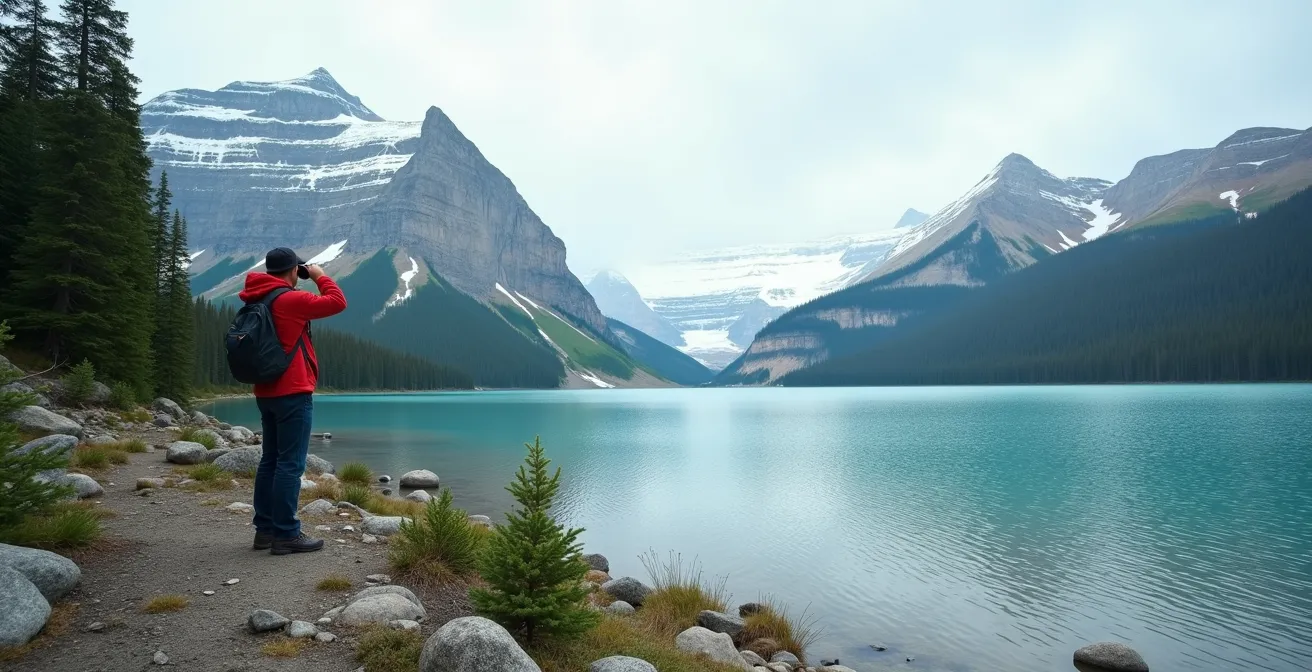
Your travel in Canada can do more than just ‘not harm’; it can become a powerful force for actively healing and protecting its precious ecosystems.
- Simple actions, like meticulously cleaning your hiking boots or reporting suspicious activity, have a massive, measurable impact on preventing ecological damage.
- Your financial support and time are most effective when directed towards permanent habitat protection through land trusts and targeted volunteering, rather than just general park fees.
Recommendation: Adopt a mindset of ‘conservation activism’. Turn every observation into scientific data, every dollar into permanent protection, and every step into an act of biosecurity.
The desire to explore Canada’s vast, wild landscapes comes with a shared responsibility. For years, the guiding principle for conscientious travellers has been “leave no trace,” a worthy but fundamentally passive approach focused on minimizing our negative footprint. We are taught to pack out what we pack in, avoid disturbing wildlife, and stick to the trails. These are the basics of good outdoor etiquette, the common knowledge shared around every campfire.
But what if minimizing our impact is no longer enough? In an era of accelerating biodiversity loss and climate change, the new frontier for the philanthropic traveller is not just to be an invisible visitor, but to be an active agent of restoration and protection. What if your vacation could leave a net-positive legacy, actively contributing to the health and resilience of the very ecosystems you’ve come to admire?
This is a shift from a “do no harm” mentality to one of “do measurable good.” It requires moving beyond the platitudes to understand the deeper mechanisms of conservation. It’s about leveraging your presence, your observations, and your resources in the most strategic way possible. This is not about grand, difficult gestures, but about small, informed actions that create powerful ripple effects.
This guide will equip you with the knowledge to make that shift. We will explore how your vacation photos can become vital scientific data, why cleaning your boots is a profound act of ecosystem defence, and how a strategic donation can protect a piece of Canada forever. You will learn to see the landscape not just as a backdrop for your adventure, but as a living system where you can play a crucial, positive role.
This article provides a roadmap for transforming your travels into a genuine force for conservation. Explore the sections below to discover concrete, actionable strategies for making a lasting difference during your journey across Canada.
Summary: A Practical Guide to Conservation Activism for Travellers in Canada
- iNaturalist or eBird: How Your Vacation Photos Can Help Scientists?
- The Boot Cleaning Mistake: How Hikers Spread Invasive Seeds Between Provinces?
- Park Fee vs Land Trust Donation: Which Actually Protects Habitat Forever?
- What to Do If You See Someone Poaching or Dumping in a Nature Reserve?
- Short-Term Volunteering: Can You Really Help a Project in Just One Day?
- The Campfire Mistake: Why Burning Food Scraps Harms the Ecosystem?
- The Wader Mistake: Why You Can’t Just Walk Into Any Flooded Bog?
- How Far Should You Stand Back from the Edge of the Cliffs in Gros Morne National Park?
iNaturalist or eBird: How Your Vacation Photos Can Help Scientists?
Your smartphone can be one of the most powerful conservation tools in your backpack. Every photo you take of a plant, insect, or animal can be transformed from a simple holiday snapshot into a valuable data point for scientists. This is the core of “citizen science,” a movement that empowers everyday people to contribute directly to our understanding of the natural world.
Platforms like iNaturalist (for all species) and eBird (for birds) allow you to upload your photos with location data. Experts and AI algorithms then help identify the species, and your observation is added to a massive global database. This data is not just for fun; it’s actively used by conservation managers and researchers to track species distribution, monitor for invasive newcomers, and assess the impacts of climate change. For instance, recent research from conservation partnerships shows that migration data for over 2,900 species is now tracked using these methods in Canada.

By participating, you are providing on-the-ground information at a scale and frequency that professional scientists could never achieve alone. You become their eyes and ears in remote valleys, along coastal trails, and in urban parks. Documenting a common robin is just as important as spotting a rare orchid; patterns of common species tell a story about ecosystem health. This is a profound shift from being a passive observer to an active data-driven steward of the landscape.
The Boot Cleaning Mistake: How Hikers Spread Invasive Seeds Between Provinces?
One of the greatest, and most underestimated, threats to Canada’s biodiversity is the spread of invasive alien species (IAS). These non-native plants, animals, and pathogens can outcompete native species, disrupt entire ecosystems, and cause staggering economic damage. A report from the Invasive Species Centre highlights that the invasive species cost is estimated at $3.6 billion per year in Ontario alone. As a traveller, you are on the front lines of this battle, and the treads of your hiking boots are a primary vector of transmission.
A tiny seed or plant fragment caught in the mud on your boot can be carried hundreds of kilometres, establishing a new infestation in a pristine environment. For example, in British Columbia, Japanese Knotweed has become a scourge. This plant can grow through concrete and a single root fragment smaller than your fingernail, transported on a boot or equipment, can start a new colony. The principle of “Play, Clean, Go” is a critical biosecurity protocol. It means inspecting and thoroughly cleaning your footwear, gear, and even pets before and after you visit a trail, river, or park.
This simple act is not just about “keeping things tidy.” It is a direct intervention to protect native flora from being choked out by invaders like garlic mustard or dog-strangling vine. It’s a defence of the local food web that depends on those native plants. By adopting this habit, you are breaking the chain of invasion and performing an act of ecological leverage—a small effort with a disproportionately large positive impact on the long-term health of Canada’s wild spaces.
Park Fee vs Land Trust Donation: Which Actually Protects Habitat Forever?
Paying your entry fee at a national or provincial park feels like a direct contribution to conservation, and to some extent, it is. These fees are crucial for maintaining trails, operating visitor centres, and funding interpretive programs. However, they primarily support the annual operational budget within existing park boundaries. They rarely fund the single most critical action for biodiversity: acquiring and permanently protecting new land.
This is where land trusts and conservancies, such as the Nature Conservancy of Canada (NCC) or Ducks Unlimited, play a unique and vital role. These non-profit organizations specialize in securing private land through purchase or donation and placing it under permanent protection through legal tools like conservation easements. This action creates new protected areas, expands existing ones, and builds essential wildlife corridors that allow species to move and adapt to climate change. Your donation to a land trust is not an operational expense; it is a capital investment in perpetual conservation.
Understanding the difference is key to maximizing the impact of your financial support. While your park fee is essential for the visitor experience, a charitable donation to a land trust is a direct investment in the permanent protection of habitat. One supports the present, the other secures the future.
This table breaks down how your money is used in each case, helping you make an informed decision for strategic philanthropic giving.
| Aspect | Park Entrance Fees | Land Trust Donations |
|---|---|---|
| Primary Use | Trail maintenance, visitor services, facilities | Land acquisition and permanent protection |
| Geographic Impact | Within existing park boundaries only | Creates new protected areas and corridors |
| Time Frame | Annual operational budget | Permanent conservation easements |
| Tax Benefits | No tax deduction | Charitable tax receipt available |
| Example Organizations | Parks Canada | Nature Conservancy Canada, Ducks Unlimited |
What to Do If You See Someone Poaching or Dumping in a Nature Reserve?
Witnessing an environmental violation—be it poaching, illegal dumping, or someone harassing wildlife—can be an unsettling experience. Your first instinct might be to confront the person, but this can be unsafe and counterproductive. The most effective action you can take is to become a discreet, accurate, and prompt informant for the authorities. You are the eyes and ears for under-resourced conservation officers and park wardens.
Your role is to be an excellent witness. Do not intervene directly. Instead, from a safe distance, document everything you can:
- Time and exact location (use your phone’s GPS).
- Description of individuals (clothing, height, distinguishing features).
- Vehicle details (license plate number, make, model, color).
- Specifics of the incident (what was being poached/dumped, how it was done).
- Take photos or videos if you can do so safely and without being seen.
This detailed information is what turns a general complaint into actionable evidence. A 2019 case in Alberta, where a public tip with detailed descriptions led to the conviction and fining of a poacher ($8,000) and his outfitter ($8,500), proves the power of citizen reporting.
Once you have the information, report it immediately to the appropriate authorities. Every province has a “Report-A-Poacher” or similar hotline. Program these numbers into your phone before you head out. Your vigilance is a powerful deterrent and a crucial part of the enforcement system that protects Canada’s wildlife and natural spaces.
- British Columbia RAPP Line: 1-877-952-7277 (24/7)
- Alberta Report A Poacher: 1-800-642-3800
- Ontario TIPS Line: 1-877-847-7667
- Quebec SOS Braconnage: 1-800-463-2191
- DFO Marine Violations (National): 1-800-465-4336
- Parks Canada Emergency: 1-888-927-3367
Short-Term Volunteering: Can You Really Help a Project in Just One Day?
The idea of “voluntourism” can sometimes seem more about the traveller’s experience than about making a real impact. However, when it comes to conservation in Canada, even a single day of focused effort can be incredibly valuable, especially in the fight against invasive species. According to the International Union for Conservation of Nature (IUCN), “invasive species are the second most significant threat to biodiversity after habitat loss,” a threat that is often best tackled with manual labour.
Many local parks, conservation authorities, and non-profits host “invasive species pulls” or “community stewardship” days. These events focus the collective energy of a group of volunteers on a specific, urgent task: removing a patch of invasive plants like garlic mustard or Himalayan balsam before they go to seed. Managing these species is a huge financial burden; a recent report shows that $50.8 million is spent per year by Ontario municipalities and conservation authorities on this issue alone. Your volunteer time directly offsets these costs and provides a surge of manpower that organizations could never afford.
The key to making your short-term volunteering effective is choosing the right project. Look for organizations with clear, task-oriented goals for the day. A well-organized event will provide you with training on how to identify and properly remove the target species to prevent further spread. In just a few hours, you can clear a significant area, protecting native biodiversity and learning invaluable skills in plant identification and ecological restoration. This is conservation activism in its most tangible form: your hands directly healing a piece of the Canadian landscape.
The Campfire Mistake: Why Burning Food Scraps Harms the Ecosystem?
It’s a common campfire myth: burning your leftover food scraps is a good way to dispose of them, turning waste into ash. The reality is that this seemingly harmless act is one of the most dangerous mistakes you can make in the backcountry. Campfires rarely burn hot enough to completely incinerate food. What’s left behind are charred, smelly remnants that act as a powerful attractant for wildlife, from small rodents to large predators like bears.
This leads to wildlife habituation, a process where animals learn to associate humans and campsites with an easy food reward. An animal that loses its natural fear of humans becomes a “problem animal.” The Conservation Officer Service in British Columbia has to euthanize numerous bears each year precisely for this reason. A food-conditioned bear is a public safety risk, and relocation efforts are rarely successful. By leaving food scraps in a fire pit, you are potentially signing that animal’s death warrant.
The only responsible method for food waste disposal in the wild is to pack out everything you pack in. This includes apple cores, orange peels, and nutshells. These items can take months or years to decompose and will attract wildlife in the meantime. Protecting Canada’s wildlife means committing to a rigorous “Pack It In, Pack It Out” protocol, ensuring the only thing you leave behind are your footprints.
Action Plan: Your “Pack It In, Pack It Out” Protocol
- Store all food, garbage, and scented items in bear-proof containers or a proper bear hang (at least 4 meters high and 1.5 meters from the tree trunk).
- Never leave food scraps, wrappers, or any garbage in a fire pit. Double-check the pit is clean before you leave.
- Pack out all organic waste, including fruit peels and nutshells, in a designated, sealed garbage bag.
- Wash dishes and cookware at least 100 meters away from your campsite and any water source to avoid contaminating them.
- Strain your dishwater to capture all food particles and pack these particles out with your garbage.
The Wader Mistake: Why You Can’t Just Walk Into Any Flooded Bog?
For anglers, waterfowl hunters, and naturalists, waders are essential gear for accessing Canada’s incredible wetlands. But just like hiking boots on a trail, this equipment can be a major vector for destructive aquatic invasive species. Felt-soled waders are particularly problematic, as they can harbour microscopic organisms for weeks. Moving from one watershed to another without proper decontamination can introduce devastating invaders like zebra mussels, spiny waterflea, or the parasite that causes Whirling Disease.
The consequences are catastrophic. Aquatic invasive species are a primary driver of biodiversity loss in freshwater systems. In the Great Lakes alone, aquatic invasive species research shows damages of $408.6 million from zebra and quagga mussels. In Alberta, the detection of Whirling Disease in 2016 sent shockwaves through the angling community. This parasite, easily spread on contaminated gear, is lethal to native trout and salmon, causing skeletal deformities and neurological damage with mortality rates up to 90%. It threatens a multi-million dollar tourism industry and the very fabric of an iconic fishery.
The principle of “Clean, Drain, Dry” is the essential biosecurity protocol for all aquatic activities. Before moving to a new body of water, you must:
- Clean all mud, plants, and debris from your boat, trailer, waders, and gear.
- Drain all water from your boat, motor, and livewells.
- Dry your equipment completely for at least 48 hours before entering a new watershed.
This isn’t an optional step; it’s a critical defence of Canada’s aquatic ecosystems. Your diligence protects the future of fishing, the health of our waters, and the survival of native species.
Key Takeaways
- Transform your role from a passive tourist to an active conservationist by contributing to citizen science and practicing strict biosecurity.
- Maximize your financial impact by directing donations to land trusts for permanent habitat protection, which complements operational funding from park fees.
- Your vigilance and adherence to protocols—from reporting poaching to packing out all waste—are powerful, direct actions that protect wildlife and ecosystems.
How Far Should You Stand Back from the Edge of the Cliffs in Gros Morne National Park?
Standing on the cliff edge at Green Point or the Lookout Trail in Gros Morne National Park, with the Gulf of St. Lawrence sprawling below, is an awe-inspiring experience. It’s tempting to get as close as possible for that perfect photo. However, that single step too close contributes to a subtle but serious form of ecosystem degradation. The ground beneath your feet is more fragile than it appears.
As Parks Canada’s conservation guidelines state, “Foot traffic on cliff edges breaks up fragile soil and plant root systems, dramatically accelerating erosion and destroying the habitat itself.” These cliff-top ecosystems are often home to unique, hardy plants that are specially adapted to the harsh, windy conditions. Their root systems are the very fabric holding the soil together. When you step on them, you break that fabric, making the soil vulnerable to being washed away by rain and wind. Over time, the collective impact of thousands of visitors “just getting a little closer” literally wears the cliff away.
The official recommendation is to stay back at least 3-5 meters from any unfenced cliff edge. This isn’t just about your personal safety; it’s an act of respect for the integrity of the landscape. It protects the habitat of nesting seabirds that may be using the cliff face and preserves the natural character of the site for all future visitors. The best view is the one that doesn’t damage the very thing you’ve come to admire. This principle applies to all fragile environments, from alpine meadows to coastal dunes: stay on designated trails and give the edge a wide berth.
Your journey through Canada’s wilderness is an opportunity not just to see, but to serve. By embracing the mindset of an active conservationist—a data collector, a biosecurity agent, a strategic donor, and a vigilant protector—you transform your travel from a simple vacation into a meaningful contribution. Start today by incorporating these practices into your next adventure, and leave Canada’s landscapes healthier than you found them.