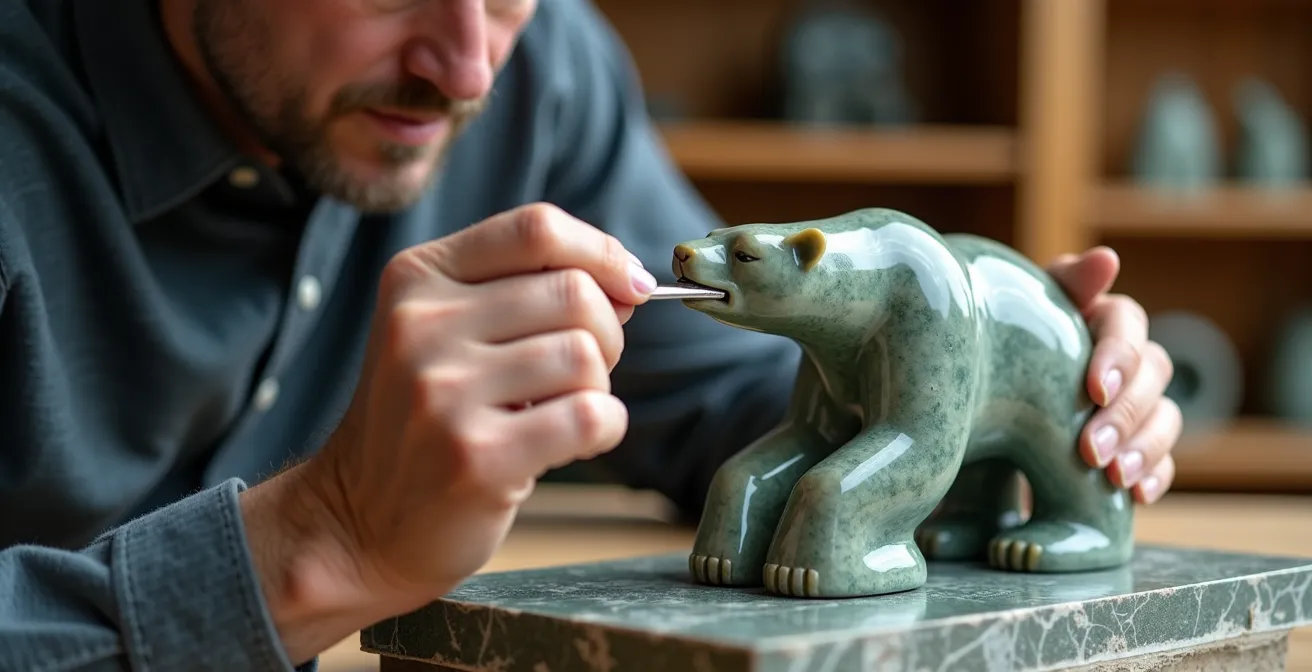
To truly invest in Inuit art is to invest in its story and its creator, but the market is rife with imitations that exploit the culture.
- Authenticity is confirmed by the government-registered Igloo Tag, which guarantees the piece is handmade by an Inuk artist who has been paid for their work.
- Genuine carvings are made from unique, naturally varied stone like serpentine or argillite, unlike the uniform, bubble-pocked appearance of resin fakes.
Recommendation: Shift from a consumer’s mindset to one of ethical stewardship. Your goal isn’t just to own an object, but to ensure your purchase honours the artist and supports the cultural ecosystem of Canada’s North.
The decision to bring a piece of Inuit art into your home is a significant one. You’re not just buying an object; you’re holding a story carved in stone, a connection to the vast landscapes of the Canadian Arctic and a tradition passed down through generations. Imagine the feel of the cool, dense soapstone, its weight a testament to its earthly origins. Yet, for every genuine carving, there are countless replicas and “inspired” souvenirs that dilute this powerful connection. Many well-intentioned buyers focus on simple rules, like looking for a signature or buying from what appears to be a reputable shop.
These basic checks, while not wrong, are no longer enough. The market for fakes is sophisticated, and the real damage they cause goes beyond a single disappointing purchase. They devalue the work of master carvers and divert critical income from Northern communities where art is a vital part of the local economy. But what if the key to authenticating a piece wasn’t a simple checklist, but a shift in perspective? What if the real task was to practice ethical stewardship, ensuring your investment protects a living culture rather than simply acquiring a decorative item?
This approach requires moving beyond the surface to understand the cultural ecosystem behind the art. It means learning to read the signs of authenticity—from the legal guarantee of a specific trademark to the narrative of the stone itself. It involves asking pointed questions of galleries and recognizing that the price of a piece reflects not only the artist’s time but a lifetime of inherited skill and cultural knowledge. This guide is designed to empower you with that deeper understanding, transforming you from a mere buyer into a conscious custodian of Indigenous artistry.
Throughout this guide, we will explore the critical markers of authenticity, the economic realities of the artists, and the practical steps you can take to make a purchase you can be proud of. By understanding this framework, you can confidently invest in a piece that is not only beautiful but also ethically sound.
Summary: How to Verify the Authenticity of Inuit Carvings Before Investing $500?
- What Does the “Igloo Tag” Guarantee on a Piece of Soapstone Art?
- Why a West Coast Mask Costs $2,000 While a Souvenir Shop Version Costs $50?
- Gallery or Artist Direct: Which Method Benefits the First Nations Community More?
- The Souvenir Error: Buying “Inspired” Art That Has No Cultural Connection
- How to Transport a Fragile Soapstone Carving Home Without Breakage?
- Authentic Local Art or Imported Souvenir: How to Tell the Difference in Lunenburg?
- Where to Buy Authentic Sichuan Pickled Vegetables in Vancouver’s Chinatown?
- How to Attend a Powwow as a Non-Indigenous Guest Without Breaking Etiquette?
What Does the “Igloo Tag” Guarantee on a Piece of Soapstone Art?
The single most important symbol in the world of authentic Inuit art is not a signature, but a small sticker: the Igloo Tag. Officially named the Inuit Art Trademark, this tag is your primary assurance of authenticity. It is a legal guarantee, registered by the Canadian government, confirming two essential facts: the work was handmade by an Inuk artist, and the artist has been fairly compensated for their creation. It is the gold standard, moving a purchase from a guess to a certainty. This tag system was created to protect artists and buyers from the flood of mass-produced fakes, establishing a clear line between genuine cultural expression and commercial imitation.
When you see the Igloo Tag, you are seeing the result of a protected supply chain. Only licensed distributors, primarily Inuit-owned co-operatives in the North, can purchase and affix the tags to works they acquire directly from artists. The value this provides is tangible; a study by the Inuit Art Foundation confirms that on average, consumers are willing to pay an average premium of $117.26 for pieces authenticated by the Igloo Tag. This isn’t just a perceived value; it’s an economic recognition of guaranteed provenance and ethical sourcing.
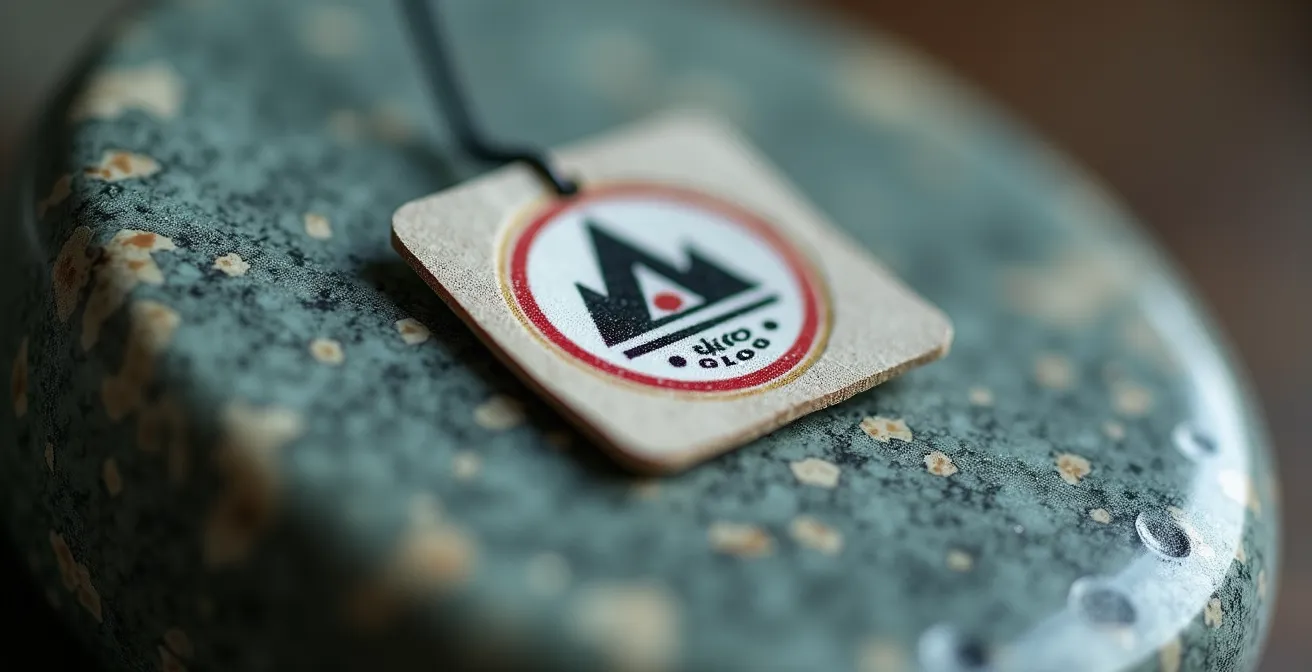
As the image above illustrates, the tag is attached directly to the art. Each tag carries a unique number that traces the carving back through the distribution system, often to the community co-op it came from. Therefore, when evaluating a piece, your first action should be to look for this tag on the base or accompanied by its certificate. Its presence is the first and strongest pillar of your verification process, representing a direct link to the cultural ecosystem of the Canadian Arctic.
Why a West Coast Mask Costs $2,000 While a Souvenir Shop Version Costs $50?
The staggering price difference between an authentic piece of Indigenous art and a tourist souvenir is often the first thing a new collector notices. A Haida or Kwakwaka’wakw mask from a reputable gallery on the West Coast can command thousands of dollars, while a similar-looking object in a souvenir shop may cost less than a meal. The disparity isn’t arbitrary; it reflects a profound difference in materials, time, skill, and most importantly, cultural integrity. An authentic mask is not merely a decorative object; it is a piece of cultural regalia, often connected to specific stories, ceremonies, and lineages. It is typically carved from a single piece of old-growth cedar by a master artist who has spent decades honing their craft.
The $2,000 price tag accounts for the artist’s lifetime of expertise, the weeks or months spent carving, and the scarcity of the traditional materials used. In contrast, the $50 “souvenir” is almost always a mass-produced replica, often made overseas from plastic resin or cheap wood. It has no connection to the culture it mimics and provides no economic benefit to the Indigenous community. This economic dimension is critical. The art market is complex, and as a study on the Inuit art economy notes, systemic factors can influence what art gets made and sold. As Big River Analytics highlights in its Impact of the Inuit Arts Economy Study:
Men tend to produce carvings and jewellery, art forms that dominate the traditional retail and wholesale markets, whereas women tend to produce more sewn goods and textiles… they constitute a much smaller proportion of the overall retail and wholesale trade, as they are less profitable than carvings and jewellery.
– Big River Analytics, Impact of the Inuit Arts Economy Study
This insight reveals that market forces and profitability shape the art world. Buying a cheap knockoff not only disrespects the culture but also actively harms the economic sovereignty of artists by flooding the market with low-quality imitations. The high price of an authentic piece is a direct investment in the survival of a cultural practice and the livelihood of the artist who is its keeper.
Gallery or Artist Direct: Which Method Benefits the First Nations Community More?
Once you’re committed to buying authentic work, the next question is where to buy it. The two primary channels are directly from an artist or through a reputable gallery or co-operative. There is no single “best” answer, as both methods can benefit the community if approached with care. Buying directly from an artist, perhaps at a market or studio tour, can be a wonderful experience. It allows you to build a personal connection, hear the story of the piece firsthand, and ensure 100% of the sale price goes to the creator. However, this is not always practical, as many Inuit and First Nations artists live in remote communities inaccessible to most buyers.
This is where reputable galleries and the Inuit co-operative system play an indispensable role. These organizations act as a bridge between Northern communities and the southern market. The co-ops, which are owned and operated by Inuit, are foundational to the cultural ecosystem. They purchase works from local artists, provide them with a stable income, and manage the logistics of getting art to a wider audience. In a population where art is a major economic driver—with an estimated 13,650 Inuit artists representing 26% of the Inuit population over 15 engaged in the craft—these institutions are vital. A good gallery will have a transparent, long-standing relationship with these co-ops or specific artists.
Your role as a steward is to vet the seller, whether it’s an individual or a gallery. A reputable dealer will be proud to share the provenance of their pieces and answer your questions thoroughly. They are partners in the ethical trade, not just retailers. Before you buy, use your power as a collector to perform due diligence.
Your Vetting Checklist: 5 Questions to Ask Canadian Galleries
- What is your gallery’s relationship with the Arctic co-operative or the artist?
- Can you provide the artist’s community name and, for Inuit artists, their disc number?
- What percentage of the final sale price goes back to the artist or their community co-op?
- Do you provide official documentation, including an Igloo Tag certificate where applicable?
- Are you an authorized dealer connected to a licensed Igloo Tag distributor (e.g., FCNQ, Canadian Arctic Producers)?
The Souvenir Error: Buying “Inspired” Art That Has No Cultural Connection
One of the greatest threats to Indigenous artists is the prevalence of “souvenir art”—mass-produced items vaguely labeled as “Native-style” or “Arctic-inspired.” These pieces are the epitome of cultural dilution. They are designed to mimic the aesthetic of authentic work at a fraction of the cost, but they possess none of its spirit, story, or quality. Typically made from molded plastic resin and painted to look like stone, these fakes can deceive an untrained eye. Buying one, even unknowingly, supports a system that directly undermines Indigenous creators and misrepresents their culture.
Learning to distinguish real stone from resin is a critical skill. Authentic soapstone (serpentine, argillite, or steatite) has natural variations. It will have subtle shifts in colour, veins of different minerals, and a cool, dense feel. No two pieces are ever identical. Resin, on the other hand, is uniform in colour. If you look closely at the base of a fake carving, you may see tiny, perfectly round bubbles that formed when the liquid plastic was poured into a mold. You might also find unnatural, uniform grinding marks from mass-finishing processes, rather than the unique tool marks of a hand-held file or adze.
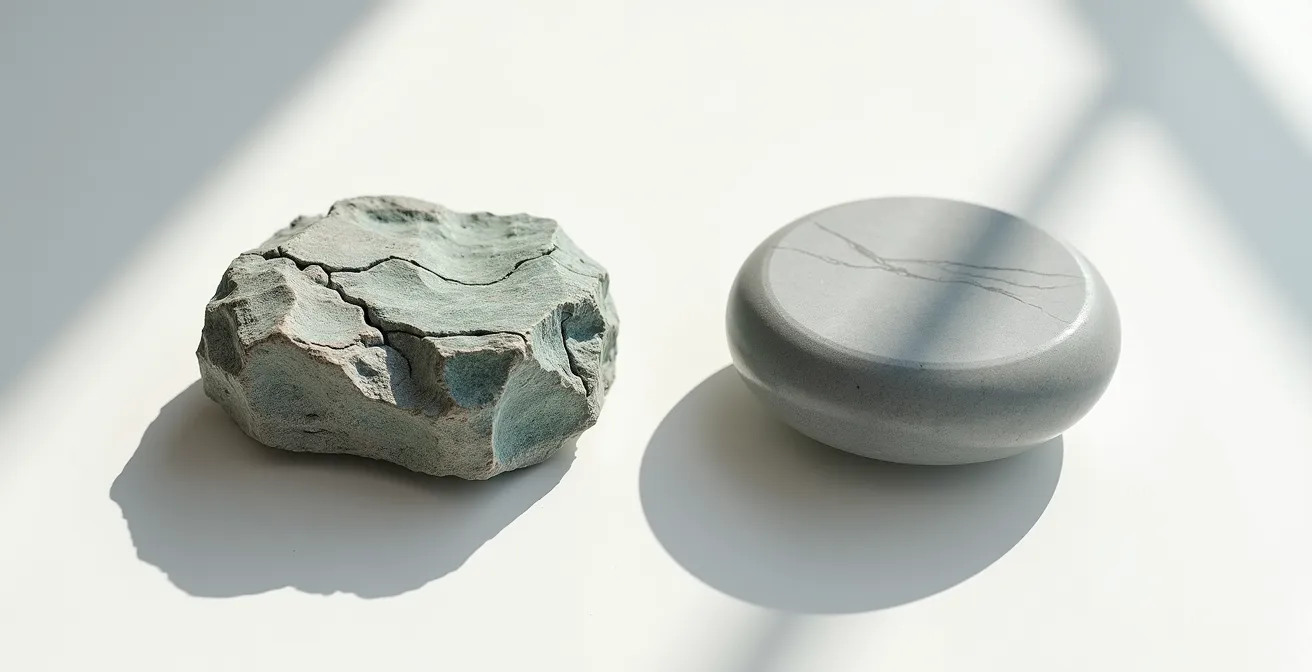
Beyond the material itself, a number of red flags can help you identify a potential fake. A suspiciously low price is the most obvious, but vague attribution is another. If a piece is simply labeled “Canadian Native Art” without a specific artist’s name or community, be cautious. A proud artist and an ethical seller will always provide this information. The provenance is the story, and its absence is a major warning sign. To protect your investment and the integrity of the art form, always be on the lookout for these indicators.
- Uniform Colour: Be wary of a solid, unvarying colour with no natural veins or imperfections.
- Mold Marks: Check the base for tiny, burst air bubbles or a seam from a two-part mold.
- Lack of an Igloo Tag: The absence of the official trademark on a piece marketed as Inuit art is a significant concern.
- Suspiciously Low Price: Authentic, hand-carved art is never cheap. If it seems too good to be true, it is.
- Vague Labeling: Avoid pieces with generic tags like “Native Inspired” instead of specific artist and community attribution.
How to Transport a Fragile Soapstone Carving Home Without Breakage?
You’ve successfully navigated the market, verified your piece’s authenticity, and made an ethical investment. Now comes the final challenge: getting your fragile stone carving home safely. Soapstone and serpentine are soft, easily scratched, and can have delicate parts that are prone to chipping or breaking. Proper packing is not an afterthought; it’s the final step in protecting your investment and honouring the artist’s work. The logistics of moving fragile art from the Arctic has a long history in Canada, forming the backbone of the industry.
Case Study: The Hudson’s Bay Company’s Historical Art Logistics
The global market for Inuit art was largely developed in the mid-20th century, with the Hudson’s Bay Company playing a key logistical role. Carvings were purchased at remote fur trading posts in communities like Inukjuak and Kinngait. These fragile stone works were then carefully packed and transported south by supply ship during the short summer season. They arrived in the fall to be sold at handicraft guilds in Montreal and Winnipeg. This historical network demonstrates the early expertise developed in Canada for transporting delicate stone art across immense and challenging distances, a practice continued today by the Inuit co-operatives.
This historical precedent underscores the importance of proper handling. For collectors today, the principles remain the same, adapted for modern travel. If you are flying, never pack a valuable carving in your checked luggage. The risk of breakage from rough handling is far too high. The best method is to bring it as a carry-on. According to the Canadian Conservation Institute, you should wrap the sculpture first in acid-free tissue paper to protect the surface, followed by several layers of bubble wrap. For extra security, place the wrapped piece inside a small, hard-sided box that fits within your carry-on allowance. For very irregular or delicate pieces, creating custom cutouts in high-density foam is the professional standard. One crucial note: if your carving includes materials like whalebone or ivory, you must obtain a CITES permit before crossing any international borders, including into the USA.
Authentic Local Art or Imported Souvenir: How to Tell the Difference in Lunenburg?
The challenge of distinguishing authentic art from imported souvenirs is not unique to the Arctic. It’s a scenario that plays out in tourist hubs across Canada, from Banff to Charlottetown. Imagine you’re strolling through the historic, colourful streets of Lunenburg, Nova Scotia. The shops are filled with maritime-themed crafts, paintings, and carvings. How do you apply the principles of ethical art buying here? The core strategy remains the same: you must look for the story behind the object. An authentic piece of local art is tied to a specific person and place; a souvenir is anonymous and generic.
Ask the shopkeeper: “Who is the artist that made this?” A seller of genuine local art will be able to tell you the artist’s name, where they live, and perhaps a little about their work. They will have a direct relationship with the creator. If the response is vague—”Oh, it’s just from a local supplier”—or if the item has a “Made in China” sticker on the bottom, you have your answer. This is an imported souvenir, not local art, regardless of what it depicts. The principles you learned for verifying Inuit art—vetting the seller, demanding provenance, and questioning suspiciously low prices—are universally applicable.
In a place like Lunenburg, look for galleries that proudly feature and promote their specific artists. Seek out pieces that are signed. Talk to the artisans themselves at the weekly farmers’ market. Just as you would look for the Igloo Tag as a guarantee of Inuit origin, look for the human connection as your guarantee of local authenticity. Choosing to buy a small, signed print from a known Nova Scotian painter over a mass-produced carving of a lighthouse is an act of ethical stewardship for that region’s creative economy.
Where to Buy Authentic Sichuan Pickled Vegetables in Vancouver’s Chinatown?
This question, seemingly out of place, offers a perfect metaphor for our quest. The hunt for authentic art is much like the hunt for authentic food. Imagine you’re in Vancouver’s vibrant Chinatown, seeking genuine Sichuan pickled vegetables (pao cai). You’re faced with two options: a generic, mass-produced jar from a supermarket shelf, labeled “Sichuan-Style,” or a jar from a small, family-run shop, filled with vegetables from a local farm, fermented in earthenware crocks according to a generations-old family recipe. The first is an imitation; the second is an artifact of living culture.
The “Sichuan-Style” jar is the equivalent of the resin “Inuit-style” carving. It mimics the flavour profile but lacks the soul, the specific terroir of its ingredients, and the nuanced technique of the maker. It has no provenance as a story. The authentic pao cai, however, is directly linked to its creators. It tells a story of place (a specific region’s fermentation style), people (the family who made it), and process (the traditional method). To find it, you don’t just look at the label; you look for the seller with deep knowledge, the one who can tell you which vegetables are in season and how long they were brined.
This parallel teaches us that authenticity is rooted in specificity. Just as you would ask about the origin of the peppers in the pickles, you must ask about the origin of the stone for a carving. Just as you would value a family recipe, you must value the artistic lineage of a carver. In both food and art, the authentic item embodies a cultural ecosystem that cannot be replicated in a factory. It requires a discerning eye and a willingness to engage with the story, whether it’s found in a Vancouver market or a gallery specializing in Arctic art.
Key Takeaways
- The Igloo Tag is your primary guarantee of authenticity, confirming the piece is handmade by a fairly paid Inuk artist.
- Provenance is a narrative, not just a label. Always seek the artist’s name and community to connect the art to its creator.
- Your purchase is an economic vote. Choosing verified, authentic art is an act of ethical stewardship that supports Indigenous artists and their cultural sovereignty.
How to Attend a Powwow as a Non-Indigenous Guest Without Breaking Etiquette?
Your journey into the world of Indigenous art is a journey into respecting culture. This principle of respect extends beyond the objects to the people and their living traditions. Attending a powwow as a non-Indigenous guest is a powerful opportunity to deepen that respect, but it requires awareness and humility. A powwow is a vibrant celebration of song, dance, and community—it is not a performance for tourists. Your role is to be a respectful observer and welcome guest. The most important rule is to listen and watch. Pay attention to the Master of Ceremonies (MC), who will guide the event and often explain the protocol to visitors.
Certain dances, like honour songs or veterans’ songs, are for specific participants only; the MC will announce when it is appropriate for everyone to join in for an intertribal dance. Always ask for permission before taking a photograph of a dancer in their regalia. That regalia is not a “costume”; it is a cherished, and often sacred, collection of handmade items with deep personal and spiritual meaning. Complimenting a dancer on their regalia is welcome, but avoid touching it. Furthermore, the dance arena (the arbour) is considered sacred ground. Do not enter it unless you are invited to dance, and never use it as a shortcut.
These rules of etiquette all stem from the same root as ethical art buying: recognizing that you are a guest in a rich and ancient cultural space. By learning to respectfully purchase an artist’s carving, you are practicing the same set of values needed to respectfully attend a community’s celebration. You are shifting from a passive consumer to an active and informed participant in cultural appreciation. This is the ultimate goal of ethical stewardship: to honour the culture in all its forms, from a stone carving held in your hand to the drumbeat you feel in your heart at a powwow.
Now that you are equipped with the knowledge to be a true steward of Indigenous art, the next step is to put these principles into practice. Begin by exploring the work of artists from different communities and visiting galleries with this new, critical eye, ready to ask the right questions and make an investment that truly matters.