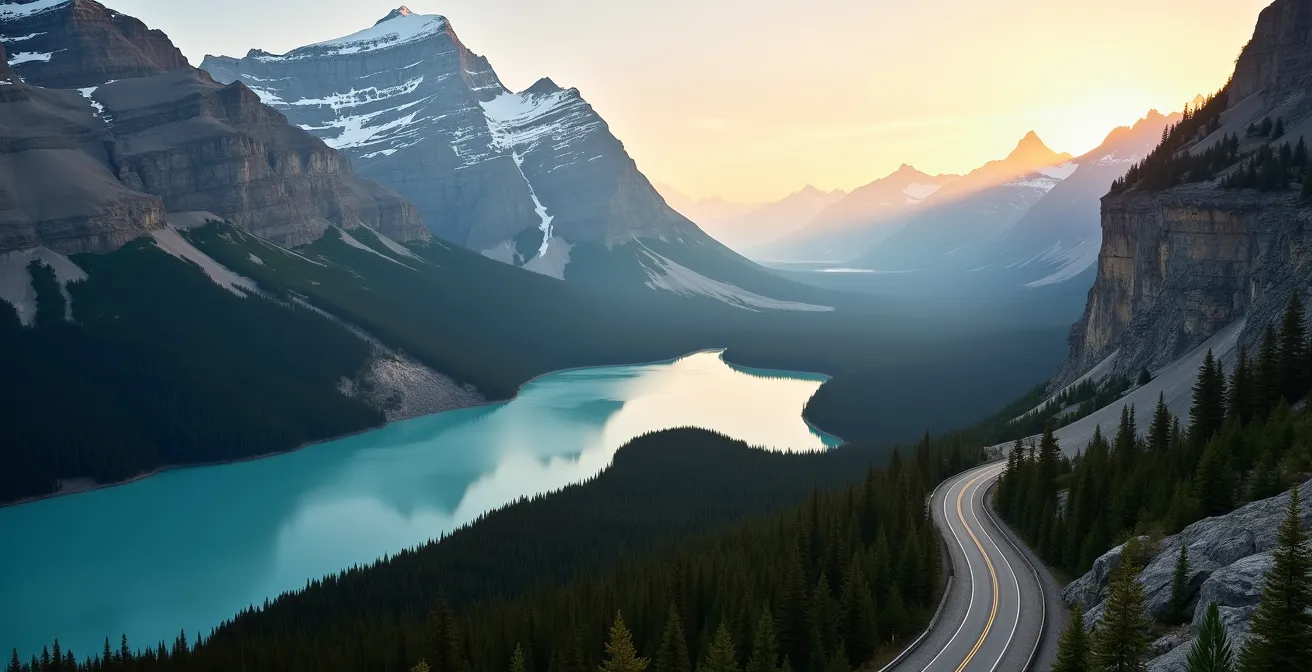
Completing this 14-hour Rockies triple-header is a logistical challenge, not a sightseeing tour; success is determined by precision and sequence, not ambition.
- Shuttle access to Moraine Lake is non-negotiable and requires mastering Parks Canada’s specific 48-hour rolling reservation window.
- Midday at Lake Louise and the single midway restaurant on the Icefields Parkway are predictable time traps that must be strategically bypassed.
Recommendation: A standard rental car is the only viable vehicle for this mission, providing the essential maneuverability and parking flexibility that an RV cannot offer.
The ambition is commendable: to witness the impossible turquoise of Moraine Lake, the grandeur of Lake Louise, and the sweeping vistas of the Icefields Parkway, all within a single, dawn-to-dusk push. Many travelers sketch this plan, believing an early start and sheer willpower are sufficient. They are mistaken. This is not a casual road trip; it is a complex logistical operation where success is dictated by a rigid, unforgiving sequence. Standard tourist advice about “booking in advance” is dangerously inadequate for an itinerary this compressed.
The entire mission hinges on conquering what can only be described as reservation warfare for shuttle access, understanding the physics of crowd flow, and making calculated efficiency trade-offs. Forget leisurely hikes or spontaneous detours. This is a day built on precision timing, strategic planning, and accepting that to see these three titans of the Canadian Rockies, you cannot do everything at any of them. The fundamental error is treating these locations as a checklist; they are a sequence-dependent puzzle.
This guide abandons platitudes and provides a non-negotiable operational sequence. We will deconstruct the process, starting with the single most critical dependency—securing your Moraine Lake access—before moving through the day’s timeline, addressing each decision point with data-driven recommendations. We will cover shuttle booking tactics, the sunrise dilemma, midday crowd avoidance, and the realities of a nighttime parkway drive. Executing this 14-hour day is possible, but only if you approach it with the mindset of a high-efficiency tour coordinator.
This detailed operational plan breaks down the mission into its critical components. Follow this sequence precisely to navigate the logistical hurdles and maximize your time in one of the most beautiful regions on Earth.
Table of Contents: A 14-Hour Rockies Operational Plan
- How to Score a Spot on the Moraine Lake Shuttle When Tickets Are Sold Out?
- How to Book the Lake Louise Shuttle Without Waking Up at 3 AM?
- Should You See Lake Louise Sunrise or Moraine Lake Sunrise First?
- Why Mid-Day is the Worst Time to Hike Around Lake Louise’s Shoreline?
- Where to Get a Quick, High-Calorie Lunch Between Louise and Jasper?
- The Top 3 Viewpoints You Must See Between Saskatchewan River Crossing and Jasper?
- How Long Does it Take to Drive the Parkway After Sunset in August?
- RV vs Rental Car: Which is the Best Way to Drive the Canadian Rockies?
How to Score a Spot on the Moraine Lake Shuttle When Tickets Are Sold Out?
Your entire 14-hour mission depends on this first step. Personal vehicle access to Moraine Lake is prohibited, making the Parks Canada shuttle the only way in. The majority of tickets are released in a hyper-competitive online environment, and understanding the system is non-negotiable. The primary opportunity is not in the initial spring release, but in the rolling release that happens two days prior. According to Parks Canada’s new rolling reservation system, a significant portion of tickets for any given day are held back for this specific window. This is your main point of attack.
Success requires preparation and speed. Failure to secure a shuttle ticket before your planned day means the entire itinerary collapses. This is not an exaggeration; it is the fundamental logistical reality of visiting Banff National Park in peak season. You are competing against thousands of other planners and automated bots. The process must be treated with military precision. Below is the only strategy that consistently works.
Action Plan: Securing Your Moraine Lake Shuttle Spot
- Create your Parks Canada reservation account well in advance. Enter and save your credit card information to eliminate any delays during checkout.
- Set multiple alarms for 7:55 AM Mountain Standard Time (MST), exactly 48 hours before your desired travel date. This is 8:00 AM MDT if you are visiting during daylight saving.
- Use a website like time.is to synchronize your clock to the official atomic time. A few seconds’ difference can mean failure.
- Log into the Parks Canada reservation system at 7:55 AM MST. Do not wait until 8:00 AM. Be ready in the “waiting room.”
- At exactly 8:00:00 AM MST, refresh the page and select the earliest possible shuttle time. The sunrise slots will disappear in under 5 seconds. Have your number of tickets and desired time slot decided beforehand.
Consider using two devices, such as a laptop on a wired connection and a phone on cellular data, to double your chances. If one device lags, the other may get through. This is the “reservation warfare” you must win to even begin your day.
How to Book the Lake Louise Shuttle Without Waking Up at 3 AM?
A persistent and damaging myth circulates among travelers: that one must wake up at 3 AM to book shuttles. This is incorrect and leads to unnecessary stress and failed attempts. The booking system operates on a clear, predictable schedule based on Mountain Standard Time, not on a random middle-of-the-night release. The primary booking window opens at 8:00 AM MST, which is the moment that matters.
The reservation system is structured in two main phases. A first batch, representing about 40% of the season’s tickets, is released in the spring (typically April). This is a good opportunity for long-term planners. However, for most, the critical window is the rolling release. 60% of tickets for any given day are released exactly 48 hours in advance at 8:00 AM MST. This is the opportunity that requires your full attention.
Therefore, the strategy is not sleep deprivation, but precision. It involves setting a calendar reminder for the date 48 hours prior to your intended visit and being logged into your prepared Parks Canada account before the 8:00 AM MST release time. Forget the 3 AM rumors; focus your energy on being ready at the correct time. As a backup, if you fail to secure a Parks Canada shuttle, the Roam Public Transit system offers service to Lake Louise, from which you can connect to the Moraine Lake shuttle, but this adds complexity and time to an already tight schedule.
Should You See Lake Louise Sunrise or Moraine Lake Sunrise First?
This is the first major strategic decision of the day, and it dictates the entire morning’s logistics. The choice is not about which is “better,” but which aligns with the operational constraints of your 14-hour blitz. Moraine Lake is the superior photographic choice for sunrise, as the sun rises behind you, casting a golden alpenglow on the Valley of the Ten Peaks. However, accessing it for sunrise requires booking one of the earliest, most competitive, and most expensive (often via private tour operators) shuttle slots.
Lake Louise, by contrast, allows for self-driving and parking (if you arrive extremely early, well before sunrise), making it logistically simpler. The sun rises over the mountains to your side, directly lighting Mount Victoria. While beautiful, the photographic conditions can be more challenging with direct light. The key advantage of a Lake Louise sunrise is that it positions you perfectly to complete an early morning hike, like to the Lake Agnes Tea House, before the midday crowds descend.
For this specific, compressed itinerary, the logical choice is a Lake Louise sunrise. It removes the high-stakes gamble of securing a 4 AM Moraine Lake shuttle and allows you to control your own timeline. You can capture the dawn, perhaps walk a portion of the shoreline, and then use your pre-booked, more reasonably timed shuttle to head to Moraine Lake immediately after.
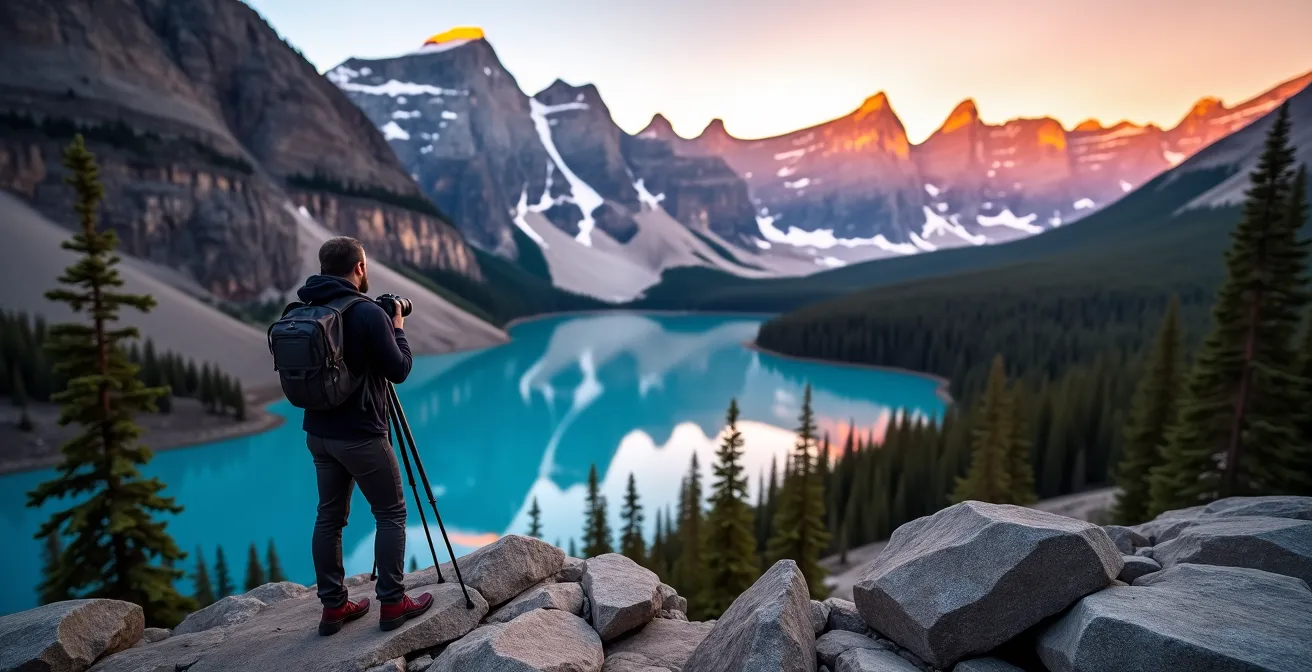
This comparison table breaks down the decision factors. For a high-efficiency day, prioritizing logistical certainty over the perfect photo is the correct trade-off.
| Factor | Moraine Lake Sunrise | Lake Louise Sunrise |
|---|---|---|
| Access Requirements | Must book 4 AM or 5 AM shuttle/tour | Drive yourself, but arrive by 5 AM for parking |
| Crowds | Much lighter due to shuttle limits | Heavier, especially near the Fairmont |
| Photography Conditions | Sun rises behind you, golden glow on Ten Peaks | Direct side-light on Mount Victoria |
| Best For | Iconic shots, peaceful experience | Logistical certainty, early start for hikes |
| Canoe Availability | Not until 9 AM | Available from sunrise |
Why Mid-Day is the Worst Time to Hike Around Lake Louise’s Shoreline?
Between 10 AM and 4 PM, the Lake Louise shoreline transforms from a serene natural wonder into a logistical bottleneck. The flat, easy-to-walk path becomes a slow-moving, single-file procession of thousands of visitors. This “human traffic jam” makes a simple stroll a frustratingly slow ordeal, wasting precious time in your 14-hour schedule. Attempting to navigate this congestion is a critical strategic error. The core problem is that this is the easiest, most accessible activity, so everyone does it at the same time.
Furthermore, midday offers the worst photographic conditions. The high, harsh sun washes out the iconic turquoise color of the lake and creates deep, unflattering shadows on the surrounding mountains and Victoria Glacier. You will be fighting for an unobstructed viewpoint among a sea of selfie sticks, only to capture a photo that is a pale imitation of what you saw at dawn. Parks Canada confirms that parking lots are at capacity from before sunrise until after sunset, meaning a constant, relentless flow of people throughout these peak hours.
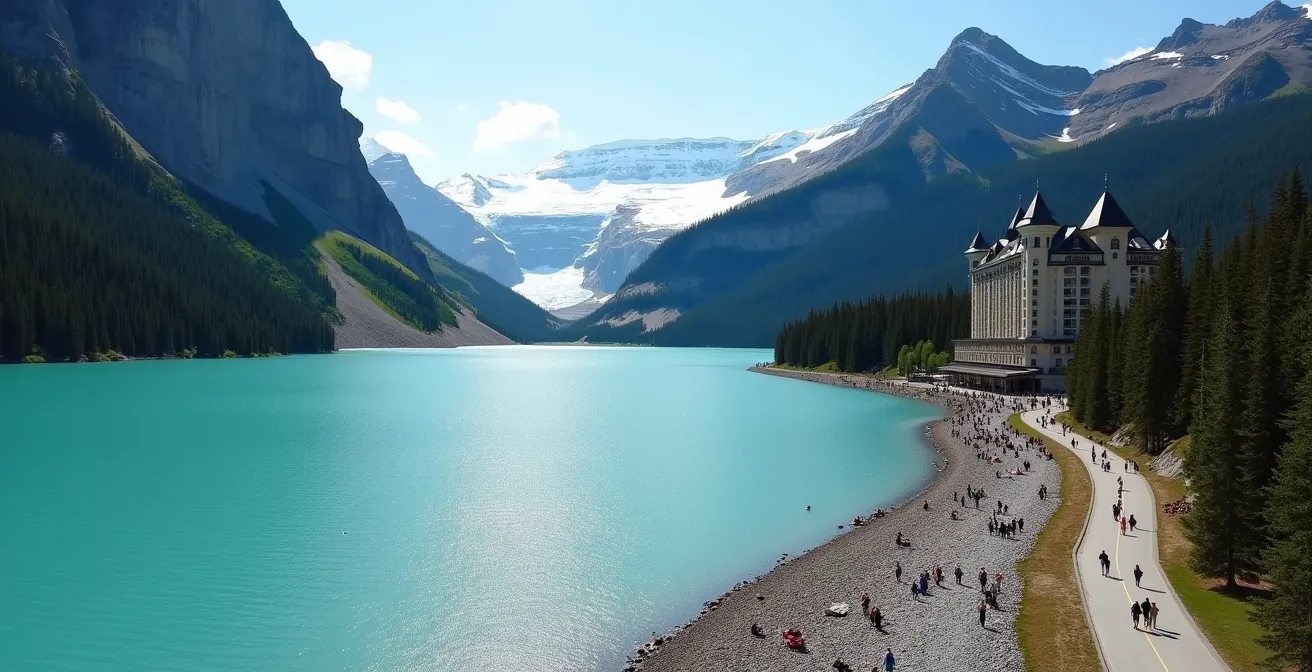
The efficient alternative is to cede the shoreline to the crowds and seek higher ground. This is an essential efficiency trade-off.
Logistical Briefing: The Fairview Lookout Alternative
Instead of joining the shoreline congestion, divert to the Fairview Lookout trail. As noted by travel strategists, this moderate hike offers a far superior return on time investment. The 45-minute round trip takes you above the chaos, providing elevated, panoramic views of the lake and the Fairmont Chateau. You escape the crowds, gain a unique photographic perspective, and convert 45 minutes of potential frustration into an efficient, rewarding activity before you proceed to your next objective.
Where to Get a Quick, High-Calorie Lunch Between Louise and Jasper?
Once you are on the Icefields Parkway, you enter a service dead zone. For a 14-hour itinerary, a lengthy, sit-down lunch is a schedule-killer. There is exactly one option for a hot meal midway: The Crossing at Saskatchewan River Crossing. However, treating this as your default plan is a rookie mistake. In peak season, you can expect long lines and waits of up to 45 minutes just to order, followed by another wait for your overpriced food. This single stop can easily consume 90 minutes of your day, which is an unacceptable delay.
The entire purpose of this itinerary is speed and efficiency. Relying on the only service point, which is guaranteed to be a bottleneck, directly contradicts this mission. The professional approach is to be entirely self-sufficient for your midday meal. This removes any dependency on external services and allows you to eat on your own schedule, perhaps at a scenic viewpoint, without losing momentum. This requires planning the night before your trip begins.
The most effective strategy is to provision your supplies in a larger town like Canmore or Banff before you even start the day. Supermarkets there offer everything needed for a quick, high-energy, portable lunch.
Action Plan: Pre-Trip Superstore Provisioning
- Acquire trail mix with a high concentration of nuts and dried fruits for sustained energy release.
- Pack multiple protein or energy bars, ensuring each contains a minimum of 250 calories.
- Prepare sandwiches or wraps using ingredients that will not spoil easily. Avoid mayonnaise-based fillings.
- Include a source of protein like hard-boiled eggs or cheese sticks, kept in a small cooler if possible.
- Carry at least 2-3 liters of water per person, plus an electrolyte drink to combat fatigue from driving and hiking.
The Top 3 Viewpoints You Must See Between Saskatchewan River Crossing and Jasper?
The stretch of the Icefields Parkway between Saskatchewan River Crossing and Jasper is dense with world-class scenery. On a compressed timeline, you cannot stop everywhere. The key is to apply an “effort vs. reward” matrix to your choices, prioritizing maximum visual impact for minimal time investment. Out of dozens of potential pullouts, three stand out as non-negotiable for their iconic status and relative accessibility.
First is Peyto Lake. After a short, 10-minute uphill walk from the parking lot, you are rewarded with one of the most famous views in the Canadian Rockies: the wolf-shaped, intensely turquoise lake. This stop offers perhaps the highest reward-to-effort ratio on the entire parkway. Plan for about 30 minutes total. Second, for a display of raw power, is Athabasca Falls. A network of paved pathways allows you to see the thundering waterfall plunge into a narrow canyon from multiple angles in about 45 minutes. The force of the water is immense and provides a different kind of spectacle than the serene lakes.
Third, for a direct glacier experience, is the Toe of the Athabasca Glacier. While many are tempted by the large-vehicle “Ice Explorer” tours onto the glacier, these are a significant time sink (90+ minutes) and budget item. For this itinerary, the efficient choice is the free hike to the toe of the glacier. This 45-minute round-trip walk brings you to the foot of the ancient ice, offering a profound sense of scale and time without the long queues and high cost of the commercial tour. These three stops—Peyto, Athabasca, and the Glacier’s Toe—deliver a complete parkway experience: an iconic lake, a powerful waterfall, and a direct glacier encounter.
Key Takeaways
- This 14-hour itinerary is a logistical operation, not a casual trip; success depends on a strict, non-negotiable sequence.
- Access to Moraine Lake is the primary dependency, requiring mastery of the 48-hour Parks Canada shuttle reservation system at 8 AM MST.
- A rental car is the only viable transport, as an RV is crippled by parking restrictions and lack of maneuverability required for this pace.
How Long Does it Take to Drive the Parkway After Sunset in August?
Calculating your return drive time from Jasper to Lake Louise after sunset is not as simple as checking Google Maps. The base driving time of 3 hours for the 232km parkway is a daytime, clear-weather fantasy. As dusk settles, two critical factors dramatically alter the equation: reduced visibility and a significant increase in wildlife activity. The parkway is unlit, and its winding, mountainous nature demands slower speeds in the dark. This alone adds a significant time buffer.
More importantly, the hours around sunset and sunrise are peak activity times for large animals. In particular, wildlife experts note that elk are most commonly spotted along the Icefields Parkway and near the Jasper townsite during evening hours. An encounter with an elk, moose, or bear on the road can cause significant delays or, worse, a dangerous accident. Driving with extreme caution is not optional, it is a requirement, and this means a slower pace.
A realistic time budget for an after-sunset drive in August must account for these variables. Expect the journey to take closer to 4.5 or even 5 hours, an increase of up to 50% over the base time. This buffer is essential for a safe return and for maintaining the integrity of your overall 14-hour schedule.
The following table provides a realistic framework for estimating your drive time based on conditions.
| Conditions | Base Time (232km) | Adjustment Factor | Realistic Time |
|---|---|---|---|
| Daytime, Good Weather | 3 hours | +0% | 3 hours |
| Daytime with Photo Stops | 3 hours | +100% | 6+ hours |
| After Sunset (August) | 3 hours | +30-40% | 4-4.5 hours |
| Night + Wildlife Caution | 3 hours | +50% | 4.5-5 hours |
| RV After Sunset | 3.5 hours | +40% | 5+ hours |
RV vs Rental Car: Which is the Best Way to Drive the Canadian Rockies?
For a general, leisurely tour of the Canadian Rockies, an RV can be a wonderful option. For this specific, high-intensity 14-hour mission, it is unequivocally the wrong tool. The choice between an RV and a rental car is the foundational decision that determines the feasibility of the entire itinerary. A rental car provides the essential agility, speed, and parking flexibility that are non-negotiable for success. An RV introduces insurmountable logistical hurdles.
First, parking. Major attractions like Lake Louise and other popular trailheads have parking lots that are often too small for large vehicles. As Parks Canada states, parking is extremely limited, and large RVs face outright prohibitions at many key locations during peak hours. This forces you into overflow lots, often requiring a shuttle transfer, which adds an hour or more to your schedule at each stop. A rental car can slip into tight spots and use lots that RVs cannot, saving critical time. Second, maneuverability. The Icefields Parkway has numerous small, unmarked pullouts for quick photo opportunities or wildlife viewing. An RV cannot safely or quickly pull into and out of these spots. You will miss opportunities that a car can easily seize.
Logistical Briefing: The RV Inefficiency Trap
An RV is inherently slower on the winding, steep grades of the parkway, adding at least 30-60 minutes to the base driving time. Furthermore, data on fuel efficiency calculations show a standard rental sedan would use approximately 37 liters of fuel for a 460km round trip on the parkway, whereas a Class C RV would consume around 92 liters. More importantly, the parking prohibitions at Moraine Lake and Lake Louise for oversized vehicles make an RV a direct impediment to the schedule. Attempting this itinerary with an RV guarantees you will have to cut major sights due to the compounding delays from parking and driving speed.
The conclusion is absolute. For a mission defined by speed, efficiency, and logistical precision, a nimble rental car is the only logical choice. An RV is a liability that will doom this ambitious 14-hour plan to failure.
To successfully execute this demanding 14-hour Rockies itinerary, every decision must be optimized for efficiency. The correct vehicle is not a preference but a prerequisite. Choose a rental car to retain the agility this mission demands.