Immersive experiences
Immersive travel experiences push beyond conventional sightseeing, demanding physical commitment and environmental awareness in exchange for encounters that remain etched in memory for decades. Canada’s vast geography offers three distinct categories of these transformative adventures: the celestial dance of aurora borealis in northern skies, overnight stays in architecturally ambitious ice structures, and the dramatic tidal movements along the Atlantic coast. Each requires specialized preparation, challenges human comfort limits, and rewards participants with profound connections to natural phenomena.
What distinguishes these experiences from standard tourism is their non-negotiable relationship with environmental conditions. You cannot summon the northern lights through sheer determination, nor can you alter the Bay of Fundy’s tidal schedule to suit your itinerary. Success hinges on understanding the scientific principles governing these phenomena, preparing your body and equipment for extreme conditions, and calibrating expectations to match reality. This comprehensive resource examines the practical, logistical, and safety dimensions of Canada’s most compelling immersive experiences, providing the foundational knowledge needed to transform interest into successful participation.
Witnessing the Northern Lights in Canada’s North
The aurora borealis results from solar wind particles colliding with Earth’s magnetosphere, creating luminous displays most visible in a band called the auroral oval. Canada’s northern territories—Yukon, Northwest Territories, and Nunavut—along with Churchill, Manitoba, position viewers directly beneath this zone, offering statistically superior viewing opportunities compared to southern latitudes.
Optimizing Your Viewing Conditions
Successful aurora viewing requires the convergence of three factors: solar activity, atmospheric clarity, and darkness. The KP index measures geomagnetic activity on a scale from 0 to 9, with readings above 3 producing visible displays in northern Canada. Monthly selection significantly impacts success rates—late August through April provides the necessary darkness, while December through March offers the coldest, clearest skies with minimal atmospheric moisture. Yellowknife averages approximately 240 aurora-visible nights annually, though cloud cover reduces actual viewing opportunities by roughly 30%.
Location selection involves balancing accessibility against light pollution. Urban aurora viewing proves disappointing even during strong displays; darkness equivalent to Bortle Scale Class 3 or lower is essential. Established viewing sites near Whitehorse, Yellowknife, and Churchill provide infrastructure while maintaining adequate darkness, though venturing 30-50 kilometers beyond city limits dramatically improves visual contrast.
Photography and Visual Expectations
Human vision and camera sensors perceive aurora differently, creating a frequent expectation gap. The naked eye typically observes white or pale green curtains during moderate displays, with colors intensifying only during exceptional KP 6+ events. Long-exposure photography reveals vibrant greens, purples, and reds invisible to human perception, as cameras accumulate photons over 10-30 second exposures. Setting your camera to manual mode with ISO 1600-3200, aperture f/2.8 or wider, and shutter speeds between 10-25 seconds captures the aurora’s full color spectrum. A sturdy tripod becomes non-negotiable equipment, as does understanding manual focus at infinity for sharp celestial imagery.
Dressing for Stationary Observation
Aurora viewing demands prolonged immobility in temperatures routinely reaching -30°C to -40°C during prime winter months. Unlike daytime winter activities where movement generates body heat, stationary observation requires insulation levels exceeding normal winter clothing. The layering system should include a moisture-wicking base layer, insulating mid-layers (wool or synthetic fleece), and a windproof outer shell rated for extreme cold. Critically, your feet require pac boots rated to -60°C with thick wool socks, as ground cold conducts rapidly through inadequate footwear. Chemical hand warmers placed in mitts and boots extend comfortable viewing duration by 60-90 minutes.
Surviving and Enjoying an Ice Hotel Stay
Quebec’s Hôtel de Glace, reconstructed annually from approximately 500 tons of ice and 15,000 tons of snow, represents Canada’s premier ice accommodation experience. Operating from January through March, this architectural phenomenon maintains internal temperatures between -3°C and -5°C regardless of external conditions, creating a controlled extreme environment that challenges conventional notions of comfortable lodging.
Booking Strategy and Logistical Planning
Optimal booking windows fall between mid-January and early February, after construction stabilizes but before late-season structural deterioration begins. Weekend rates command premium pricing, while midweek bookings often include value packages. First-time guests benefit from rooms closer to heated washroom facilities, typically a 15-30 meter walk through outdoor corridors. Most ice hotel experiences include access to traditional heated accommodations for the hours before sleep and after waking, acknowledging that 12+ consecutive hours in sub-zero environments exceeds most people’s comfort thresholds.
Thermal Management and Sleeping Systems
Ice hotel sleeping arrangements utilize expedition-grade sleeping bags rated to -30°C or colder, placed atop insulating mattresses on ice bed frames covered with deer hides or synthetic insulation. The critical technique involves wearing minimal clothing—typically thermal underwear only—inside the bag. Overdressing creates moisture from perspiration, which then conducts heat away from your body, triggering the exact cold discomfort you sought to prevent. A fleece liner adds warmth without bulk, while keeping your head covered with a toque retains significant body heat lost through an uncovered scalp.
Electronics suffer catastrophic battery depletion in extreme cold, with smartphone batteries losing 40-60% capacity at -5°C. Keep devices in inside jacket pockets against body heat, and carry external battery packs also kept warm. Cameras should transition gradually from cold to warm environments to prevent condensation damage; place them in sealed plastic bags while still cold, then allow 30-45 minutes for temperature equalization.
Practical Considerations and Family Travel
Managing bodily functions represents the least glamorous but most practical concern. Ice hotels provide heated washroom facilities requiring outdoor transit, making pre-sleep bathroom visits strategic. Limiting fluid intake after 7 PM reduces nighttime needs, though dehydration in cold, dry air presents its own risks—balance remains essential.
Children under 12 often struggle with the sustained cold exposure, and many ice hotels enforce minimum age policies around 9-12 years. Younger children lack the body mass for efficient thermoregulation and may not articulate discomfort before it becomes serious. Families should consider daytime ice hotel tours as introductions before committing to overnight stays, allowing children to assess their comfort with the environment during lower-stakes visits.
Experiencing the Bay of Fundy’s Extreme Tides
The Bay of Fundy, straddling New Brunswick and Nova Scotia, exhibits the world’s highest tidal range, with water levels fluctuating up to 16 meters between high and low tide twice daily. This dramatic movement creates temporary landscapes—exposed ocean floors, revealed rock formations, and powerful tidal bores—that exist for brief windows before the returning tide reclaims them.
Understanding Tidal Timing and Dynamics
Tidal cycles follow lunar schedules with 6 hours and 13 minutes between high and low tide, creating a 50-minute daily shift in tide times. This mathematical reality means optimal low-tide viewing windows move progressively later each day, requiring careful schedule coordination. Spring tides occurring during new and full moons produce the most extreme ranges, while neap tides during quarter moons show reduced differential. Fisheries and Oceans Canada publishes precise tidal predictions, though local weather patterns—particularly atmospheric pressure and wind direction—can accelerate or delay predicted times by 15-30 minutes.
The tide’s incoming speed reaches 6-8 kilometers per hour during peak flow, faster than walking pace. This seemingly modest velocity proves deceptive across the bay’s wide tidal flats, where water advances across multiple fronts simultaneously. Visitors engrossed in photographing exposed formations may find themselves surrounded by channels within 10-15 minutes, transforming casual exploration into genuine emergency.
Safety Protocols and Activity Planning
Safe tidal exploration requires arriving at low tide, not approaching low tide. The two-hour rule suggests beginning your exploration within 90 minutes after documented low tide, allowing ample time for photography, walking, or kayaking before the turn. Hopewell Rocks, the region’s most visited tidal site, implements mandatory exit times when incoming tides reach designated markers, removing individual judgment from safety decisions.
Kayaking tidal changes offers unique perspectives but demands experience with powerful currents and standing waves. Outfitters operating in Fundy typically restrict tidal kayaking to individuals with intermediate paddling skills and provide mandatory guide accompaniment. The tidal bore on the Shubenacadie River creates surfable waves for advanced kayakers, though the bore’s timing—predicted to the minute—leaves no margin for scheduling error.
Vehicle parking near tidal zones requires awareness of high-tide reach markers. Several parking areas along the bay flood during exceptional spring tides, and the combination of slippery boat ramps plus rising water has necessitated vehicle recoveries by tow services. Local signage indicates safe parking elevations, though photographing these markers during low tide provides helpful perspective on the water’s vertical travel distance.
Canada’s immersive experiences demand more than enthusiasm—they require education, preparation, and respect for natural forces indifferent to human schedules. The northern lights operate on solar timescales, ice hotels challenge thermal comfort, and tides follow gravitational certainties. Understanding the scientific principles underlying these phenomena, preparing appropriate gear, and calibrating expectations transforms potential disappointment into profound appreciation for experiences that exist at the intersection of human adventure and natural spectacle.
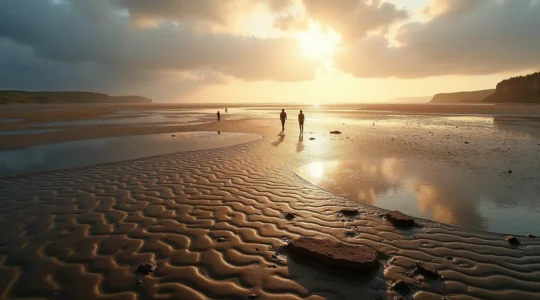
How to Read Tide Tables to Avoid Getting Trapped on the Mudflats?
Misreading a tide table isn’t an inconvenience; it’s a potentially fatal error that my team and I respond to every season. The most dangerous time on the flats is not at high tide, but during the 3rd and 4th hours…
Read more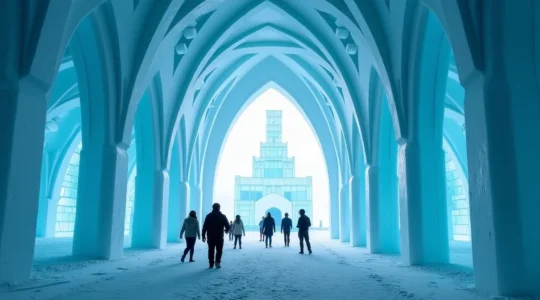
Is Sleeping in the Quebec Ice Hotel Worth the $600 Nightly Rate?
The $600 price for a night at the Hôtel de Glace is justified only if you approach it as a logistical challenge to be mastered, not as a typical luxury stay. Success hinges on counter-intuitive strategies like wearing fewer layers…
Read more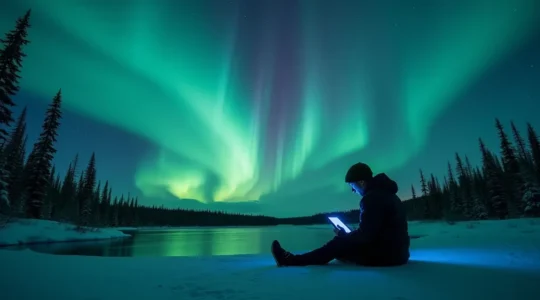
Is the Kp-Index Enough? A Masterclass in Northern Canadian Sky and Wildlife Photography
For the serious Northern traveller, relying solely on the Kp-index is a recipe for missed opportunities; true mastery lies in triangulating solar data with local Canadian weather and geography. Optimal aurora viewing depends more on clear skies and local conditions,…
Read more