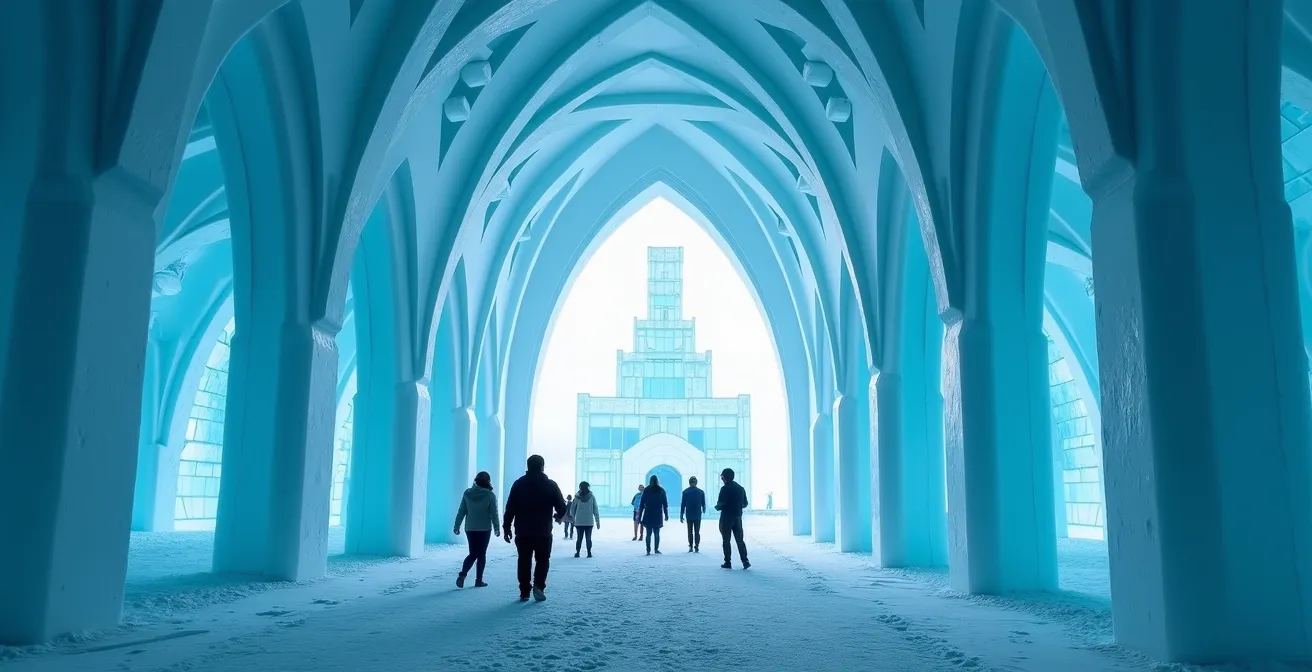
The $600 price for a night at the Hôtel de Glace is justified only if you approach it as a logistical challenge to be mastered, not as a typical luxury stay.
- Success hinges on counter-intuitive strategies like wearing fewer layers to bed and timing your visit for January’s superior ice quality.
- Your comfort depends entirely on your preparation for practical issues, from late-night bathroom runs to preventing battery death in your electronics.
Recommendation: Before booking, assess your tolerance for ‘active participation’ in your own comfort—the experience rewards meticulous planners, not passive guests.
The question hangs in the frigid Quebec air, as sharp and clear as the ice sculptures themselves: is a single night at the Hôtel de Glace truly worth the price of a weekend at a five-star hotel? As a Quebec City-based critic who has seen countless luxury offerings, I can tell you the answer is complex. The experience is often sold on the sheer novelty—the ice-carved bar, the chapel, the surreal beauty of sleeping in a room where the walls, bed, and nightstands are cut from frozen water. This is where most reviews stop, lost in the ‘once-in-a-lifetime’ cliché.
But for the discerning traveler, the one writing the cheque, novelty isn’t enough. Value is measured in comfort, seamlessness, and memorable moments that aren’t overshadowed by logistical frustrations. The common advice to “pack warm” is laughably insufficient. The real challenge isn’t just surviving the cold; it’s engineering your own comfort in an environment actively working against it. The true value proposition of the Hôtel de Glace doesn’t lie in the ice itself, but in the satisfaction of mastering the unique set of challenges it presents.
This is not a passive experience where you are simply catered to. It is an active adventure that demands intelligence and preparation. The difference between a magical night and a miserable, shivering ordeal lies in a series of non-obvious micro-strategies. It’s about understanding the physics of body heat, the quirks of electronics in sub-zero temperatures, and the critical importance of timing.
This guide will move beyond the superficial to give you the detailed, operational briefing you actually need. We will dissect the logistics of comfort, from handling middle-of-the-night bathroom breaks to the precise layering science that keeps you warm. We’ll analyze why January is the connoisseur’s choice over March, how to keep your phone from dying, and at what age this adventure becomes too much for children. This is the playbook for turning a high-priced gimmick into a triumphant luxury conquest.
To help you decide if this unique Quebec experience is right for you, we have broken down the critical logistical and experiential factors you must consider. This detailed analysis covers everything from personal comfort to the very structure of the hotel itself.
Summary: A Critic’s Guide to the Quebec Ice Hotel Experience
- How to Handle Bathroom Breaks in the Middle of the Night at the Ice Hotel?
- Why Wearing Too Many Layers Can Actually Make You Colder in an Ice Room?
- January or March: Which Month Offers the Best Ice Structure Stability?
- The Electronics Error That Kills Your Phone Battery in 20 Minutes Inside?
- Kids in the Ice Hotel: At What Age Is It Too Difficult for Them?
- The Layering Strategy That Keeps You Warm at -35°C for 4 Hours?
- Why January is the Best Month to See the Falls Without the Hype?
- What is the Secret Ingredient That Makes Quebec Poutine Sauce Unique?
How to Handle Bathroom Breaks in the Middle of the Night at the Ice Hotel?
Let’s address the most pressing and least glamorous concern immediately: the 3 a.m. call of nature. This single logistical hurdle can make or break the entire experience. The rooms themselves are entirely without plumbing; all facilities are located in a separate, heated pavilion. The journey from your thermal sleeping bag to a warm toilet seat is a mission that requires a pre-planned strategy. The key is to minimize time, exposure, and friction. Forget fumbling for clothes in the dark; your success is determined before you even get into your sleeping bag.
First, implement the “Last Call” rule, a staple of winter campers: cease all non-water beverage consumption at least three hours before your planned bedtime. This significantly reduces the odds of a nocturnal disturbance. Second, you must prepare your “go kit.” This isn’t a suggestion; it’s a requirement for comfort. Keep a pair of insulated, slip-on boots—Canadian brands like Baffin are ideal for this—directly beside your bed platform. Inside them, place a headlamp. You do not want to rely on your phone’s light, as we’ll discuss later.
Finally, rehearse your route. Before settling in for the night, walk the path from your room to the heated pavilion. Memorize the turns. The corridors of ice can be disorienting in the low light. When you sleep, do so in your base layers (merino wool or synthetic, never cotton). This way, you’re already partially dressed. If the need arises, the process is swift: slip on your boots, grab your headlamp, and execute the 90-second dash. According to the hotel’s operational procedures, guests have exclusive, private access to their rooms and the nearby facilities from 9 PM to 9 AM, ensuring you won’t be navigating around daytime tourists.
Why Wearing Too Many Layers Can Actually Make You Colder in an Ice Room?
The most common mistake first-timers make is rooted in a logical but flawed assumption: more is warmer. In the context of sleeping in an ice room, piling on every sweater you own is a direct path to a cold, miserable night. The real enemy inside your high-tech sleeping bag isn’t the ambient air temperature; it’s your own perspiration. Your body generates moisture even when you’re resting, and if that moisture gets trapped in your clothing, it will chill you to the bone. This is where the science of thermal efficiency becomes paramount.
Cotton is your worst enemy. It acts like a sponge, absorbing moisture and losing all its insulating properties, actively pulling heat from your body. The expert-endorsed solution, as confirmed by a deep dive into Canadian outdoor guidance, is a strict three-layer system for walking around, but an even more spartan approach for sleeping. When you are inside your arctic-grade sleeping bag, which is designed to trap your body heat, you should wear as little as possible. A single, high-quality base layer of moisture-wicking merino wool or a synthetic fabric is all you need. This layer pulls sweat away from your skin, keeping you dry.
As explained by Canadian outdoor experts in a guide on what to wear in winter, the goal is to let the sleeping bag do its job. It works by trapping a layer of air warmed by your body. Excessive clothing layers crush this pocket of air, reducing the bag’s efficiency. Furthermore, if you wear too much, you may start the night too warm, begin to sweat, and then wake up freezing a few hours later when that trapped moisture cools down. It’s a counter-intuitive but critical principle: to stay warm in an ice hotel bed, you must dress to stay dry, not to add bulk.
January or March: Which Month Offers the Best Ice Structure Stability?
Not all nights at the Hôtel de Glace are created equal. The month you choose to visit has a profound impact on the very quality of the ice, the crowds, and the overall aesthetic. While March might seem appealing with its milder temperatures, from a purist’s perspective, January is unequivocally the superior choice. The experience you get in early season is fundamentally different, and in my opinion, far more aligned with the hotel’s unique promise. In January, you are staying in a structure in its pristine, freshly packed state. The walls are sharp, the sculptures are crisp, and the ice has a brilliant, crystalline clarity.
This is because the hotel is constructed during the coldest part of the year, when temperatures reliably sit between -25°C and -35°C. This deep cold ensures maximum structural integrity. By March, the freeze-thaw cycle has begun to take its toll, even with average temperatures of -5°C to -15°C. You may notice walls that appear to be ‘weeping’ or a slight degradation in the finer details of the carvings. January is also a strategic sweet spot for crowds. The post-holiday lull means a more serene and exclusive atmosphere before the February rush of the Carnaval de Québec.

The table below, based on data from the official city tourism site, provides a clear comparison. For the traveler seeking the most authentic and visually stunning experience, the choice is clear. You are paying a premium for an architectural marvel of ice and snow; it is only logical to see it in its perfect form. The milder weather of March is a poor trade-off for the diminished quality of the core product.
This comparative data, drawn from official visitor information, highlights the distinct advantages of a January visit for the discerning traveler.
| Factor | January | March |
|---|---|---|
| Ice Quality | Pristine, freshly packed | Some melting/weeping walls |
| Crowds | Lower post-holidays | Higher with spring break |
| Temperature | -25°C to -35°C average | -5°C to -15°C average |
| Special Events | Pre-Carnaval quiet period | Maple syrup season begins |
| Hotel Condition | Perfect structural integrity | Freeze-thaw wear visible |
The Electronics Error That Kills Your Phone Battery in 20 Minutes Inside?
In the digital age, a dead phone isn’t just an inconvenience; it’s a severance from your camera, your contact with the outside world, and your alarm clock. Inside the Hôtel de Glace, the cold is a ruthless vampire for your electronics. A fully charged phone can plummet to zero in under 20 minutes if you make one critical error: leaving it exposed to the ambient temperature. The lithium-ion batteries in modern devices simply cannot function effectively in sub-zero conditions. The cold drastically slows the chemical reactions inside, leading to a rapid perceived loss of charge.
The single biggest mistake is thinking your phone can’t find a signal. The four-foot-thick walls of snow and ice are essentially a Faraday cage. Your phone will continuously burn its battery searching for a cell tower it will never find. Therefore, the moment you enter the ice structure, your first action should be to enable Airplane Mode. This alone will significantly prolong your battery life. The second rule is to never leave your device on the ice nightstand. It must be kept warm using your own body heat.
The same principle applies to your power banks. A cold power bank is a useless brick. Keep it in an inside jacket pocket or, when sleeping, inside your sleeping bag with you. As winter travel experts from My Tickle Feet explain, “Cold weather has a direct impact on electronics. Your power bank, cell phone battery, camera battery, etc, will run out more quickly in cooler temperatures.” To avoid disaster, you need a strict protocol.
Action Plan: Your Phone Battery Survival Protocol
- Enable Airplane Mode immediately upon entering to stop battery drain from signal searching through the thick ice walls.
- Store your phone in an inside jacket pocket, close to your body, to maintain a stable operational temperature.
- Keep power banks in the same warm inside pocket; they are useless if they become cold.
- Never charge a frozen device. Warm it to room temperature in the heated pavilion first to prevent condensation and permanent damage.
- Bring spare camera batteries and keep them warm, as they are equally susceptible to rapid draining in the cold.
Kids in the Ice Hotel: At What Age Is It Too Difficult for Them?
Bringing children to the Hôtel de Glace can transform the trip into a magical family saga or a very expensive, sleepless nightmare. The decision hinges on a realistic assessment of a child’s resilience and communication skills. Based on reports from families who have successfully navigated the experience and guidance from travel experts, there is a general consensus on a “sweet spot” for age. The primary factors are a child’s ability to articulate their level of comfort and their capacity to last through the night without bathroom emergencies.
For an overnight stay, many seasoned family travelers and experts suggest that children should be at least 7-8 years old. At this age, they can clearly communicate “I’m cold” or “I need to use the washroom” before the situation becomes critical. Younger children may not be able to differentiate between being slightly chilled and genuinely dangerously cold. The experience should be framed as a grand adventure. One Canadian family’s report highlighted the success of creating ‘Junior Explorer’ certificates and turning it into a game, which kept their 8-year-old engaged and positive.
It’s also crucial to manage expectations and have a backup plan. The hotel staff are accustomed to this and offer a “no-shame tap-out.” If the night becomes too much for your child (or for you), there is a procedure to move to your backup standard room at the adjacent Hôtel Valcartier mid-night. For families, booking a package that includes a regular hotel room isn’t just a convenience; it’s an essential safety net. Packing high-calorie snacks, a pre-loaded tablet with movies, and their favorite pillowcase can also provide a crucial sense of comfort and normalcy in an otherwise alien environment.
The Layering Strategy That Keeps You Warm at -35°C for 4 Hours?
While sleeping requires minimal layers, exploring the grounds, visiting the ice bar, or enjoying the outdoor Nordic spa requires a robust and intelligent layering strategy. Surviving, and indeed enjoying, an extended period in -35°C weather is a science. This isn’t just about piling on clothes; it’s about creating a personal microclimate that is both warm and dry. The stakes are high; between 2011 and 2024, Canada’s health authorities recorded over 1,650 cold-related injury cases, with the vast majority occurring in winter. Proper layering is your primary defence.
The gold standard, universally recommended by Canadian outdoor professionals, is the three-layer system. Each layer has a distinct and crucial function:
- Base Layer: This is your second skin. Its only job is to wick moisture away. It must be merino wool or a synthetic like polyester. Never, ever wear cotton as a base layer.
- Mid-Layer: This is your insulation. Its purpose is to trap your body heat. A fleece jacket, a down vest, or a synthetic insulated jacket (like an Arc’teryx Atom LT) is perfect. The key is trapping air, which is the actual insulator.
- Outer Shell: This is your shield against the elements. It must be windproof and waterproof. Look for a jacket with a hood and sealed seams to prevent any drafts or moisture from getting in.
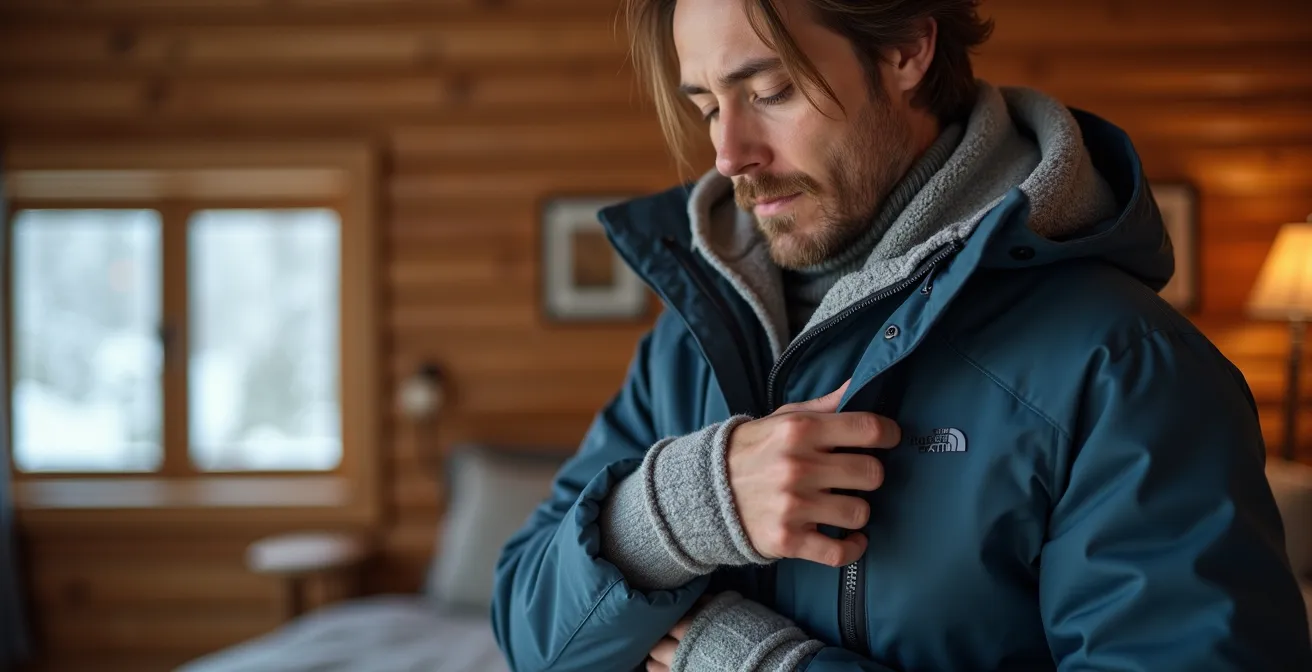
This system must extend to your extremities, which are the most vulnerable to cold. This means liner gloves inside mittens (mittens are warmer than gloves as they keep your fingers together), thick wool socks, and a toque that fully covers your ears. When transitioning to the Nordic spa’s hot tubs, a quick-dry towel, an insulated robe, and easy-to-slip-on boots are essential for minimizing the brutal shock of the cold between the changing room and the water.
Why January is the Best Month to See the Falls Without the Hype?
While the Hôtel de Glace is the main draw, a savvy traveler plans their visit to coincide with other unique regional phenomena. Just a short distance away, Montmorency Falls transforms in January into a spectacle that far outshines its summer persona. Visiting in January allows you to witness the formation of the “Pain de Sucre” (Sugar Loaf), a massive and spectacular cone of ice that builds at the base of the falls. This natural monument, reaching up to 30 meters high, is a product of the deep, consistent cold of mid-winter and is often gone by March.
This provides more than just a photo opportunity; it offers free, world-class entertainment. Professional ice climbers flock to the Sugar Loaf in January for its stable, thick ice, and watching them ascend the frozen monolith is a breathtaking sight. Furthermore, the lighting is simply better. The low-hanging January sun strikes the ice formations at a dramatic angle in the mid-afternoon (between 3-4 PM), creating a photographer’s paradise of light and shadow that you won’t find in other months.
Strategically, a January visit is what Quebec tourism insiders might call the “Pre-Carnaval Sweet Spot.” You experience the falls at their absolute winter peak without the immense crowds that descend upon the region for the world-famous Carnaval de Québec, which typically begins in early February. This allows for a more intimate and impressive viewing experience, turning a side trip into a highlight that rivals the main event. It’s a classic example of how timing your visit around local knowledge elevates the entire journey.
What to Remember
- Comfort is engineered, not provided: your success depends entirely on meticulous preparation.
- Timing is everything: January offers pristine ice and fewer crowds, while March shows signs of wear and tear.
- Master the micro-logistics: from bathroom runs to battery life, small details make or break the premium experience.
What is the Secret Ingredient That Makes Quebec Poutine Sauce Unique?
After a day and night of engineered survival against the cold, there is no greater reward than a hot, decadent plate of authentic Quebec poutine. But what makes the sauce here so distinct from the countless imitations found elsewhere? The secret isn’t a single ingredient but a foundational French culinary technique known as ‘pincage’. This involves browning tomato paste with a dark roux, which creates a deep, complex, and slightly tangy flavour profile that simple beef or chicken stock can never replicate.
Beyond this core technique, the beauty of Quebec poutine sauce lies in its regional variations. A visit to the area around the Hôtel de Glace, in the Quebec City region, will typically yield a traditional, perfectly balanced, medium-brown sauce. But travel to Montreal, and you’ll find a darker, more peppery version. Head to the Beauce region, and the sauce becomes noticeably lighter and sweeter. Local chefs often guard their specific recipes, but common enhancers to boost umami include a splash of vinegar for tang, a dash of Worcestershire or soy sauce for depth, and a hint of poultry seasoning.
After burning calories simply by staying warm, a rich poutine is the perfect caloric replenishment. For a truly local experience, pair it with a classic Quebec craft beer. A strong, complex ale like Unibroue’s La Fin du Monde or Maudite has the character and effervescence to cut through the richness of the sauce and cheese curds, creating a perfect culinary conclusion to your ice adventure.
| Region | Sauce Style | Key Characteristics | Best Pairing |
|---|---|---|---|
| Montreal | Dark & Peppery | Dark roux, black pepper forward | Smoked meat on side |
| Beauce | Light & Sweet | Lighter color, subtle sweetness | Fresh cheese curds |
| Quebec City | Traditional | Balanced, medium brown | Classic fries |
| Saguenay | Hearty | Thicker consistency, meat base | Local microbrews |
So, is the Hôtel de Glace worth it? Yes, but conditionally. It is worth it for the planner, the adventurer, the person who derives satisfaction from preparation and execution. It is not worth it for the passive luxury guest expecting to be pampered. The $600 is not a fee for a hotel room; it is an entry fee for a unique and demanding environmental challenge. Your return on investment is directly proportional to the effort you put into mastering the logistics of your own comfort.