The best vehicle choice for the Canadian Rockies isn’t about freedom vs. cost; it’s determined by your family’s tolerance for logistical friction and hidden operational risks.
- An RV’s perceived flexibility is offset by a “mountain physics tax” on fuel and brakes, plus severe parking and driving constraints in key areas.
- A car’s simplicity is challenged by strict seasonal tire regulations, limited cargo space for essential supplies, and the high cumulative cost of lodging.
Recommendation: Before booking, perform an “Operational Calculus” on your specific itinerary by weighing the eight critical logistical factors detailed in this guide.
For any family planning a trip through the Canadian Rockies, the first major decision looms large: rent a sprawling RV, the very symbol of road trip freedom, or opt for a nimble rental car and the comfort of hotels? The debate often circles around familiar themes. An RV promises spontaneous detours and nights spent under starry mountain skies. A car and hotels offer simplicity, predictable comfort, and relief from cooking and cleaning.
Conventional wisdom frames this as a choice between flexibility and convenience, or a simple cost comparison. But this perspective is dangerously incomplete. It ignores the fundamental physics and regulations of mountain travel. The true deciding factors are not found in glossy rental brochures but are hidden in the fine print of highway regulations, the steep gradients of mountain passes, and the geometric constraints of century-old townsites. These elements create a unique “Operational Calculus” that can quickly invalidate the assumed benefits of either vehicle.
The core of the issue is that the Canadian Rockies impose a non-negotiable tax on all travellers—a tax paid in fuel, brake wear, and logistical stress. Understanding this is the key. This guide moves beyond the generic debate to provide a practical, mathematical framework for your decision. We will dissect the eight critical logistical equations you must solve, from tire legality and fuel deserts to the stark realities of parking a 30-foot rig in a town built for horse-drawn carriages. Only by calculating these variables can you determine which vehicle truly aligns with your family’s budget, comfort level, and tolerance for risk.
For those who prefer a visual introduction, the following video offers a stunning immersion into the landscapes of the Icefields Parkway, perfectly complementing the practical advice in this guide by showcasing the very terrain you’ll be navigating.
To help you navigate these critical decision points, this article is structured as a series of logistical challenges. By understanding each one, you can build a clear picture of the true costs and benefits of each vehicle option for your family’s journey through the Canadian Rockies.
Summary: RV vs Rental Car: Which is the Best Way to Drive the Canadian Rockies?
- The M+S Tire Confusion: Are All-Seasons Legal on BC Highways in October?
- Why Your Gas Mileage Drops by 30% When Driving the Icefields Parkway?
- Brake Burning: How to Drive Downhill Without Ruining Your Rental Car?
- The RV Parking Nightmare: Where Can You Actually Park a 30ft Rig in Banff?
- One Pass per Person or per Vehicle: How to Avoid Overpaying at the Gate?
- SUV or Campervan: Which Vehicle Suits a Coast-to-Coast Journey in September?
- When is the Next Gas Station After the Columbia Icefield Centre?
- How to Drive the Icefields Parkway With Only 4 Hours of Daylight Remaining?
The M+S Tire Confusion: Are All-Seasons Legal on BC Highways in October?
One of the first and most critical “regulatory landmines” for an autumn Rockies trip is British Columbia’s winter tire law. From October 1st to April 30th, designated highways—which include major routes to and through the Rockies like the Trans-Canada Highway 1 and Highway 93—require vehicles to be equipped with proper winter tires. This is not a suggestion; it’s a legal requirement enforced with fines, and more importantly, it’s a crucial safety measure.
The confusion for many travellers, especially those from warmer climates, lies in the tire markings. Most standard rental cars and RVs are fitted with “M+S” (Mud and Snow) all-season tires. While these are the legal minimum to avoid a ticket, their performance plummets as soon as the temperature drops below 7°C (45°F). The rubber compounds harden, drastically reducing grip on cold, wet, or icy pavement. True winter tires, identified by the Three-Peak Mountain Snowflake (3PMSF) symbol, use softer compounds that remain flexible in the cold, providing significantly better traction and shorter stopping distances.
For a family, the choice between a car and an RV becomes a question of guaranteed compliance and safety. Most rental fleets offer M+S tires as standard. Securing a vehicle with 3PMSF tires often requires a specific request and an upgrade fee. This is a non-negotiable budget item if your trip falls within the mandatory period. The following table breaks down the crucial differences, a key part of your pre-trip operational calculus.
This data, highlighted in a comparative analysis of Rockies driving conditions, underscores the safety gap between legal compliance and genuine preparedness.
| Tire Type | Legal Status (Oct 1-Apr 30) | Performance Below 7°C | Ice Traction | Availability in Rentals |
|---|---|---|---|---|
| M+S All-Season | Legal minimum on BC highways | Reduced grip | Poor | Standard in most fleets |
| 3PMSF Winter | Recommended by locals | Optimal grip | Good | Available for upgrade fee |
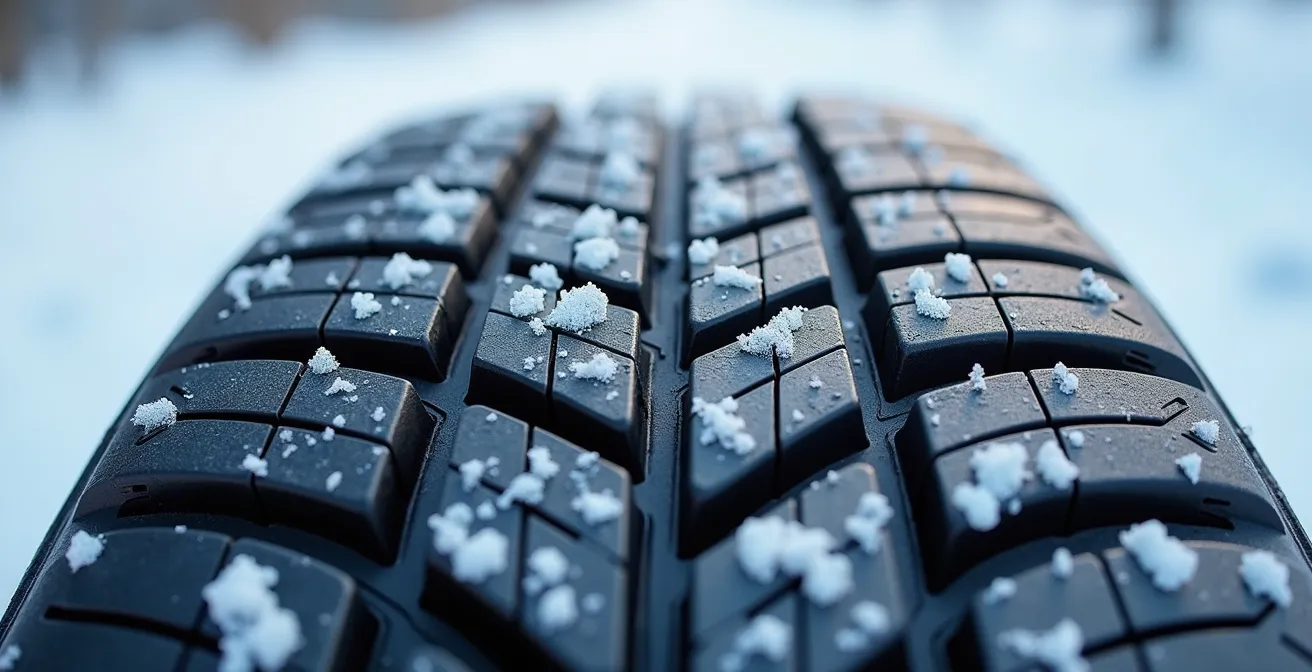
As the image shows, the deep, intricate treads of winter-rated tires are designed to bite into snow and ice, a feature standard all-seasons lack. Assuming the standard “all-season” tires are sufficient is a common but potentially dangerous oversight. Your first logistical task is to confirm with your rental agency not just what is legal, but what is safe for the specific time and routes of your journey.
Why Your Gas Mileage Drops by 30% When Driving the Icefields Parkway?
The second major variable in your logistical equation is the “Mountain Physics Tax” on fuel consumption. Manufacturer-stated fuel economy figures are based on ideal, flat-terrain driving. The Canadian Rockies are anything but. When driving a heavy vehicle like an RV or even a loaded SUV on the Icefields Parkway, you must budget for a significant drop in efficiency, often as much as 30% or more.
This dramatic increase in fuel use is not due to a single factor, but a combination of relentless physical forces. Constant elevation changes require the engine to work much harder on ascents. Steep grades mean frequent gear changes, keeping the engine at higher, less efficient RPMs. Furthermore, the lower oxygen levels at altitude can slightly reduce combustion efficiency. For an RV, this is compounded by its poor aerodynamics and sheer weight, turning it into a gas-guzzling machine on mountain roads.
A standard Class C RV that gets 23 L/100km (10 mpg) on the highway might see that figure plummet to over 30 L/100km (7.5 mpg) on a route like the Parkway. For a family doing the full 233 km trip from Jasper to Lake Louise, this difference can add up to an extra 16 litres of fuel for a single leg of the journey. Over a one-week trip, this “mountain tax” can easily add $100-$200 in unbudgeted fuel costs for an RV. While a rental car is also affected, its lower weight and better aerodynamics mean the penalty is far less severe. This calculation is essential when comparing the “total cost of ownership” for the trip duration.
Brake Burning: How to Drive Downhill Without Ruining Your Rental Car?
What goes up must come down, and in the Rockies, descents are a serious test of both driver skill and vehicle mechanics. The “Mountain Physics Tax” applies just as much to your brakes as it does to your fuel tank. Relying solely on your brake pedal to control speed on long, steep descents is a recipe for disaster. This action, known as “riding the brakes,” generates immense heat, which can cause brake fluid to boil, leading to a terrifying loss of braking power known as brake fade.
Both rental cars and RVs are susceptible, but the immense weight of an RV dramatically increases the risk. Rental companies are well aware of this, and evidence of “brake burning”—a distinctive acrid smell and bluish discoloration on the brake rotors—can lead to significant damage charges upon return. The key to safe descent is not to use your brakes, but to use your engine. By downshifting to a lower gear (‘L’, ‘2’, or manual mode), you engage engine braking, using the engine’s compression to maintain a slow, steady speed without ever touching the brake pedal.
A prime example of this challenge is the descent from Kicking Horse Pass. As noted by experienced drivers, this particular section presents a significant challenge. An analysis of high-risk mountain roads highlights that the descent from Kicking Horse Pass (elevation 1,627m) to Field drops 400m over just 12km, creating an average 6% grade. This stretch is notorious for overheating the brakes of unprepared drivers, especially those in heavy RVs.
Your Action Plan: Step-by-Step Engine Braking Technique for Automatic Transmissions
- As you approach the descent, reduce speed to 60-70 km/h before the grade begins.
- Shift your automatic transmission from ‘D’ (Drive) to a lower gear, such as ‘L’ (Low), ‘2’, or use the manual/sport mode to select a low gear.
- Allow the engine’s compression to control your speed; you will hear the engine RPMs increase, which is normal.
- Use the brake pedal only intermittently for short, firm applications to fine-tune your speed, not constantly to hold it back.
- If you smell a burning odour or the brake pedal feels soft, pull over at the next safe location and allow the brakes to cool for at least 15-20 minutes.
- For larger RVs, if your vehicle is equipped with an exhaust brake (jake brake), be sure to engage it before starting the descent.
Mastering this technique is not just about avoiding a repair bill; it’s a fundamental safety skill for anyone driving in the mountains. For a family, the question becomes: who is comfortable and skilled enough to manage this in a large, unfamiliar vehicle?
The RV Parking Nightmare: Where Can You Actually Park a 30ft Rig in Banff?
The idyllic image of an RV often neglects a harsh reality: “spatial inefficiency.” While an RV offers a home on wheels, that home is often too large for the world it’s trying to explore. This is nowhere more apparent than in the towns of Banff and Jasper. These historic mountain towns were designed long before the advent of 30-foot motorhomes, and their infrastructure reflects that. Finding a parking spot for a car can be a challenge; finding one for an RV during peak hours is a logistical nightmare.
Most street parking is off-limits, and standard parking lots cannot accommodate the length or turning radius of a large rig. Attempting to navigate the busy downtown core of Banff in a Class C RV is a high-stress activity that can quickly sour a family outing. The town has designated specific oversized vehicle parking areas, but these are limited and often require a significant walk to the main attractions. For example, the primary RV lot on Railway Avenue is a 10-minute walk from the center of town and fills up quickly.
This spatial constraint extends to the attractions themselves. The parking lots for iconic spots like Lake Louise and Moraine Lake are famously congested and have size restrictions. Access to Moraine Lake is now restricted to shuttles, and RVs are often directed to park-and-ride facilities far from the main sites. This “freedom” of having your kitchen with you is nullified if you have to park a kilometre away and hike just to get to the trailhead. This is a critical factor for families with young children or members with mobility issues.
This table summarizes the primary options and their trade-offs, based on data compiled by frequent Rockies visitors.
| Location | RV Size Limit | Best Times | Cost | Walking Distance to Town |
|---|---|---|---|---|
| Railway Ave Oversized Lot | No limit | Before 9 AM/After 5 PM | $4/hour | 10 min walk |
| Fenlands Recreation Centre | 35 ft | All day | Free with Roam Transit | Transit required |
| Tunnel Mountain Campground | 40 ft (some sites) | Check-in after 1 PM | $33-40 CAD/night | 25 min walk or transit |
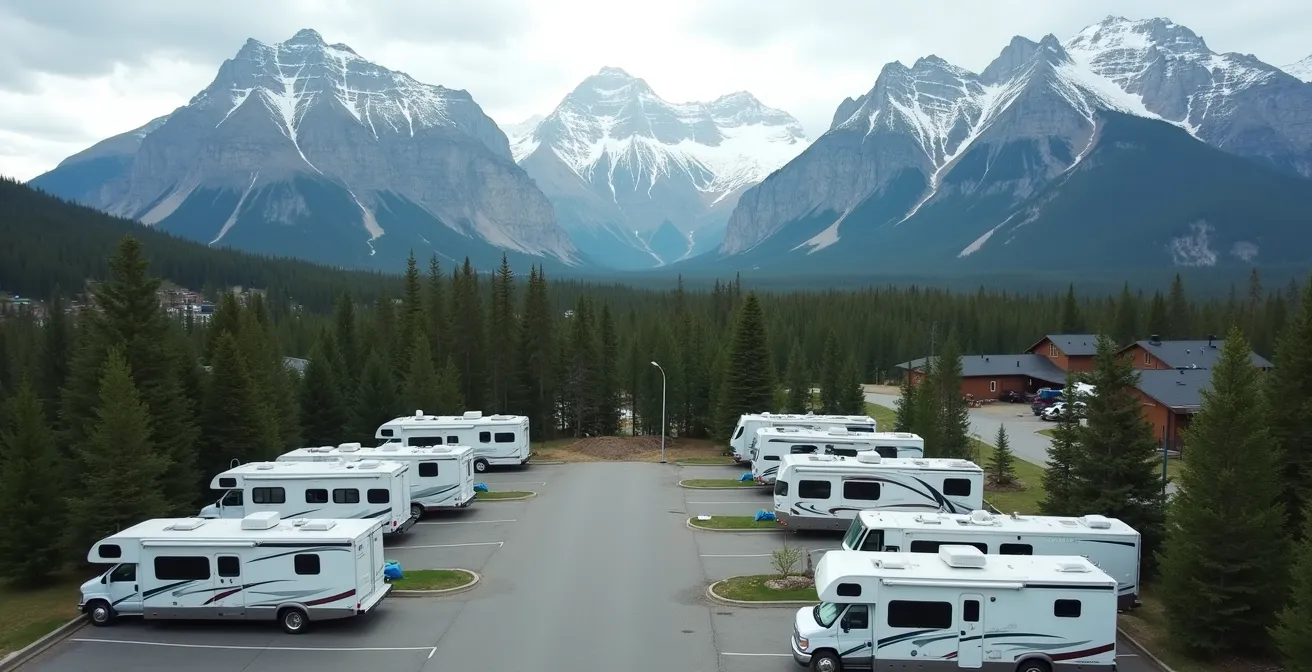
Ultimately, opting for an RV requires a strategic shift: the vehicle is a basecamp, not a convenient shuttle. The day’s activities must be planned around public transit or long walks from designated lots, a significant logistical layer that doesn’t exist with a more versatile rental car.
One Pass per Person or per Vehicle: How to Avoid Overpaying at the Gate?
Entering Canada’s mountain national parks—Banff, Jasper, Yoho, and Kootenay—requires a Park Pass. This is a simple concept that hides a surprisingly complex cost calculation, creating another “regulatory landmine” where families can easily overpay. The critical detail to understand is that the pass is priced in two ways: a daily rate per person/group, or an annual pass per vehicle.
The daily fee is charged for each day you spend in any of the national parks. A single daily pass for a family or group in one vehicle is expensive. The far more economical option for almost any trip longer than a few days is the Parks Canada Discovery Pass. This is an annual pass that covers admission for a group of up to seven people in a single vehicle to all national parks in Canada for a full year. The key is that it’s tied to the vehicle; it must be hung from the rearview mirror.
The math is straightforward. According to travelers who documented their expenses, the annual pass at around $140 CAD becomes cheaper than buying daily passes for a family of three after just a few days. For a typical week-long family vacation, the Discovery Pass is a financial no-brainer. The logistical challenge is acquiring it. While you can buy it at the park gates, this often involves long queues, especially during peak season. A smarter approach is to purchase it in advance.
Here are the most efficient strategies to get your pass and bypass the entry gate queues:
- Purchase online from the official Parks Canada website well before your trip and have it mailed to your home.
- Buy one upon arrival at the visitor information desk at the Calgary International Airport (YYC).
- Stop at the Canmore Visitor Centre, which is located just before the Banff National Park east gate and typically has no line.
- Purchase at a retail partner like MEC (Mountain Equipment Co-op) in Calgary or Edmonton.
For both an RV and a car, the Discovery Pass is the correct financial choice for a family trip. The only difference is the physical act of displaying it. In an RV, it can remain in place for the whole trip, while with a car, you must remember to move it between vehicles if you switch rentals. It’s a small detail, but another piece of the logistical puzzle.
SUV or Campervan: Which Vehicle Suits a Coast-to-Coast Journey in September?
Expanding the scope to a coast-to-coast journey in September introduces a new set of variables. The primary challenge becomes adapting to drastically different environments, from the wide-open prairies to the dense urban cores of Montreal and Vancouver, all under the threat of unpredictable transitional weather. The choice between an SUV and a campervan (or larger RV) is less about mountain-specific physics and more about cross-country versatility.
September is a “shoulder season” month. While it can offer beautiful autumn colours, it can also bring the first significant snowfalls in the Rockies and powerful crosswinds across Saskatchewan and Manitoba. A real-world account from a late September 2018 RV trip through the Rockies encountered severe weather with 1.5-meter icicles forming on the RV mirrors, a stark reminder of the extreme conditions possible. The high profile of a campervan or RV makes it much more susceptible to crosswinds than a lower-slung SUV, turning a long prairie drive into a white-knuckle experience.
Furthermore, the logistical friction of a larger vehicle is amplified in major cities. Navigating and parking an RV in downtown Vancouver or Old Montreal is nearly impossible and extremely stressful. An SUV, by contrast, can handle urban environments with ease. Another critical factor is the cost of ferry crossings in British Columbia. The price for a BC Ferries trip is based on vehicle length; a standard SUV is significantly cheaper than a campervan or RV, which can be charged as an “over-height” and “over-length” vehicle, sometimes tripling the cost.
For a September cross-Canada trip, the SUV with winter-rated tires presents a more robust and versatile logistical solution. It offers superior handling in potential snow and wind, easy navigation of cities, and lower costs on essential transport links like ferries. The campervan’s benefit of having built-in accommodation is often outweighed by the sheer lack of flexibility across the country’s diverse landscapes.
When is the Next Gas Station After the Columbia Icefield Centre?
The Icefields Parkway is one of the most beautiful drives in the world, but it is also one of North America’s most significant “fuel deserts.” This is perhaps the single most important piece of logistical information for any driver: between Jasper and Lake Louise, there is only one gas station at Saskatchewan River Crossing. Crucially, this station is seasonal and typically closes in early October.
When it closes, drivers face an uninterrupted, service-free stretch of mountainous road. The distance from the Columbia Icefield Centre heading south to the next available fuel in Lake Louise is approximately 130 km. However, the true logistical trap is for those starting from Jasper. Once Saskatchewan River Crossing is closed, drivers must cover a 233 km stretch with zero fuel stops between Jasper and Lake Louise. Compounded by the 30% reduction in fuel economy from the “mountain physics tax,” this is a journey many vehicles, especially thirsty RVs, cannot make on a single tank if they don’t start completely full.
There is absolutely no cell service for the majority of this drive. Running out of gas here is not an inconvenience; it’s a serious emergency situation, especially in the colder months. You cannot call for help. You are entirely dependent on the kindness of passing motorists, in a location where traffic can be sparse. For a family, the consequences of this miscalculation are severe.
This reality makes fuel planning an essential, non-negotiable part of your operational calculus. The rule is simple: never, ever enter the Icefields Parkway from either Jasper or Lake Louise with anything less than a full tank of gas. This section has no room for error, and the vehicle choice directly impacts your margin of safety. An RV’s larger tank may seem like an advantage, but its higher consumption often negates it.
Your Action Plan: Emergency Fuel Planning Checklist for Icefields Parkway
- Never start the parkway from Jasper or Lake Louise with less than a 3/4 tank of fuel; a full tank is the safest rule.
- If travelling near early October, call Saskatchewan River Crossing directly at (403) 761-7000 to confirm if their fuel pumps are still operational for the season.
- Calculate your vehicle’s realistic range: find its official fuel economy, then subtract 30% to estimate your mountain driving range. Ensure the 233 km distance is well within that limit.
- Always carry emergency supplies in your vehicle, including extra water, food, and warm blankets, as there is no cell service for over 200 km.
- If you find yourself unexpectedly low on fuel, conserve it by turning off the A/C and heat, maintaining a steady speed of 80 km/h, and coasting down hills in gear (engine braking) when safe.
- Know the exact distances for your plan: Jasper to the Columbia Icefield is 104 km, and the Icefield to Saskatchewan River Crossing is another 53 km.
Key Takeaways
- The “best” vehicle is not about comfort but about your tolerance for logistical complexity; every choice has a hidden cost.
- Mountain driving imposes a real “physics tax” on fuel and brakes that must be factored into your budget and safety planning.
- Local regulations (like BC’s tire laws) and physical constraints (like RV parking in Banff) are non-negotiable and can define your entire trip’s experience.
How to Drive the Icefields Parkway With Only 4 Hours of Daylight Remaining?
The final logistical equation is one of time and risk. In the autumn, daylight hours in the Rockies dwindle rapidly. Attempting to drive the full 230+ km Icefields Parkway with only a few hours of daylight is an exceptionally poor decision, especially for a family. The risks are twofold: compromised sightseeing and a dramatic increase in the likelihood of a wildlife collision.
The parkway’s beauty unfolds in the light; in the dark, it is simply a long, unlit, and potentially treacherous road. More critically, as a Parks Canada advisory states, peak wildlife activity occurs at dawn and dusk. Large animals like elk, deer, bighorn sheep, and even bears are most active during these twilight hours, and they frequently cross the road. A collision with a multi-hundred-kilogram elk can be devastating for a car and still cause significant damage and potential injury in a large RV. In the dark, on an unfamiliar winding road, your reaction time is severely limited.
A smart logistical approach means accepting limitations. If you find yourself in Lake Louise with only four hours until sunset, the correct answer is not to “race the dark” to Jasper. Instead, a more calculated approach is the “Peyto Lake Compromise.” As experienced local guides suggest, this involves driving the 40 minutes north to the spectacular Peyto Lake viewpoint, spending 45 minutes to an hour soaking in one of the parkway’s most iconic vistas, and returning to Lake Louise with ample daylight to spare. This strategy maximizes the scenic reward for the time available while completely mitigating the risk of dusk driving.
This is the essence of a successful Rockies road trip: it’s not about seeing everything, but about making smart, safe, and enjoyable choices based on the real-world constraints of time, weather, and logistics. The vehicle choice is secondary to the driver’s judgment. Whether in an RV or a car, the decision to push on into the darkness is always the wrong one.
Ultimately, the decision between an RV and a rental car is a personal one, but it must be an informed one. By working through these eight logistical challenges, you can perform a realistic “Operational Calculus” for your family. Calculate the true costs—in dollars, time, and stress—and you will arrive at the vehicle choice that doesn’t just look good in a photo, but one that genuinely enhances your unforgettable journey through the Canadian Rockies.