While Tadoussac offers the highest concentration of whales, it’s not automatically the “best” choice for every traveler.
- Tadoussac provides maximum whale-sighting probability due to its unique underwater geography and high density of tours.
- Rimouski offers a less crowded, more authentic experience with a strong focus on marine science and conservation.
Recommendation: Choose Tadoussac for sheer numbers and tour variety. Choose Rimouski for a quieter, educational, and more sustainable encounter.
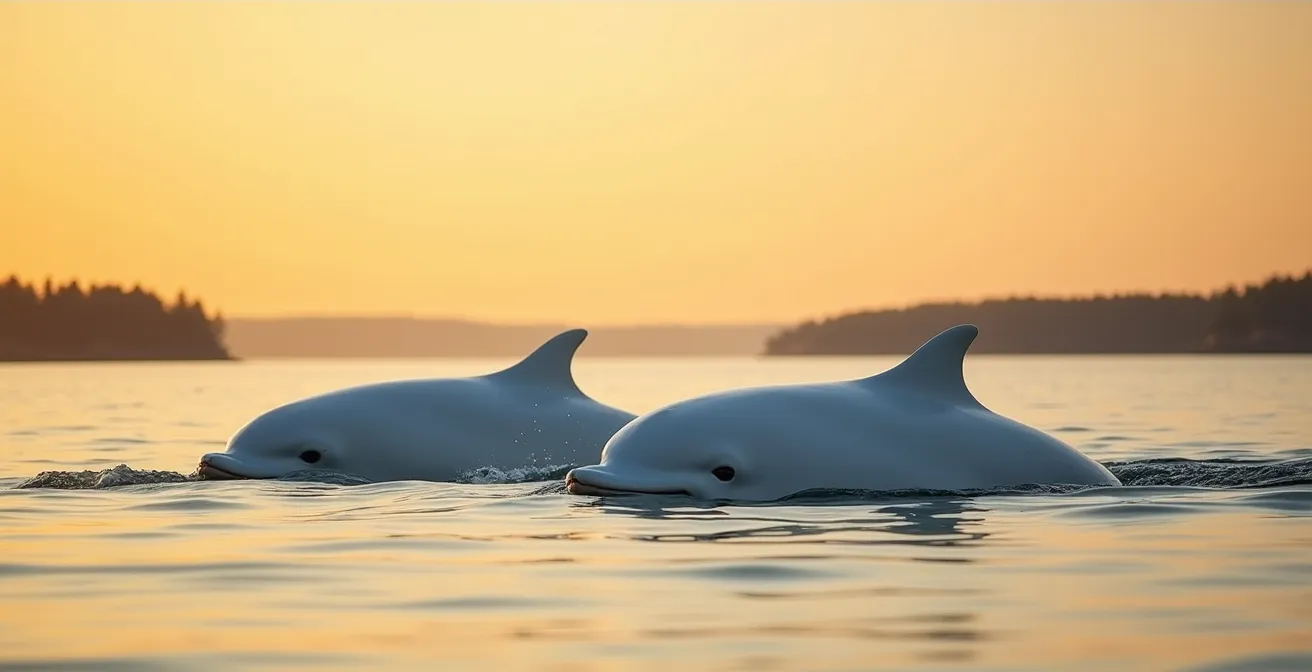
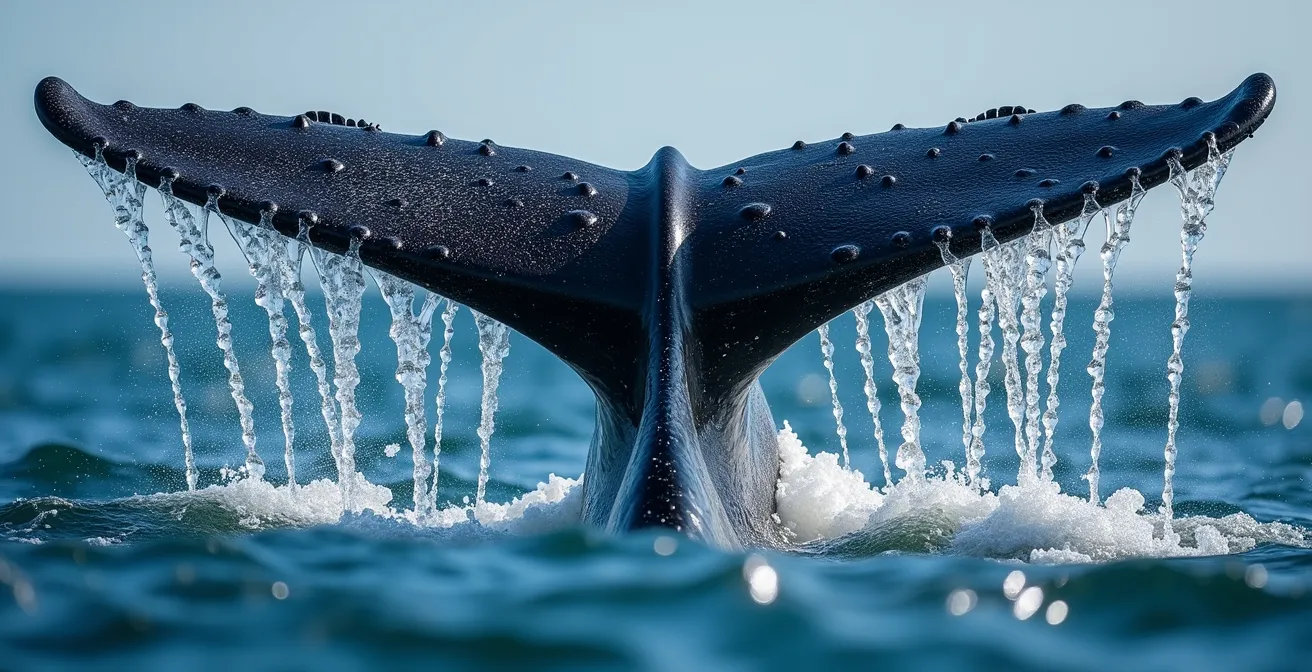
You’ve seen the breathtaking photos: the ghost-white skin of a beluga whale arching through deep blue water, a massive humpback tail fluke crashing into the St. Lawrence Estuary. All signs point to Quebec as the ultimate destination for marine mammal encounters in Eastern Canada. But the critical question remains: *where*, exactly, should you go? The village of Tadoussac is universally hailed as the whale-watching capital, a bustling hub of tour boats and activity. For many, the decision stops there.
But what if the “best” experience isn’t just about joining the largest flotilla of boats? This guide challenges that conventional wisdom. We propose that choosing between Tadoussac and its quieter southern-shore counterpart, Rimouski, is a strategic decision. It’s a choice between maximizing your sighting probability versus enriching the quality and context of the encounter. This isn’t about good versus bad; it’s about aligning your travel style with the unique ecological and cultural offerings of each port.
Drawing on data from marine biologists, Canadian regulations, and tour operators, we’ll move beyond the surface-level recommendations. We will analyze everything from the seasonal timing of migrations and the complex ethics of observation to the very geography that makes this region a global hotspot. This data-driven comparison will equip you to choose the port that truly matches your definition of an unforgettable whale-watching adventure.
This article provides a detailed, comparative analysis to help you make an informed choice. Explore the key factors, from optimal timing and tour types to the unique characteristics of each launch point.
Summary: Tadoussac vs. Rimouski: A Data-Driven Guide to Choosing Your Quebec Whale Watching Port
- When Do the Humpbacks Pass the Quebec City Area on Their Way North?
- Small Zodiac vs Large Cruise Ship: Which Offers Better Whale Viewing Experience?
- How Close Can Your Boat Legally Get to a Fin Whale?
- The Polarizing Filter Trick for Richer Blue Water Shots in the St. Lawrence?
- Should you visit Trois-Rivières or Quebec City first on a St. Lawrence Cruise?
- Telegraph Cove vs Victoria: Which Launch Site Has Higher Orca Probability?
- Boat vs Helicopter Tour: Which Gets You Closer to the Icebergs Safely?
- How to Find Authentic Fishing Villages Not Overrun by Cruise Ships?
When Do the Humpbacks Pass the Quebec City Area on Their Way North?
Timing your trip is critical, and understanding whale migration is key. While the primary feeding grounds are further downriver near Tadoussac, humpback whales do travel through the waters closer to Quebec City. The migration is a gradual process. You can spot the first pioneering individuals arriving from their Caribbean breeding grounds as early as May. However, the true peak season is a bit later.
According to experienced whale watching operators in the St. Lawrence, the window from early May to early June marks the gradual arrival of humpbacks, with their numbers steadily increasing. The population in the estuary reaches its highest density from July through August, which is considered the absolute peak season for watching multiple species. September and October are also excellent months, often featuring highly active feeding behaviors as the whales prepare for their long journey south.
It’s important to remember that whales are wild animals, and their behaviour can be unpredictable. In a rare and widely reported event in late May 2020, a young humpback whale famously ventured far upstream past Quebec City, reaching the waters near Montreal. This unusual journey, which saw it filmed breaching off Portneuf and observed near the Laviolette bridge in Trois-Rivières, highlights the exploratory nature of some individuals during the migration period. While not a typical occurrence, it proves that surprising encounters are always a possibility.
Small Zodiac vs Large Cruise Ship: Which Offers Better Whale Viewing Experience?
Once you’ve chosen your timing, the next major decision is the type of vessel. This choice fundamentally shapes your experience, pitting the thrill and proximity of a small Zodiac against the comfort and stability of a large cruise ship. There’s no single “better” option; the right choice depends entirely on your personal preferences for adventure, comfort, and viewing style.
A Zodiac offers an exhilarating, at-the-water-level encounter. You feel the spray and the movement of the waves, creating an intimate and adventurous connection to the marine environment. These nimble boats can reposition quickly, reacting swiftly to a distant spout or a sudden breach. The trade-off is exposure to the elements; full waterproof gear is a must, and conditions can be challenging on windy days.
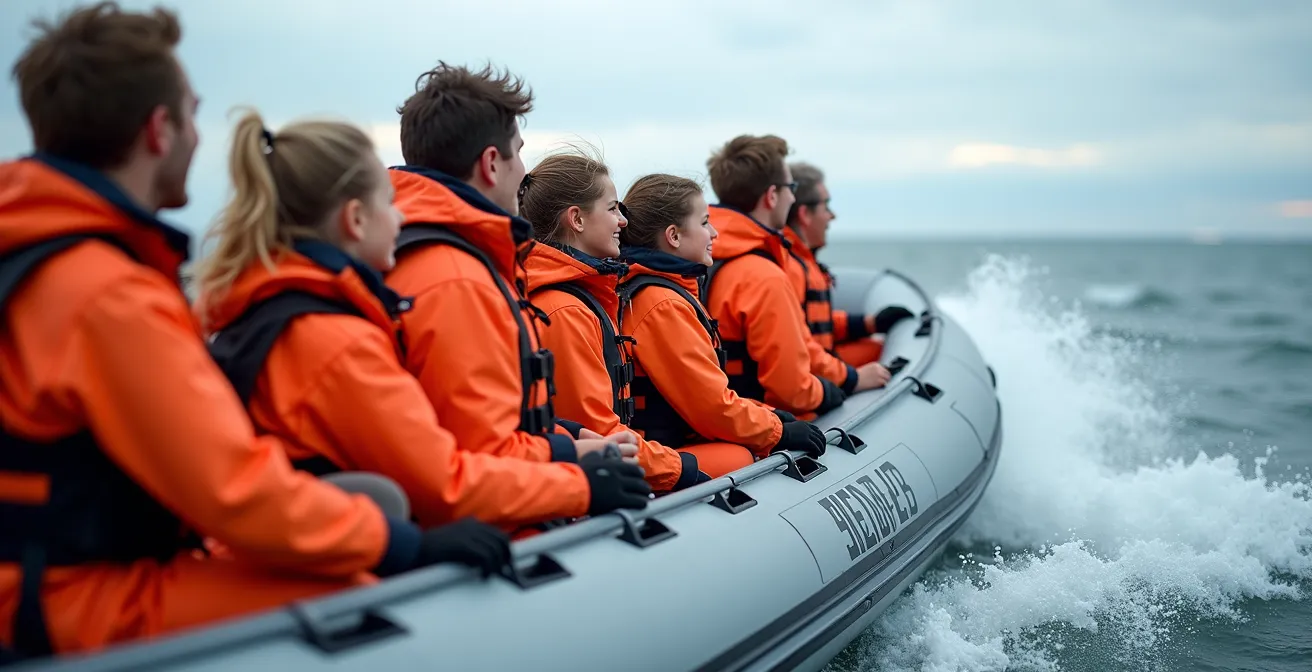
In contrast, larger vessels provide a more stable and protected platform. With amenities like indoor seating and washrooms, they offer superior comfort, making them ideal for families with young children or anyone concerned about rough seas. Their higher vantage point can also be an advantage for spotting whale blows far off in the distance, allowing you to scan a wider expanse of the estuary. The following table breaks down the key differences to help guide your decision.
| Feature | Zodiac (12-24 passengers) | Large Cruise Ship (200+ passengers) |
|---|---|---|
| Maneuverability | Excellent – can quickly reposition for whale sightings | Limited – slower to change course |
| Viewing Distance | Eye-level with whales, feels more intimate | Higher vantage point for spotting distant blows |
| Weather Protection | Minimal – full waterproof gear required | Full coverage – comfortable in most conditions |
| Family Suitability | Age 6+ only for safety reasons | All ages welcome including young children |
| Beluga Viewing (400m rule) | No advantage due to legal distance requirements | Better for scanning wider areas |
| Price Range (CAD) | $100-150 per adult | $70-100 per adult |
How Close Can Your Boat Legally Get to a Fin Whale?
The desire to get as close as possible to these magnificent creatures is understandable, but in Canada, the well-being of the animals comes first. The waters of the St. Lawrence, particularly within the Saguenay-St. Lawrence Marine Park, are governed by strict federal regulations designed to minimize disturbance to marine mammals. These rules are not guidelines; they are the law, and they are actively enforced.
The Canadian Marine Mammal Regulations enforce these distances as law, setting clear boundaries for all vessels. For most whales, including fin whales and humpbacks, boats must maintain a minimum distance of 100 meters. This distance increases to 200 meters if the whale is accompanied by a calf. However, for the threatened and endangered species of the St. Lawrence, the rules are even stricter.
The most critical regulation concerns the resident beluga whale population. A mandatory approach distance of 400 meters is enforced for belugas to protect this vulnerable and genetically distinct group from stress and vessel noise. This is a crucial factor in the Tadoussac vs. Rimouski debate, as it means no tour boat, regardless of its size, can legally offer a “close-up” beluga encounter. The focus shifts from proximity to respectful observation from a distance, reinforcing the importance of good binoculars and telephoto lenses for a rewarding experience.
The Polarizing Filter Trick for Richer Blue Water Shots in the St. Lawrence?
Photographing whales is a challenging and rewarding pursuit that requires a blend of patience, luck, and technical skill. Capturing a truly stunning image in the unique lighting conditions of the St. Lawrence Estuary involves more than just a fast shutter speed. One of the most effective tools in a photographer’s bag is a circular polarizing filter.
The waters where the dark, tannin-rich Saguenay River meets the saline St. Lawrence are prone to surface glare, which can wash out colours and obscure details beneath the surface. A circular polarizing filter works by cutting through this reflective haze. By rotating the filter, you can dramatically reduce glare, deepen the blue of the water, and enhance the contrast between the whale and its environment. This single piece of equipment can be the difference between a flat, hazy snapshot and a rich, professional-quality photograph.
Of course, the filter is just one part of the equation. Success depends on a combination of the right gear and the right settings, all while respecting the legal approach distances. The following checklist provides a practical guide for preparing your camera for a day on the water.
Action Plan: St. Lawrence Whale Photography Settings
- Use a circular polarizing filter to cut glare from the brackish water where the Saguenay meets the St. Lawrence.
- Set a minimum shutter speed of 1/1000s to freeze breaching action and water droplets.
- October provides optimal autumn lighting conditions with the bonus of fall colours as a background.
- Use spot metering on the whale’s body to avoid underexposure against a bright sky.
- Pack a 200-400mm telephoto lens to fill the frame while maintaining legal 100-400m distances.
- Practice filter adjustments on a ferry crossing before the tour to understand the local light conditions.
Should you visit Trois-Rivières or Quebec City first on a St. Lawrence Cruise?
For travelers planning a broader tour of the St. Lawrence region, the order of your itinerary can have a significant strategic impact, especially if whale watching is a priority. The choice between starting in Trois-Rivières or Quebec City often comes down to aligning your location with the peak whale-watching season and managing logistics.
From a purely logistical standpoint, starting in Quebec City offers a distinct advantage for accessing the primary whale-watching zone. As a case study in strategic planning shows, up to 13 species of cetaceans inhabit the St. Lawrence between May and October. The epicenter of this activity is the mouth of the Saguenay Fjord near Tadoussac. Quebec City is located just a 2.5 to 3-hour drive from Tadoussac, making it an ideal base. This proximity allows for flexible day trips, empowering you to choose a day with the best weather and sea conditions, which is especially critical during the peak July-August season.
However, this doesn’t mean Trois-Rivières should be dismissed. Starting your trip there can be a smart move to avoid the large crowds that congregate in Quebec City, particularly around major holidays like the Fête Nationale (June 24) or Canada Day (July 1). Trois-Rivières offers a calmer, more relaxed introduction to the region, which can be preferable for families. Ultimately, regardless of your starting point, the premium whale-watching tours launch from Tadoussac and the surrounding small harbours like Bergeronnes and Les Escoumins. Your starting city is about the journey; the destination for peak whale encounters remains the same.
Telegraph Cove vs Victoria: Which Launch Site Has Higher Orca Probability?
To truly understand why Tadoussac is such a reliable spot for belugas, it’s helpful to look across the country to Canada’s other world-famous whale-watching hotspot: British Columbia’s Johnstone Strait. The question of whether Telegraph Cove or Victoria offers a higher probability of seeing orcas provides a powerful analogy. The answer in both provinces lies in a concept known as an ecological bottleneck.
Just as the narrow Johnstone Strait near Telegraph Cove concentrates salmon runs and, consequently, the orcas that feed on them, the St. Lawrence Estuary has its own unique geographical feature. The confluence of the deep, cold, and nutrient-rich Saguenay Fjord with the St. Lawrence River creates a massive upwelling of food. This makes the area around Tadoussac an incredibly rich feeding ground that attracts numerous whale species, including the resident belugas who live there year-round. This is why Tadoussac offers such high sighting probability—it’s a natural buffet.
Both regions also share profound conservation challenges. The Southern Resident orcas of BC are critically endangered, while the St. Lawrence beluga population is also struggling. The most recent estimates suggest the St. Lawrence beluga population is between 1,530 and 2,180 individuals, and they are listed as Endangered under Canada’s Species at Risk Act. This context makes the choice of where and how we watch these animals all the more significant.
| Feature | Telegraph Cove (BC) | Tadoussac (QC) |
|---|---|---|
| Geographic Feature | Johnstone Strait narrows | Saguenay Fjord confluence |
| Target Species | Resident and transient orcas | Beluga whales year-round |
| Why High Probability | Narrow passage concentrates salmon runs | Deep cold waters upwell nutrients |
| Best Season | June-October for salmon runs | May-October for all species |
| Secondary Species | Humpbacks, Pacific white-sided dolphins | Minke, fin, blue whales |
| Conservation Challenges | Southern Residents critically low (~75 individuals) | Belugas not recovering despite protection |
Boat vs Helicopter Tour: Which Gets You Closer to the Icebergs Safely?
While icebergs are more of a Newfoundland spectacle, the question of “getting closer” via different tour types—be it to an iceberg or a whale—touches on a core tenet of Canadian wildlife tourism. The underlying philosophy, codified in law and practice, is that proximity is secondary to safety and respect. As experts from Transport Canada’s marine safety division emphasize, “In Canada, safety and respect for nature legally trump getting as close as possible.” This principle governs all responsible tour operations in the St. Lawrence.
In Canada, safety and respect for nature legally trump getting as close as possible
– Transport Canada Marine Safety, Regulatory framework for iceberg and whale watching tours
This raises an interesting point: “closer” doesn’t always mean “better.” A helicopter might offer a stunning aerial view of an iceberg’s scale, but a boat tour provides a sense of its immense size relative to yourself. The same is true for whale watching. A boat provides an immersive, eye-level encounter where you feel the scale of the animal. However, land-based observation offers a different, equally valid perspective that is, in some ways, more akin to an aerial view.
For example, the cliff-top observation points at Cap-de-Bon-Désir, part of the Saguenay-St. Lawrence Marine Park, offer a panoramic, helicopter-like perspective. From this high, stable vantage point, you can track the movements of multiple whales, understand their interactions, and hear their powerful spouts echo off the rocks without any engine noise. This contextual understanding of whale behaviour is a different kind of “closeness”—one based on knowledge and broad perspective rather than physical proximity.
Key takeaways
- The peak season for whale numbers is July-August, but September-October offers highly active feeding behaviours against a backdrop of fall colours.
- The choice between a Zodiac and a large ship is a trade-off between the thrill of an eye-level encounter and the comfort of a stable, all-weather platform.
- Rimouski and its surrounding south-shore villages offer a compelling, authentic, and less-crowded alternative to the main tourist hub of Tadoussac.
How to Find Authentic Fishing Villages Not Overrun by Cruise Ships?
For the traveler seeking a deeper connection to the region’s marine heritage, the answer lies on the south shore of the St. Lawrence. While Tadoussac is the undisputed centre of whale-watching tourism, this high concentration of activity can lead to a feeling of being in a tourist bubble. If your goal is a more authentic experience that combines whale watching with a genuine sense of place, Rimouski is the clear winner.
Choosing Rimouski as your base opens up a network of quieter, authentic coastal villages like Sainte-Luce and the stunning Parc national du Bic. Here, you can combine a whale-watching excursion with hiking along dramatic coastal trails, offering land-based wildlife viewing with significantly fewer crowds than the popular lookouts around Tadoussac. This approach also helps distribute tourism impact, which is a critical conservation strategy. With only between 1,530 and 2,200 belugas remaining in the St. Lawrence today, making smaller village observation points crucial for reducing pressure on the main tourist areas is a responsible choice.
Furthermore, Rimouski is a hub for marine science. It is home to the Institut des sciences de la mer (ISMER), offering a scientific perspective on the challenges facing the estuary. Many local tour operators partner with research groups like the Group for Research and Education on Marine Mammals (GREMM), ensuring your tour is not just a spectacle but also an educational experience. By choosing operators from smaller harbours like Bergeronnes or Les Escoumins, or focusing on the Rimouski area, you are actively choosing a more sustainable and intimate form of tourism.
Now that you have the data and the context, the next step is to align your choice with your personal travel philosophy. Explore Eco-Whale Alliance certified tour operators in your chosen region to book a responsible and unforgettable encounter with the giants of the St. Lawrence.
Frequently Asked Questions on How to Choose Between Tadoussac and Rimouski for the Best Beluga Sightings?
Who enforces these whale protection distances?
The Department of Fisheries and Oceans (DFO) mandates the rules at the federal level, while Parks Canada wardens actively enforce them within the Saguenay-St. Lawrence Marine Park.
What if a whale approaches my boat closer than the legal distance?
You must put the engine in neutral immediately, avoid any sudden movements, and wait for the whale to move away on its own. Never attempt to drive away while the whale is within the minimum distance.
Are there different rules for different boat types?
The same minimum distances apply to all vessels, including kayaks, Zodiacs, and large ships. However, operators certified by the Eco-Whale Alliance receive special training in advanced approach protocols to minimize disturbance.