Successfully using your Ikon Pass at Whistler is a logistical game of anticipating system friction and making strategic trade-offs, not just a ski trip.
- Blackout dates are just the start; the real barrier is the reservation system, which requires planning months in advance for peak periods.
- The “best” accommodation or parking isn’t about luxury, but a calculated decision weighing cost against precious on-mountain time.
Recommendation: Treat your Whistler plan like a project. Focus on logistical arbitrage—exploiting small inefficiencies in booking, parking, and mountain flow—to gain a significant advantage in crowd avoidance and maximize your limited Ikon days.
For an Ikon Pass holder, opening the Whistler Blackcomb trail map can spark a unique mix of excitement and anxiety. You hold a key to one of the world’s most epic ski destinations, yet you’re a guest in a house owned by your pass’s main rival, Vail Resorts. This creates a layer of systemic friction that goes far beyond simple blackout dates. While many guides will offer generic advice like “book early” or “check the app,” they fail to address the core challenge: maximizing your limited, precious days requires a strategic, almost contrarian, mindset. It’s about understanding the complex interplay between booking systems, accommodation choices, and on-the-ground crowd dynamics.
This isn’t a guide about finding the steepest run. It’s a logistical playbook for outsmarting the system. We will move past the obvious and dive into the specific strategies that turn a potentially frustrating experience into a seamless one. We will analyze the critical booking deadlines that most people miss, perform a true cost-benefit analysis of accommodation, and reveal how to use predictive crowdsourcing to your advantage. This guide is built on the principle of logistical arbitrage: finding value where others only see inconvenience. By mastering these tactics, you won’t just ski Whistler—you’ll conquer its complex logistics, ensuring every moment on your Ikon Pass counts.
To help you navigate these complexities, this guide breaks down the essential strategies into a clear, actionable plan. Below, you will find a detailed table of contents covering everything from critical booking mistakes to expert terrain progression, allowing you to master your Whistler trip from start to finish.
Contents: Your Strategic Whistler Ikon Pass Playbook
- The Booking Deadline Mistake That Blocks Access to Whistler on Christmas Week
- Ski-in/Ski-out vs Village Accommodation: Does the Premium Pay Off?
- Whistler vs Blackcomb: Which Peak Offers Better Beginner Terrain?
- How to Use the Whistler App to Find the Shortest Line for the Peak 2 Peak Gondola?
- Why Summer Mountain Biking at Blackcomb is a Better Value Than Winter Skiing?
- Why Buying Your Season Pass in April Saves You Over $400 Annually?
- Why Parking at Shannon Falls is Easier on a Tuesday Than a Saturday?
- How to Handle Steep Rock Gardens on BC Mountain Bike Trails?
The Booking Deadline Mistake That Blocks Access to Whistler on Christmas Week
The most common error Ikon Pass holders make is confusing blackout dates with booking availability. While your pass might be valid, Whistler’s finite capacity during peak times like Christmas week means that without a reservation, your pass is worthless. The system is designed to prioritize Epic Pass holders, making advance planning non-negotiable for Ikon users. Historically, Ikon Pass reservations for the entire season open on a single day, typically around August 4th. Missing this window, especially for holiday periods, means you’ll likely be shut out.
The Ikon Base Pass, for example, has explicit blackout periods during the holidays. For the upcoming season, December 27-31, 2025 are blackout dates for Base Pass holders, a fact confirmed by partner resorts. However, even for full Ikon Pass holders without these blackouts, the reservation pool can be depleted within hours of opening. The key is to treat the reservation opening day with the same urgency as a concert ticket sale. If you find Whistler is fully booked, your strategic pivot should be immediate. Have a plan B ready, which for many in British Columbia means checking availability at other Ikon destinations like Revelstoke or Sun Peaks, which often have less reservation pressure.
A persistent strategy can also pay off. Many skiers book speculative dates far in advance and cancel as their plans change. Checking the reservation system frequently, especially within the 24-72 hours before your desired ski day, can reveal last-minute openings from these cancellations. This requires diligence but can be the secret to salvaging a trip if you missed the initial booking rush. It’s a game of persistence and timing.
Ski-in/Ski-out vs Village Accommodation: Does the Premium Pay Off?
The debate between slope-side convenience and village affordability is a classic one, but for an Ikon Pass holder with a limited number of days, it becomes a critical time-value calculation. Paying a premium for ski-in/ski-out isn’t a luxury; it’s a strategic investment in maximizing on-mountain time. Staying in a location like Creekside, with direct gondola access, eliminates the time-consuming and often stressful process of morning parking and bus shuttles. This can easily add an extra hour of skiing to your day, which, over a five-day pass, is nearly a full extra day on the slopes.
Conversely, staying further out requires a deep understanding of the associated logistical costs. As confirmed by the Resort Municipality of Whistler’s 2024 rates, parking can cost up to $18 CAD per day in the primary day lots. This financial cost is secondary to the time cost: arriving after 8:30 AM on a weekend often means being relegated to lots 4 or 5, followed by a crowded bus ride to the village base. This process can take 30-45 minutes from car to lift, eating into your valuable ski time.
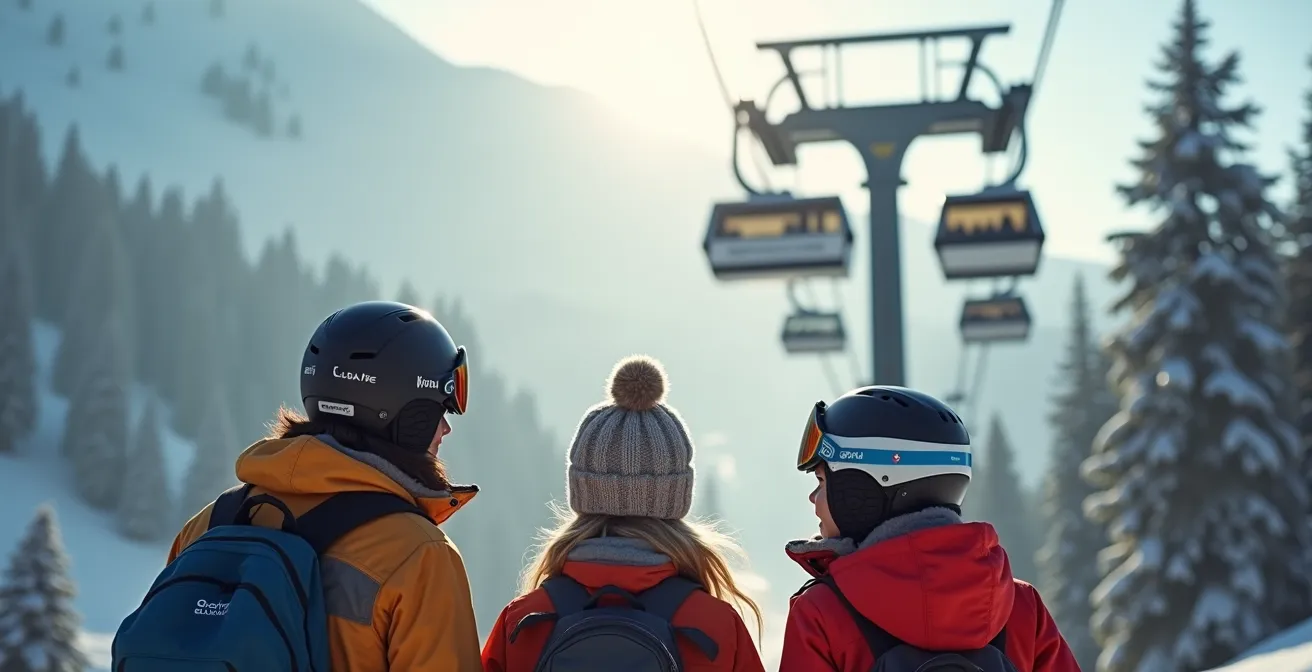
The illustration above, showing the calm morning access at Creekside, highlights the strategic advantage. While others are fighting for parking in the main village, you are already ascending the mountain. This decision framework is essential for anyone trying to extract the most value from their pass.
This comparative analysis, based on data from Whistler’s official transportation guidance, breaks down the true cost of each option.
| Accommodation Type | Daily Extra Costs | Time to Lifts | Best For |
|---|---|---|---|
| Ski-in/Ski-out (Creekside) | $0 parking | 0-5 minutes | Maximizing ski time on limited Ikon days |
| Village Base (with shuttle) | $0-18 CAD parking | 20-30 minutes | Nightlife and dining access |
| Off-site with car | $18 CAD parking + gas | 30-45 minutes | Budget-conscious families |
Whistler vs Blackcomb: Which Peak Offers Better Beginner Terrain?
For families or those new to the sport, choosing where to start your Whistler Blackcomb journey can be intimidating. Both mountains boast excellent beginner areas, but they offer distinctly different experiences in terrain sequencing. The key to a successful start is not just finding a green run, but finding a progression of runs that builds confidence. Whistler Mountain is often the superior choice for day one. The area under the Magic Chair and the nearby Yellow Brick Road trail provides a contained, low-pressure environment perfect for finding your ski legs. From there, progressing to the wide, gentle slopes of Ego Bowl offers a seamless step up.
Blackcomb, on the other hand, is arguably better for the “confident beginner” ready for a true alpine experience. Once you’re comfortable linking turns, taking the Peak 2 Peak Gondola across to Blackcomb opens up a world of scenic, high-alpine green runs. The Expressway traverse, leading from the Rendezvous Lodge to the 7th Heaven Express chairlift, is a family-friendly adventure with stunning vistas. It feels less like a learning zone and more like an exploration. This makes it an ideal goal for day two or three of your trip.
For the ultimate beginner experience with breathtaking views, Whistler’s Burnt Stew Trail in the Harmony 6 Express zone is unmatched. While it requires navigating a slightly more advanced blue run to access, the trail itself is a wide, rolling green run that meanders through a spectacular alpine bowl. It provides an “expert” feel with beginner-friendly terrain, making it a memorable graduation run for any new skier. The strategic approach is to use Whistler for foundational skills and then “graduate” to Blackcomb for scenic exploration.
How to Use the Whistler App to Find the Shortest Line for the Peak 2 Peak Gondola?
The Whistler Blackcomb Live App is an essential tool, but most skiers use it reactively, only checking it when they are already stuck in a long line. The strategic Ikon Pass holder uses it proactively for predictive crowdsourcing. Your first check shouldn’t be on the hill, but at 7 AM from your accommodation. By monitoring live lift-line data before the lifts even open, you can map out your first runs to actively avoid the predictable morning rush at the main gondolas. Note that as an Ikon holder, you cannot scan your pass from the phone; you must carry your physical pass at all times.
The Peak 2 Peak Gondola is a classic chokepoint. To find the shortest line, you must understand its traffic patterns. The biggest rushes occur between 10 AM and 1 PM as skiers cross between mountains. The secret is to monitor the lines at the base of the access lifts on either side. If the app shows a 15-minute wait at Harmony 6 Express on the Whistler side, the line to board the Peak 2 Peak from that side will soon be just as long. Conversely, a short line at the 7th Heaven Express on the Blackcomb side often signals a clear path to cross back to Whistler.
Beyond the Peak 2 Peak, use the app to create multi-hour circuits that bypass known congestion zones. During the 10 AM to 1 PM peak, avoid lifts like Harmony 6 and Crystal Ridge. Instead, use that time to explore less-trafficked areas like the runs off the Peak Express on Whistler or the Glacier Express on Blackcomb. After 3 PM, the dynamic changes. Start monitoring the download gondola wait times. If lines are building for the ride down, it’s often faster and more enjoyable to ski all the way out to Creekside or the Upper Village, a decision the app can help you make in real-time.
Why Summer Mountain Biking at Blackcomb is a Better Value Than Winter Skiing?
This may sound counter-intuitive for a skier, but one of the most valuable moves an Ikon Pass holder can make for their winter Whistler trip is to visit in the summer. While the Ikon Pass does not include summer access, a short, self-funded “reconnaissance trip” for mountain biking or hiking provides an unparalleled strategic advantage. It allows you to learn the intricate village layout, test different parking strategies, and scout accommodation locations without the pressure and chaos of peak ski season. This is the ultimate form of logistical arbitrage.
Imagine arriving in December already knowing that parking in Day Lot 4 is a false economy due to the slow bus loop, or that the grocery store in Creekside is far less crowded than the one in the main village. A summer visit allows you to dial in these logistical details. You can walk the village stroll, time the distance from various condos to the lifts, and identify the best après-ski spots. This knowledge is invaluable and transforms your future winter trip from a series of stressful guesses into a smooth, efficient operation. You’ll spend less time navigating and more time skiing.

The summer landscape, as seen in the winding bike trails through alpine meadows, reveals the mountain’s structure in a way that snow conceals. You can see the fall lines, the creek beds, and the true distances between points of interest. This off-season intelligence gathering is a small investment that pays massive dividends, making your precious Ikon days in winter significantly more productive and enjoyable. It’s the ultimate “outsmart the system” maneuver.
Why Buying Your Season Pass in April Saves You Over $400 Annually?
For Canadian skiers, the single biggest financial decision isn’t where to ski, but when to buy your pass. The Ikon Pass, priced in US dollars, creates a currency risk for Canadians. Buying early, during the spring renewal period (typically March-April), is the most effective way to mitigate this. Pass providers often offer their best exchange rates and renewal discounts during this window to lock in customers for the following season. Waiting until autumn not only exposes you to months of currency fluctuation but also means you’ll pay the highest price tier.
For the 2024/2025 season, a Canadian-focused analysis showed significant price differences. According to a Fresh Adventures’ 2024/2025 season analysis, the full Ikon Pass was priced at $1,840 CAD and the Ikon Base Pass at $1,310 CAD during the early-bird period. Those who wait until December can expect to pay hundreds more, not only due to tiered pricing increases but also due to a potentially less favorable USD to CAD exchange rate. The “savings” of over $400 is a combination of early-bird discounts and hedging against a weakening Canadian dollar.
Furthermore, purchasing in the spring often comes with an additional perk: access to spring skiing for the *current* season. This can mean getting several bonus ski days at resorts that are still open, effectively lowering the per-day cost of your pass for the upcoming year. For returning pass holders, taking advantage of the renewal discount in April is a financial no-brainer. It is the most predictable way to control costs on an otherwise variable expense, turning a simple purchase into a savvy financial move.
Why Parking at Shannon Falls is Easier on a Tuesday Than a Saturday?
The answer to this question has less to do with the provincial park itself and more to do with its role as a powerful predictive tool for Whistler-bound traffic. The Sea-to-Sky Highway is the single artery feeding Whistler from Vancouver. The parking lot at Shannon Falls, a popular stop along the way, acts as a real-time barometer for weekend crowds. If this lot is overflowing by 9 AM on a Saturday, it’s a clear signal that the Whistler Day Lots are already under extreme pressure. This is logistical intelligence in action.
Using this external signal allows you to make strategic pivots before you even reach Whistler. A full lot at Shannon Falls should trigger an immediate change of plans: bypass the main village entirely and head directly to the Creekside parking areas, which absorb overflow traffic. On a weekday, particularly a Tuesday, the Shannon Falls lot will have ample space well into the late morning. This directly correlates to parking availability in Whistler, where arriving at Day Lot 3 by 9 AM is typically sufficient, a luxury unheard of on a weekend.
This predictive method is far more reliable than any app because it measures the actual volume of people moving up the corridor. Whistler’s official data confirms this pattern: Day Lots fill progressively based on the pulse of Vancouver traffic. A Saturday demands a pre-8 AM arrival to secure a spot in a decent lot, while a Tuesday allows for a much more relaxed start. By “reading the tea leaves” on the highway, you can avoid the biggest parking headaches and start your ski day with minimal stress.
Your Weekday vs. Weekend Parking Playbook
- Monday-Tuesday: Aim for Day Lot 3. An arrival by 9:00 AM is generally sufficient for a good spot.
- Wednesday-Thursday: The window tightens. Day Lot 3 often fills by 8:30 AM; have Day Lot 4 ready as your immediate backup.
- Friday: Treat it like a weekend. Arrive by 8:00 AM for any of the main day lots, or default your plan to Creekside.
- Saturday-Sunday: Non-negotiable. A pre-8:00 AM arrival is essential. If you’re any later, commit to paid underground parking or a long walk.
- Holidays: If you are staying for multiple days, investigate the monthly parking pass option (around $108/month) which can be cheaper than paying the daily rate.
Key Takeaways
- Your Whistler strategy begins in August with the Ikon reservation system, not in December when you arrive.
- Calculate the value of your time: premium accommodation or parking is an investment in more skiing, not a luxury.
- Use external data, like highway traffic, to predict internal resort crowds and make smarter logistical choices.
From Rock Gardens to Double Blacks: Translating Trail Skills to Ski Strategy
At first glance, the technical skill of navigating a steep, rocky mountain bike trail in British Columbia seems unrelated to skiing. However, the mindset required is identical and serves as the perfect metaphor for maximizing your Ikon Pass at Whistler. Handling a rock garden on a bike isn’t about brute force; it’s about line choice, commitment, and reading the terrain ahead. This is the exact same mental skill set required to confidently ski Whistler’s legendary expert zones like Spanky’s Ladder or the Spearhead Traverse.
The ability to adapt to rapidly changing conditions—a core tenet of technical mountain biking—directly translates to handling Whistler’s variable coastal snowpack. A single expert run can transition from soft powder to wind-scoured ice and then to heavy, wet snow. A skier who, like a mountain biker, anticipates these changes and chooses their line accordingly will thrive. Those who expect uniform conditions will struggle. The mental preparation needed to commit to a technical bike descent is precisely what’s needed before dropping into the steep, consequential terrain of Whistler Bowl.
Ultimately, this article has been about more than just isolated tips. It has been about adopting a strategic, proactive mindset. Just as a biker scouts a trail, you must scout your accommodation and parking. Just as a biker chooses a line to maintain flow, you must use the app to choose a lift sequence that avoids crowds. The physical skills are different, but the strategic approach is universal. Mastering the logistics of an Ikon Pass at Whistler requires you to think like an expert rider navigating a complex trail: always looking ahead, making smart commitments, and finding the smoothest line through the chaos.
With this strategic mindset, you are now equipped to not just visit Whistler, but to maximize every second of your time there. The next logical step is to take these concepts and build your own personalized, day-by-day logistical itinerary.