In summary:
- To truly experience Niagara Falls, you must actively avoid the “tourist funnels” for parking, dining, and viewing.
- Strategic use of off-site parking and the WEGO bus system is the single best way to save money and frustration.
- Visiting in the off-season, particularly January, offers a completely different, serene experience with huge cost savings.
- Toronto’s cultural diversity is best explored by “hacking” the TTC’s Bloor-Danforth subway line to hop between distinct neighbourhoods.
- Authentic experiences in both cities are found by decoupling from the main tourist zones for activities like dining and photography.
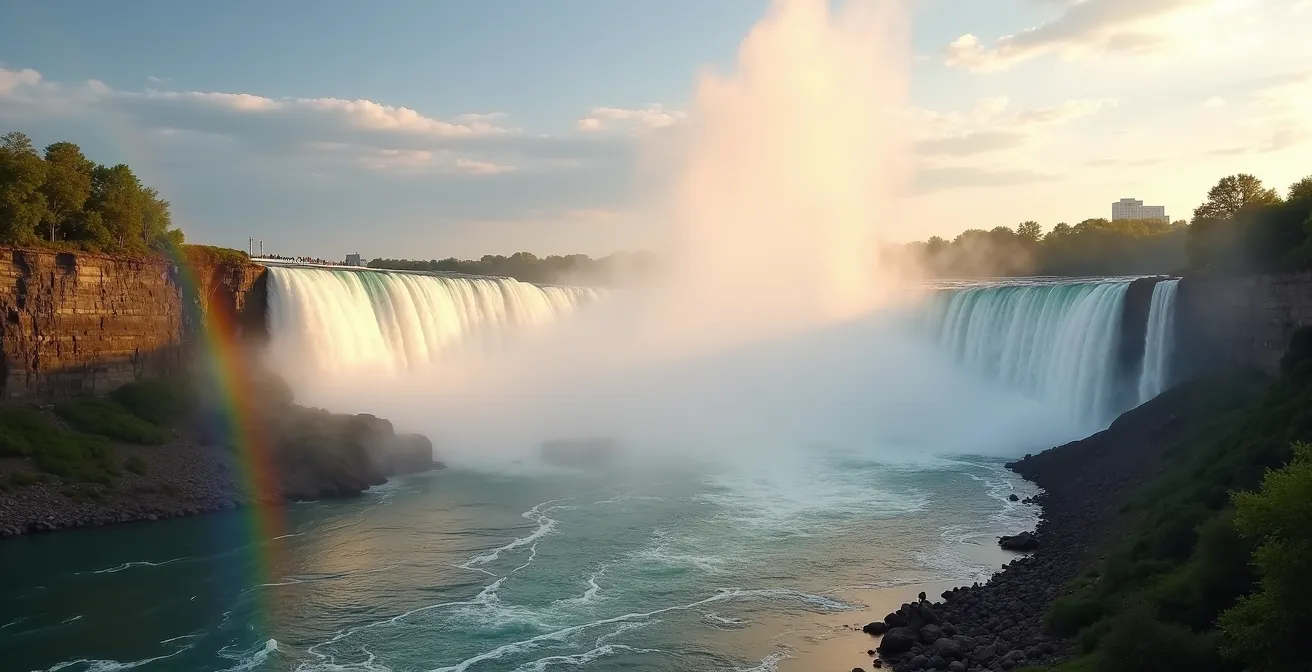
Everyone thinks they know how to do a Niagara Falls trip. You show up, find a parking spot as close as you can get, elbow your way to the railing for a photo, and maybe grab a bite at a restaurant with “Fallsview” in the name. The result? You spend a fortune to feel like a sardine, seeing more of the crowd than the natural wonder. Then you might head to Toronto and walk a few blocks around the CN Tower, feeling like you’ve barely scratched the surface. It’s the standard, exhausting, and expensive Southern Ontario tour.
But what if the key wasn’t just to go at a different time, but to play a different game entirely? The real secret to enjoying Niagara isn’t just avoiding people; it’s about understanding and sidestepping the entire tourist-funnel infrastructure that’s designed to guide you into the most crowded and overpriced experiences. It’s about knowing which parking lot is a trap, which boat tour offers a real advantage, and why the best view isn’t always from the top of the tallest tower. This is the local’s playbook.
This guide will give you the street-smart strategies to hack the system, first at Niagara Falls and then in the heart of Toronto. We’ll dismantle the common tourist traps one by one, giving you practical, money-saving alternatives that deliver a better, more authentic experience. Get ready to see these iconic Canadian destinations like you actually live here.
To help you navigate this insider’s guide, we’ve broken down the essential strategies for both Niagara and Toronto. You’ll find specific, actionable advice to transform your trip from a stressful ordeal into a memorable adventure.
Summary: The Local’s Playbook for Niagara & Toronto
- Why You Should Never Park in the Lot Closest to the Falls?
- Hornblower vs Maid of the Mist: Is There Actually a Difference?
- Why January is the Best Month to See the Falls Without the Hype?
- The Tower Dining Trap: Is the Revolving Restaurant Food Worth the View?
- Day Trip or Overnight: Is the Falls Illumination Worth Staying Late For?
- The Transit Route That Connects Little Italy, Koreatown, and Greektown Quickly?
- The Best Free Spot Near the Financial District to Photograph the CN Tower?
- How to Experience 5 Different Global Cultures in One Weekend in Toronto?
Why You Should Never Park in the Lot Closest to the Falls?
Here’s the first and most expensive mistake almost every visitor makes: they follow the signs to the Table Rock Centre parking lot, right at the brink of the Horseshoe Falls. It feels logical, but it’s a perfectly set trap. This is the epicentre of the tourist funnel, and you pay a massive premium for the perceived convenience. In reality, you’re paying to sit in traffic only to end up in a lot that’s still a considerable walk from many attractions. During peak season, local tourism reports show that parking rates at Table Rock can surge by up to a 400% price increase compared to off-site options.
The local’s hack is simple: geographic decoupling. Separate the act of parking from the act of sightseeing. Drive to the Rapidsview parking lot, located about three kilometres south of the falls. Not only is the rate often half of what you’d pay at Table Rock, but it’s also the main hub for the WEGO bus system. For a flat fee, you get unlimited rides connecting you to every major site, from the Falls itself to Clifton Hill and the hotels.
This strategy flips the script. Instead of fighting for a spot in the most congested area, you park stress-free and use the climate-controlled bus as your personal chauffeur. This is especially brilliant on brutally hot summer days or in the freezing cold. You’re not just saving money on parking; you’re buying back your time and sanity. It’s the first and most critical step in breaking free from the herd.
Hornblower vs Maid of the Mist: Is There Actually a Difference?
The boat tour into the mist is an iconic Niagara experience, but many visitors don’t realize there are two different operations: Niagara City Cruises (formerly Hornblower) on the Canadian side and Maid of the Mist on the US side. So, is there a difference? From a crowd-avoidance perspective, yes. While both boats go to the same spot, the Canadian boats are larger catamarans, holding up to 700 passengers compared to the American boats’ 600. This might seem minor, but it affects the feeling of space on board.
More importantly, the departure points and routes offer slightly different visual experiences. The Canadian cruise provides a more direct, head-on view of the massive Horseshoe Falls, which many consider the superior perspective. The US boat offers a great view of the American Falls before heading to the same basin. For a pure “power of the falls” experience, the Canadian side has a slight edge.
But the real pro-tip isn’t just about which boat to choose, but which *tour*. Niagara City Cruises offers a 40-minute “Falls Fireworks Cruise” in the evening. While it doesn’t get you quite as deep into the spray, it gives you a front-row, on-the-water seat for the nightly illumination and fireworks. This is a fantastic “parallel experience” that most day-trippers miss, offering a more relaxed atmosphere and a completely different kind of magic.
To help you decide, here is a breakdown of the key differences based on crowd-management factors from travel analysts.
| Feature | Hornblower (Canadian) | Maid of the Mist (US) |
|---|---|---|
| Vessel Capacity | 700 passengers (catamarans) | 600 passengers |
| Best Time to Avoid Crowds | 8:30-10:30am, after 6pm | Early morning, late afternoon |
| Busiest Days | Weekends & Tuesdays | Weekends & holidays |
| Quietest Days | Monday, Wednesday, Thursday | Mid-week |
| View Advantage | Head-on Horseshoe Falls view | Side angle perspective |
This comparison, detailed in analyses like those from travel blogs focused on Niagara logistics, shows that mid-week trips on the Canadian side offer a statistical advantage for crowd avoidance.
Why January is the Best Month to See the Falls Without the Hype?
Ask a local the absolute best time to see the Falls, and they won’t say a sunny day in July. They’ll tell you to come in January. It sounds counter-intuitive, but this is the ultimate hack for avoiding crowds and experiencing a version of Niagara that most tourists will never see. In the dead of winter, the tourist funnel shrinks to a trickle. The massive crowds vanish, the kitschy attractions on Clifton Hill are quiet, and the entire atmosphere transforms from a chaotic theme park to a serene natural wonder.
The visual reward is immense. The constant mist freezes onto every surface, creating a surreal landscape of ice sculptures on trees, railings, and lampposts. At the base of the falls, a massive “ice bridge” often forms, a breathtaking spectacle of nature’s power. It’s a photographer’s dream and a profoundly peaceful experience. This is the Falls in its most raw and dramatic state.

The financial incentive is just as compelling. With visitor numbers at their lowest, hotels slash their prices. It’s not uncommon to find that hotel deals in winter can drop to less than $60 CAD per night for rooms that would cost hundreds in the summer. You get five-star views for a one-star price. Even the annual Winter Festival of Lights, a stunning display of millions of lights, is best enjoyed on a quiet winter weeknight, free from the weekend rush.
Your Action Plan: Winter Festival of Lights Crowd-Avoidance
- Visit illumination displays on weeknights (Tuesday-Thursday) for minimal crowds.
- Park for free at Dufferin Islands and walk the quieter, beautifully lit parkway route.
- Start your viewing from the southern entrance of Queen Victoria Park and work your way north against the typical flow of traffic.
- Arrive about 30 minutes after the official illumination start time to let the initial rush of visitors disperse.
- Make use of the heated indoor viewing spots at the Table Rock Welcome Centre to warm up without losing the view.
The Tower Dining Trap: Is the Revolving Restaurant Food Worth the View?
The allure of dining in a revolving restaurant high above the illuminated falls is powerful. It’s marketed as the ultimate Niagara experience. This is the tower dining trap. You are not paying for gourmet food; you are paying an exorbitant fee for the view, often accompanied by a mediocre, overpriced meal. Locals know that the best food in Niagara is almost never found in the places with the best views of the Falls. This is where the concept of value arbitrage comes into play.
Instead of splurging on a single, disappointing meal at the Skylon or Fallsview Tower, reallocate that budget towards a Fallsview hotel room. For a similar price, you get the same stunning, elevated view not just for two hours, but for your entire stay. You can watch the illumination from your bed, see the sunrise over the mist, and experience the view in a private, relaxed setting. As one traveller noted about their stay, “there’s truly something special about seeing Niagara Falls from above during both the day and night.” This move gets you a better, longer-lasting version of the main benefit (the view) for the same or less money.
Once you’ve secured your view from your room, you’re free to explore the region’s actual culinary scene. For this, you need to apply geographic decoupling again. Head away from the tourist core of Clifton Hill and Fallsview Boulevard. The Lundy’s Lane district, just a short drive or WEGO ride away, is where locals go for authentic and reasonably priced food. Here you’ll find quiet gems like Micah’s Bistro for Thai or Carpaccio for Italian, free from the tourist markup. For a truly world-class experience, the wineries of nearby Niagara-on-the-Lake offer phenomenal dining with vineyard views, a perfect pairing for your trip.
Day Trip or Overnight: Is the Falls Illumination Worth Staying Late For?
For day-trippers from Toronto, this is the million-dollar question. Is it worth staying for the nightly illumination, or should you catch an early train home? The logistics often make the decision for you. If you’re relying on public transit, you need to know that the last GO Train to Toronto departs Niagara Falls at 5:45 PM, well before the sun sets and the lights come on for most of the year. This single fact makes a day trip via train incompatible with seeing the illuminated falls.
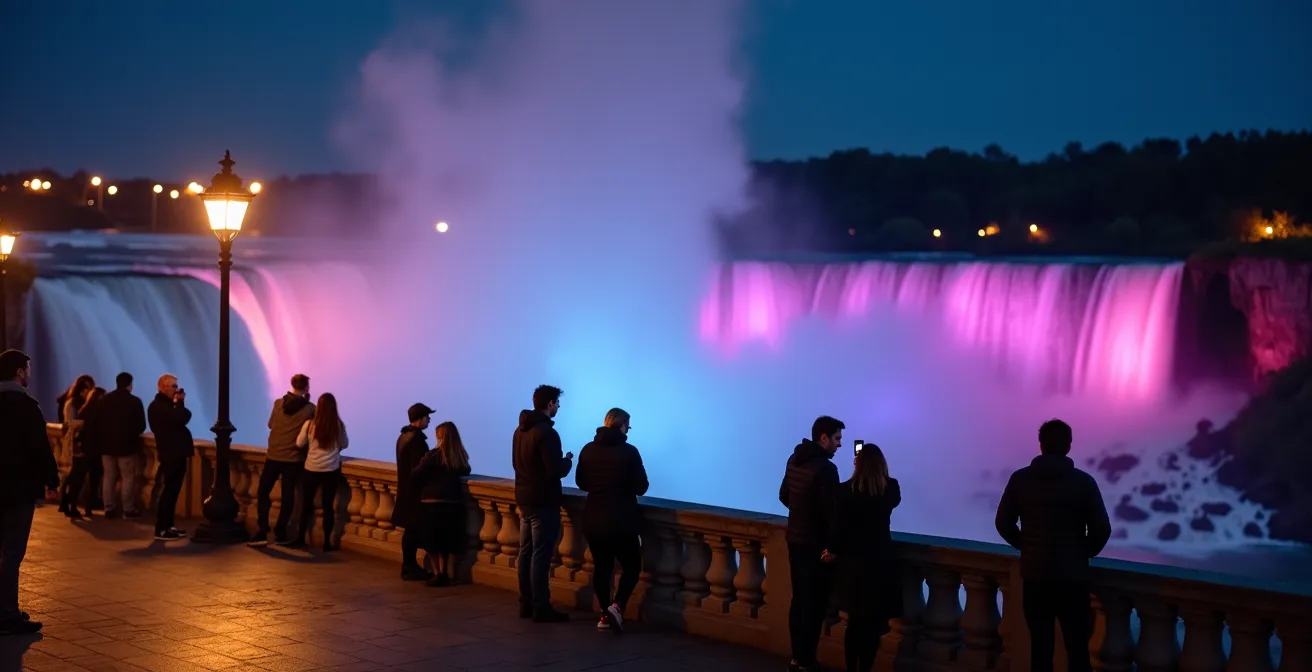
So, is the illumination worth the hassle and expense of staying overnight? Absolutely. The Falls at night are a completely different entity. The raw power you feel during the day is transformed into a colourful, ethereal spectacle. The atmosphere along the railing changes, too. The frantic daytime crowds thin out and morph into a more relaxed, contemplative audience. It’s less of a “must-see” checklist item and more of a shared, beautiful moment.
You don’t need to be in a specific, crowded spot to enjoy it. The views are stunning from almost anywhere along the promenade between the Rainbow Bridge and the brink of the Horseshoe Falls. In fact, one of the best experiences is to simply walk the entire length, watching the colours change on the water as it tumbles over the crest. This mesmerizing view is the reward for those who choose to stay, a peaceful and unforgettable bookend to the day’s excitement.
The decision to stay overnight unlocks a second, more magical side of Niagara Falls. It transforms the trip from a frantic rush into a proper getaway and allows you to transition naturally to the next leg of a Southern Ontario journey: exploring Toronto.
The Transit Route That Connects Little Italy, Koreatown, and Greektown Quickly?
After conquering Niagara, the next challenge is navigating Toronto’s sprawling cultural landscape. The secret weapon for any savvy visitor is not a car or an Uber; it’s the Toronto Transit Commission (TTC), specifically the Line 2 Bloor-Danforth subway. This single east-west artery is the city’s cultural spine, acting as a high-speed connector between some of its most vibrant immigrant communities. Forget traffic and parking—this is the ultimate system hack for a day of global exploration.
The strategy is simple: get a TTC day pass or use your PRESTO card and hop on and off along Line 2. Start by exiting at Christie station, and you’re in the heart of Koreatown. A few stops west is Ossington station, a short walk from the heart of Little Italy on College Street. Head east past the downtown core, and getting off at Chester or Pape station drops you right onto the Danforth, the main street of North America’s largest Greektown.
This method allows you to experience three distinct global cultures in a matter of hours. You can have a Korean BBQ lunch, an Italian espresso and cannoli in the afternoon, and a Greek souvlaki dinner without ever getting stuck in traffic. The key is using the subway’s efficiency to maximize your time. With a PRESTO card, your fare includes a transfer window, meaning PRESTO card holders can transfer freely within 2 hours, making short hops even more economical. This isn’t just transportation; it’s a strategic tool for cultural immersion.
The Best Free Spot Near the Financial District to Photograph the CN Tower?
Every tourist wants that perfect shot of the CN Tower, but most end up with a generic, uninspired photo from its base or a crowded spot by the waterfront. To get a truly stunning, free, and less-clichéd photograph, you need to use the surrounding urban environment to your advantage. The best spots are often hiding in plain sight within the concrete canyons of the Financial District.
One of the most dramatic perspectives is the “canyon shot” from the intersection of Bay Street and Adelaide Street. Standing here and looking south, the CN Tower is perfectly framed by the towering skyscrapers on either side of Bay Street, creating a powerful sense of scale and urban density. It’s a quintessential Toronto image that most visitors completely miss.
For an elevated, weather-proof option, use the public PATH system to access the bridge connecting the towers of the TD Centre. This provides a clean, mid-level view of the tower without having to fight for space on the street. Another excellent location is David Pecaut Square, just west of the district. Here, you can use the unique architecture of Roy Thomson Hall as a compelling foreground element to frame your shot of the tower.
The ultimate pro-tip is about timing. Visit any of these spots during the “blue hour”—the 30 minutes right after sunset. The deep blue of the twilight sky creates a stunning contrast with the illuminated buildings and the tower itself, resulting in a far more professional and dynamic photograph than a simple shot in the harsh midday sun.
Key takeaways
- The smartest way to visit Niagara is to park remotely (Rapidsview Lot) and use the WEGO bus system.
- In Toronto, the Bloor-Danforth subway line is your key to efficiently exploring multiple cultural neighbourhoods in one day.
- For better value, get your Niagara Falls view from a Fallsview hotel room, not an overpriced revolving restaurant.
- The best photos of the CN Tower are free and found by using the Financial District’s architecture as a frame.
How to Experience 5 Different Global Cultures in One Weekend in Toronto?
Toronto’s multiculturalism isn’t just a talking point; it’s a lived reality you can taste, see, and explore in its distinct neighbourhoods. With a bit of planning and a TTC pass, you can pack a world tour into a single weekend. The key is to structure your days geographically, using the transit system to hop from one cultural enclave to another, fully immersing yourself in each one before moving on.
A perfect 48-hour itinerary could start Saturday morning in Chinatown (Spadina/Dundas) for a classic dim sum experience at a bustling spot like Rol San. Afterwards, a short streetcar ride west takes you to Koreatown for an afternoon of exploring H-Mart and grabbing some fiery Korean BBQ. As evening approaches, walk south to College Street for an aperitivo in Little Italy, followed by authentic gelato.
On Sunday, start your day in the eclectic and bohemian Kensington Market, a microcosm of global cultures where you can find everything from Jamaican patties to Tibetan momos. From there, take the subway east to Gerrard India Bazaar, also known as Little India, for a fragrant curry lunch and to browse the colourful sari shops. Finally, end your weekend on the Danforth in Greektown with a classic souvlaki dinner and a dessert of sweet loukoumades, soaking in the Mediterranean atmosphere. This isn’t just a checklist; it’s a sensory journey through the heart of modern Toronto.
To help you navigate, this table highlights the signature experiences in each key neighbourhood.
| Neighborhood | Must-Try Food | Cultural Activity | Best Time |
|---|---|---|---|
| Chinatown | Soup dumplings at Mother’s Dumplings | Dragon City Mall shopping | Weekend mornings |
| Koreatown | Korean fried chicken at The Fry | Karaoke at BMB Karaoke | Friday nights |
| Little Italy | Cannoli at Sud Forno | Vintage shopping on Ossington | Saturday afternoons |
| Little India | Dosa at Udupi Palace | BJ Supermarket spice shopping | Sunday afternoons |
| Greektown | Gyros at Messini Authentic | Taste of the Danforth (August) | Summer evenings |
By applying these local strategies—whether it’s sidestepping a tourist trap in Niagara or hacking the transit system in Toronto—you can transform your trip into a genuinely authentic and memorable experience.