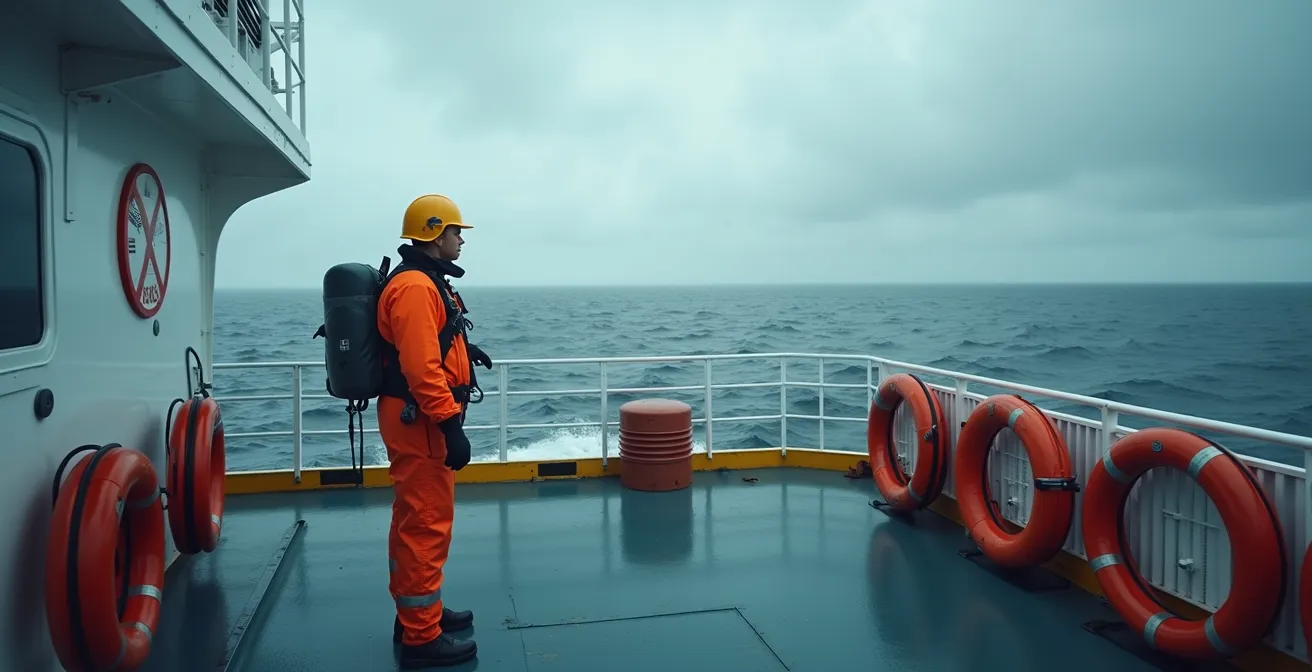
Compliance with Transport Canada regulations is the floor, not the ceiling; it does not guarantee survival in cold water.
- Your body’s physiological response to cold water is brutally fast, with functional movement lost in as little as 10 minutes.
- Common materials like cotton and inadequate equipment (e.g., wrong knots, wrong suit) act as hazard multipliers in Atlantic conditions.
Recommendation: Your operational standard for safety must exceed the legal baseline. Base your protocols on the specific, unforgiving conditions you will face, not just on a generic checklist.
For recreational boaters in Canadian Atlantic waters, the question of legal requirements for immersion suits is common. The answer, however, is dangerously incomplete. Focusing solely on the letter of the law—what is minimally required to avoid a fine—is a fundamental error in judgment. The regulations outlined in the Canada Shipping Act, 2001 provide a baseline, a starting point. They are not, and were never intended to be, a comprehensive survival guide for the lethal cold of the North Atlantic.
Many operators believe that having the mandated number of PFDs and a flare kit makes them “safe.” This is a fallacy. The real questions are not about legality but about physics and physiology. How does the human body actually react to 5°C water? What is the functional difference between a flare that requires a visual target and a beacon that alerts a global rescue system? How does the choice of an inner clothing layer dramatically alter your survival timeline?
This guide dismisses the notion of safety as a checklist. It establishes safety as a non-negotiable protocol. We will not discuss the bare minimums. We will detail the operational standards required to survive. The distinction is critical. One satisfies a regulation; the other respects the unforgiving reality of the ocean. This is not about avoiding a penalty. It is about returning to shore.
This document will lay out the critical factors that go beyond baseline compliance. From understanding the body’s timeline in cold water to the specific equipment protocols for signaling and securing your vessel, each section is designed to replace legal ambiguity with operational certainty.
Table of Contents: A Protocol for Atlantic Maritime Safety
- How Long Can You Survive in 5°C Water Without a Survival Suit?
- The Inner Layer Mistake: Why Cotton Kills in Atlantic Kayaking?
- Flares vs EPIRB: When Should You Use a Flare vs Activate Your Beacon?
- How Fast Do Currents Move Near the Grand Banks?
- The Knots Mistake That Leads to Losing Your Dinghy in a Storm
- Dry Suit or Wetsuit: What is Necessary for Pacific Ocean Paddling?
- Why the “Rule of Twelfths” Matters for Your Beach Walk Safety?
- How to Choose Between Tadoussac and Rimouski for the Best Beluga Sightings?
How Long Can You Survive in 5°C Water Without a Survival Suit?
The survival timeline in cold water is not measured in hours; it is measured in minutes. Without a proper immersion suit, the body undergoes a predictable and rapid series of failures. This is not theory; it is a physiological certainty. Understanding this timeline is the first step in respecting the water. The process is defined by the 1-10-1 principle, a core tenet of cold water safety that every mariner must know.
The four stages of cold water immersion are non-negotiable. They will happen to anyone unprotected, regardless of their swimming ability or physical fitness.
- Stage 1: Cold Shock Response (1 Minute). Upon immersion, you have approximately one minute to gain control of your breathing. The body’s involuntary gasp reflex and hyperventilation can lead to immediate drowning. Panic is the enemy; conscious breath control is your only tool.
- Stage 2: Cold Incapacitation (10 Minutes). You have about 10 minutes of meaningful, controlled movement. During this window, your muscles and nerves are rapidly cooling. This is your only chance to perform self-rescue, get into a life raft, or secure yourself to the vessel. After this, swimming failure is inevitable.
- Stage 3: Hypothermia (1 Hour). If you survive the first two stages, you have approximately one hour before you lose consciousness due to hypothermia as your core body temperature drops to critical levels. The exact time varies, but unconsciousness is the inevitable outcome.
- Stage 4: Post-Rescue Collapse. Rescue is not the end of the danger. Victims can suffer circulatory collapse and cardiac arrest during or after being removed from the water. Immediate and correct medical intervention is critical.
These numbers are not an academic exercise. They are the clock against which you are measured from the moment you enter the water. Your choice of equipment is the only factor that can change this timeline.
The Inner Layer Mistake: Why Cotton Kills in Atlantic Kayaking?
Your choice of clothing beneath your outer gear is as critical as the outer gear itself. The most common and dangerous mistake is wearing cotton. The phrase “cotton kills” is not hyperbole; it is a statement of physical fact. When wet, cotton loses all its insulating properties and actively works against you. According to maritime safety experts, wet cotton drains heat 25 times faster than modern synthetics. In the cold waters of the Atlantic, this is a death sentence.
Proper layering is a protocol, not a fashion choice. It is a system designed to manage moisture and retain heat even when compromised. For any cold-water activity in Canada, from kayaking to sailing, this system is mandatory.
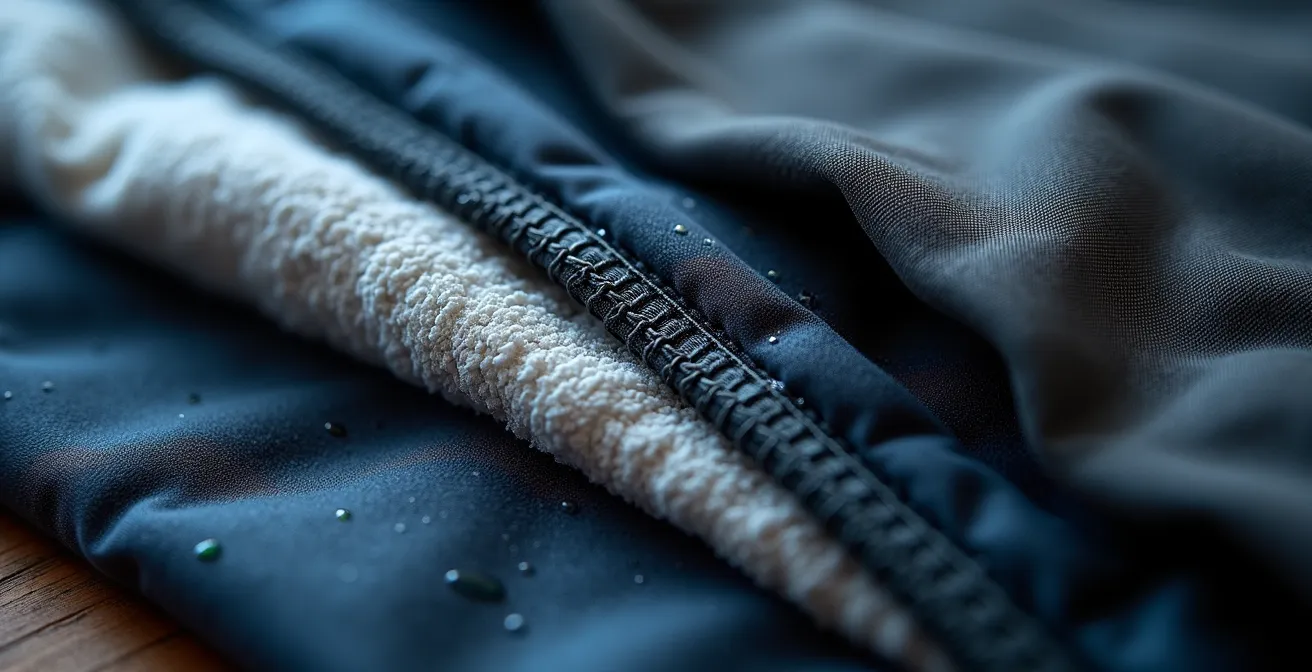
The image above demonstrates the components of a professional system. Each layer has a specific, non-negotiable function. Failure to adhere to this protocol compromises the entire system and your safety. Your life depends on the technical performance of these fabrics.
Action Plan: The Atlantic Canada Paddling Layering Protocol
- Base Layer: Select a moisture-wicking fabric. This must be either merino wool or a synthetic like polypropylene. Its sole job is to pull sweat and water away from your skin. Cotton is explicitly forbidden.
- Insulating Layer: Inventory your mid-layers. You must have fleece or another synthetic insulation that retains warmth when wet. The thickness will depend on the specific water and air temperature for your trip.
- Outer Layer: Verify your shell is a waterproof and breathable paddling jacket or dry suit with sealed seams. This is your primary defense against wind and water entry. Check all gaskets and zippers for integrity.
- Emergency Layer: Your safety gear must include a storm cag or an additional dry insulating layer stored in a fully waterproof, sealed dry bag. This is not optional.
- Sourcing: Procure gear from reputable Canadian or international maritime suppliers. Recommended brands include MEC, Mustang Survival, and Stanfield’s for their proven performance in these conditions.
Flares vs EPIRB: When Should You Use a Flare vs Activate Your Beacon?
Signaling for help is a critical protocol, and misuse of equipment can be as fatal as having no equipment at all. Recreational boaters often misunderstand the fundamental difference between visual distress signals (flares) and satellite beacons (EPIRBs). They are not interchangeable. Each has a precise and distinct function.
Flares are a line-of-sight tool. Their purpose is to attract the attention of a resource that is already within visual range. You deploy a flare when you can see or hear another vessel, an aircraft, or people on shore. Using a flare when no one is in sight is a waste of a limited and life-saving resource. The protocol is simple: if you have a visual target for rescue, use flares. If you do not, do not.
An EPIRB (Emergency Position Indicating Radio Beacon) is for when you are truly lost. It is your last resort when you have no other means of communication and no visual contact with potential rescuers. When activated, it transmits a distress signal to the Cospas-Sarsat satellite system, which is then relayed to search and rescue (SAR) authorities, including the Canadian Coast Guard. Activating an EPIRB initiates a major SAR operation. It is a declaration that you are in grave and imminent danger. This is not a tool for reporting mechanical trouble or for when you are merely delayed.
The decision is a simple, binary choice based on your situation:
- Is there a ship on the horizon or an aircraft overhead? Use a flare.
- Are you alone, out of communication, and in immediate peril? Activate your EPIRB.
This is not a guideline. It is the operating procedure. Confusing the two can cost you your life.
How Fast Do Currents Move Near the Grand Banks?
The environmental conditions in Atlantic Canada are a significant hazard multiplier. Nowhere is this more apparent than in the currents, particularly near the Grand Banks of Newfoundland. This area, where the cold Labrador Current collides with the warm Gulf Stream, creates some of the most powerful and unpredictable water movements on the planet. Underestimating this force is a critical error.
A person in the water is not a static object. The belief that one can simply “wait for the boat to come back” is a fatal misconception. In a moderate current, separation is alarmingly fast. In these conditions, a 3-knot current can separate a person from their vessel by nearly a half nautical mile in just 10 minutes. This distance is insurmountable for even the strongest swimmer, especially in cold water.
Case Study: The Physics of Separation
The Grand Banks are an oceanographic anomaly. The convergence of major currents creates eddies and variable flows that are impossible to predict without advanced data. Even if a vessel is adrift with a dead engine, it will not drift at the same rate as a person in the water. The vessel’s windage (the surface area exposed to wind) and hull profile create a different drift pattern. A person in the water is subject almost entirely to the current. This differential drift is a primary factor in man-overboard fatalities. The combination of current, wind, and water temperature is a hazard multiplier, making a bad situation exponentially worse.
The only protocol for a man-overboard situation in these currents is immediate and practiced response. This includes deploying a GPS-enabled marker, making a Mayday call with a precise location, and never, ever losing sight of the person in the water. The current is an unforgiving force that must be respected with rigorous procedure.
The Knots Mistake That Leads to Losing Your Dinghy in a Storm
Seamanship is a discipline of precision. There is no room for “good enough,” especially regarding knots. A poorly tied or incorrectly chosen knot is a point of failure waiting to happen. In a storm, the forces exerted on lines are immense and dynamic. Losing a dinghy being towed or secured on deck is not merely an inconvenience; it can become a hazard to navigation or result in the loss of your primary means of abandoning ship if necessary.
The common bowline, while a useful knot, is known to shake loose under cyclic loading—the exact conditions of a vessel in a storm. Using a standard bowline without a backup is a procedural error. Proper protocol demands a more secure system.
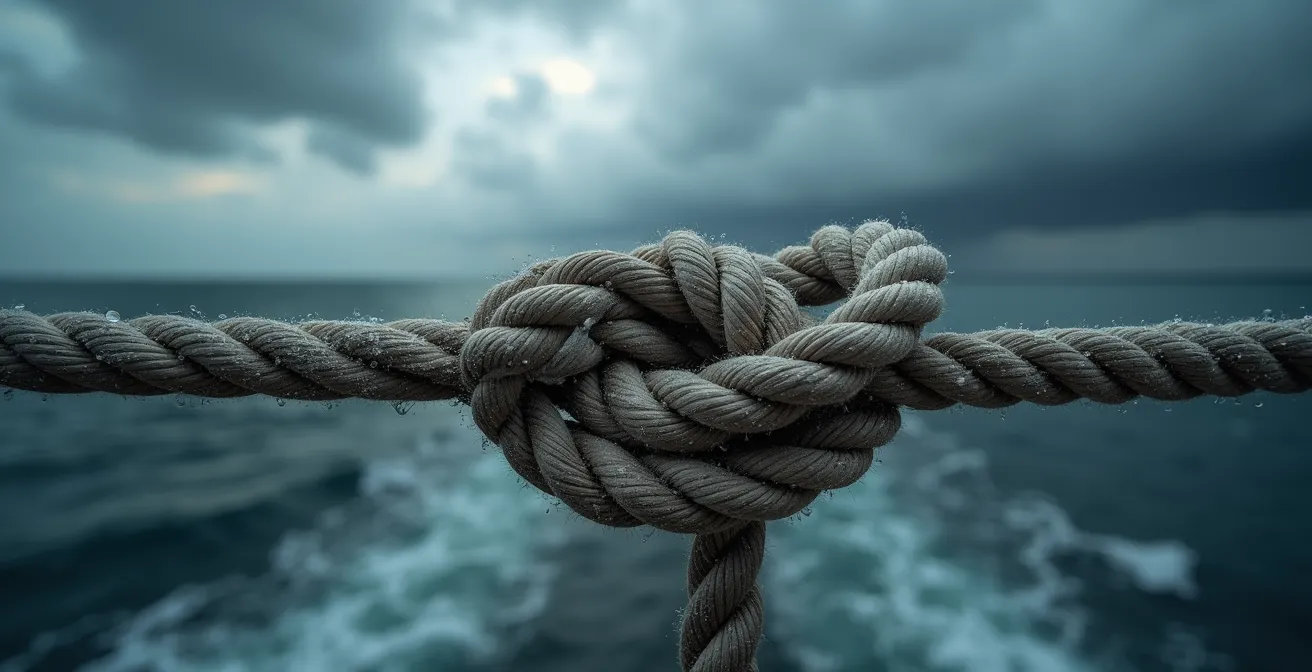
The knot pictured above is not just a knot; it is a system. It demonstrates redundancy and a correct choice of materials for a high-load, critical application. Every detail matters, from the type of rope to the finishing of the knot. The following procedures are not optional for securing a dinghy or any critical gear in heavy weather.
- Knot Selection: Use a Yosemite Bowline or a standard bowline with a backup stopper knot (like a double overhand). This prevents the knot from working loose.
- Line Material: Use nylon line for any towing application. Its inherent elasticity provides shock absorption, reducing peak loads on both the dinghy and the mothership’s cleats.
- Line Diameter: Ensure a minimum of 3/8″ (10mm) diameter line for adequate breaking strength. Undersized lines will fail.
- Chafe Protection: Add dedicated chafing gear at every point of contact—fairleads, chocks, and cleats. This is the most common point of failure.
- Pre-Weather Inspection: Double-check all connections, knots, and chafe points *before* the weather deteriorates, not during the storm.
Dry Suit or Wetsuit: What is Necessary for Pacific Ocean Paddling?
The question of a dry suit versus a wetsuit is determined by one factor: water temperature. While this section’s title specifies the Pacific, the principles apply universally, though the specific conditions differ. The legal requirements for safety equipment under the Small Vessel Regulations of the Canada Shipping Act, 2001 are consistent nationwide. However, the operational standard required for survival must adapt to local water temperatures.
A wetsuit works by trapping a thin layer of water against the skin, which is then warmed by the body. This is effective only when the water is moderately cool, not cold. A dry suit keeps you completely dry by using waterproof material and seals at the neck, wrists, and ankles. It provides thermal protection through the insulating layers worn underneath. In the cold waters of Canada, for most of the year, a dry suit is not a luxury; it is a requirement for survival.
This table outlines the mandatory and recommended equipment based on a risk assessment of water temperature, not on legal minimums. It serves as a clear, non-negotiable guide for paddlers on both of Canada’s coasts.
| Water Temp | Atlantic (Exposed) | Pacific (Sheltered) | Activity Type |
|---|---|---|---|
| Below 10°C | Drysuit required | Drysuit recommended | All paddling |
| 10-15°C | Drysuit or thick wetsuit | Wetsuit acceptable | Short trips only |
| 15-18°C | Wetsuit with layers | Wetsuit or semi-dry | Touring/surfing |
| Above 18°C | Rarely occurs | Wetsuit optional | Summer conditions |
Transport Canada provides the Small Vessel Compliance Program as a tool for operators to understand their legal obligations. However, this program is a starting point. As the table clearly shows, the operational reality of paddling in 10°C water in the Atlantic demands a higher standard of protection than the legal minimum PFD requirement.
Why the “Rule of Twelfths” Matters for Your Beach Walk Safety?
The danger of Atlantic Canada’s marine environment is not confined to the open ocean. The region’s massive tides, especially in the Bay of Fundy, pose a significant threat to those on the shoreline. The “Rule of Twelfths” is a critical tool for understanding the speed of a rising or falling tide. It is not an abstract concept; it is a survival calculation.
The rule states that in the first and sixth hours of a tidal cycle (either rising or falling), 1/12th of the total tidal range will move. In the second and fifth hours, 2/12ths will move. In the third and fourth hours—the middle of the cycle—3/12ths (or one-quarter) of the total volume moves per hour. This means the tide moves fastest in the middle of its cycle. For beach walkers in places with large tidal ranges, this acceleration can quickly cut off their exit.
At Hopewell Rocks, New Brunswick, this is a matter of life and death. With some of the world’s highest tides, it’s not uncommon for the water to rise up to 1.5 metres (5 feet) vertically in the third and fourth hours of the cycle alone. A flat, expansive beach can become completely submerged in minutes, trapping the unwary. Ignoring tide charts and this rule is a grave error.
The following protocol is mandatory for anyone walking on the foreshore in the Bay of Fundy or any area with a significant tidal range:
- Check Official Charts: Always consult the official tide charts from the Canadian Hydrographic Service for your specific location and date. Do not rely on generalized information.
- Note Low Tide Time: Identify the exact time of low tide. Your entire plan revolves around this moment.
- Plan Your Return: You must plan to be back at your safe access point no later than two hours after the posted low tide time. This ensures you are well away before the tide’s speed accelerates.
- Use Technology: Download a reputable Canadian tide prediction app for real-time data on your phone.
- Inform Someone: Leave a detailed plan of your route and expected return time with a responsible person on shore.
Key Takeaways
- Survival in cold water is a function of time and temperature, governed by the inescapable 1-10-1 principle.
- Proper equipment protocol, from layering (no cotton) to knot-tying, is a non-negotiable system, not a checklist of items.
- Environmental factors like currents and tides are hazard multipliers; your safety plan must account for their specific, local behaviour.
How to Choose Between Tadoussac and Rimouski for the Best Beluga Sightings?
The question of where to see whales is often framed by tourism. This is the wrong framework. From a maritime safety perspective, the question should be: which location presents which specific set of hazards? Both Tadoussac, at the confluence of the Saguenay and St. Lawrence rivers, and Rimouski, further out in the estuary, are in extremely cold water with significant marine traffic and environmental risks. Your choice of operator and vessel is a safety decision first, and a tourism decision second.
The primary safety consideration is cold water exposure. A trip on a small, open Zodiac offers a more intimate experience but carries a much higher risk of spray, wind, and immersion. A larger, covered vessel offers more protection from the elements but a more distant view. The water temperature in these areas is dangerously cold even in mid-summer. An accidental immersion without proper gear is a life-threatening event.
This table reframes the choice from a safety and risk-assessment perspective. This is how a professional mariner evaluates the options.
| Factor | Tadoussac | Rimouski |
|---|---|---|
| Current Strength | Strong at Saguenay confluence | Moderate open water |
| Water Temperature | 4-8°C summer average | 6-10°C summer average |
| Vessel Types | Zodiacs and cruisers | Primarily larger vessels |
| Minimum Whale Distance | 100-400m (species dependent) | Same regulations apply |
| Cold Exposure Risk | High on Zodiacs | Lower on covered vessels |
Ultimately, the discussion returns to the fundamental point of this entire guide: personal protective equipment. As Transport Canada states, different gear offers vastly different levels of protection.
If you’re wearing an immersion suit you won’t get cold shock. If you’re wearing floater coveralls or a floater coat they will stave off hypothermia but they will not really eliminate cold shock.
– Transport Canada Marine Safety, Hypothermia Prevention Guidelines
This distinction is critical. Eliminating cold shock is the first step to survival. Merely delaying hypothermia is insufficient. Whether you are operating your own vessel or are a passenger on a tour, your personal safety protocol must account for the worst-case scenario.
Your final action item is to conduct a full and honest audit of your own vessel, equipment, and personal procedures against the non-negotiable standards outlined in this document. Do not ask if you are compliant. Ask if you are prepared.